
ASTM D6111 Standard Test Method for Bulk Density And Specific Gravity of Plastic Lumber and Shapes by Displacement

    What is ASTM D6111?

    ASTM D6111 describes a standard test method for determining the bulk density and specific gravity of plastic lumber and shapes using a displacement technique. Technicians measure the volume of a specimen by immersing it in water and measuring the displaced volume. The method determines the bulk density and specific gravity of the product in its “as-manufactured” form, making it a product evaluation method rather than a pure material property test. Manufacturers produce plastic lumber and shapes predominantly with recycled plastics, though the method also applies to products made from virgin resins or non-homogeneous cross-sections. The test method applies to plastic lumber products that have a specific gravity greater than 1.0, meaning they sink in water. For materials with specific gravity less than 1.0, technicians use a sinker weight to keep the specimen submerged. Technicians use this test method for quality control, product development, and material comparison purposes. There is no known ISO equivalent to this test method.

    Read more

    Get Certified ASTM D6111

    Certification verifies that certified laboratories test plastic lumber and shapes fairly with consistent testing methods. Experienced laboratory testing helps manufacturers measure bulk density and specific gravity to check product qualities. ASTM D6111 certified testing supports quality control, material comparison, and product development for plastic lumber products. Professional laboratory services ensure labs perform tests to standard requirements and provide confidence in the results. Quality control engineers use certified testing to ensure consistent product quality and prevent quality problems.
    What is the Scope of the ASTM D6111 Test Standard? 

    ASTM D6111 outlines methods for calculating the bulk density and specific gravity of plastic lumber and shapes by displacement. The test method includes everything starting with specimen preparation to data analysis. The standard specifies criteria for specimen size, water temperature, and calculation methods. The ASTM D6111 standard-

    Read more

    • Determines bulk density of plastic lumber and shapes.
    • Determines specific gravity of plastic lumber and shapes.
    • Uses the water displacement method to measure volume.
    • Applies to materials with specific gravity greater than 1.0.
    • Requires a sinker weight for materials with specific gravity less than 1.0.
    • Tests specimens in the as-manufactured condition.
    • Assists with product quality control and development.

    What are the Uses of ASTM D6111 Testing?

    ASTM D6111 testing helps manufacturers assess the bulk density and specific gravity of plastic lumber and shapes. Manufacturers use the test results for quality control, material verification, and product development. This standard is very common for construction, decking, and outdoor products. This standard-

    • Maintains uniform product density during production.
    • Assists with materials selection and design decisions.
    • Enables comparison of different plastic lumber materials.
    • Ensures quality control of production.
    • Assists in the formulation and development of products.
    • Ensures conformance to specifications.
    • Contributes information to structural calculations.

    Which materials can be tested under ASTM D6111?

    ASTM D6111 applies to plastic lumber and structural products, including those made from recycled plastics, virgin resins, and non-homogeneous cross-sections. The test method also applies to other plastic composite products, such as wood-plastic composite products. Typical uses include outdoor decking and structures, structural supports and beams, fencing and landscaping materials, marine and waterfront uses, and construction and building materials.

    Why is ASTM D6111 Important? 

    ASTM D6111 provides a standardized method for measuring the bulk density and specific gravity of plastic lumber and shapes. The test method sets forth test requirements to assist manufacturers in assuring that products meet the density requirement. The standard provides consistency in the procedure of testing and interpretation of data. Quality control engineers use these test results to guarantee product consistency and quality. Bulk density and specific gravity measurements yield useful information for quality control, product development, and material comparison.

    ASTM D6111 Equipment and Sample Preparation Guide

    ASTM D6111 requires a water displacement device that accurately measures the volume of the specimen. Technicians work with representative specimens in the as-manufactured state, carefully preparing them for testing and evaluation. The equipment includes a water displacement machine, a balance or scale, a water bath with temperature control, a sinker weight (if necessary), and dimensional measurement tools.

    Read more

    Sample and Specimen Details Technicians test five specimens per sample set. They select specimens that are representative of the production lot. 
    Specimen Preparation Technicians cut specimens to the required dimensions. They clean the specimens thoroughly. They condition the specimens at the specified temperature before testing. 
    Specimen Dimensions The dimensions depend on the product size and testing requirements. The specimen must be large enough to provide a measurable displaced volume. 
    Instrumentation The equipment includes a water displacement apparatus, analytical balance (0.01 g accuracy), water bath with temperature control (±0.5°C), sinker weight, and dimensional measurement tools. 

    Testing Procedures and Requirements for ASTM D6111

    Plastic lumber and shapes are tested for bulk density and specific gravity in accordance with ASTM D6111. Laboratories conduct tests in a standardized way to ensure reliable, accurate results. Technicians prepare specimens, measure mass, measure volume by displacement, and calculate results. The ASTM D6111 test method is comprised of the following test procedure: 

    Read more

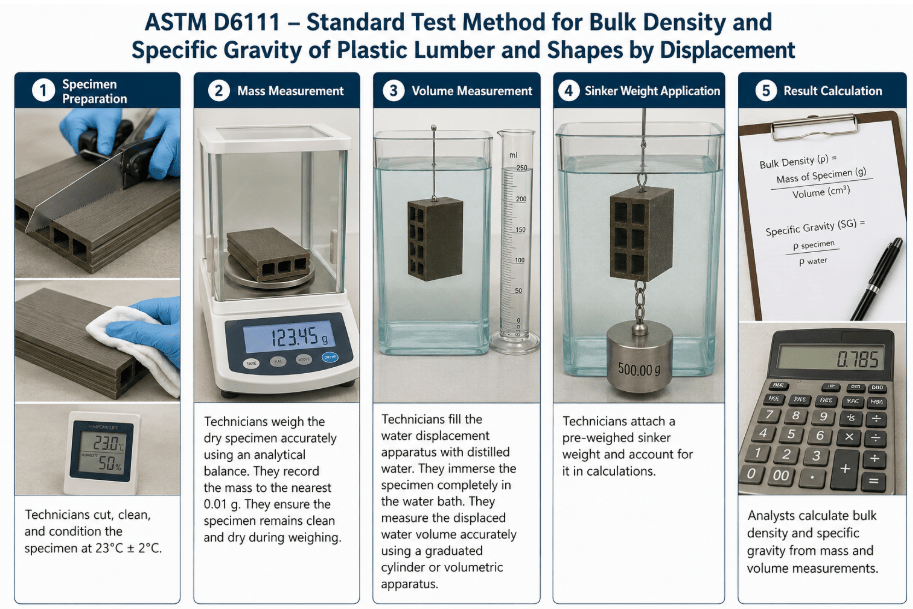
    Specimen Preparation Technicians cut, clean, and condition the specimen at 23°C ± 2°C. 
    Mass Measurement Technicians weigh the dry specimen accurately using an analytical balance. They record the mass to the nearest 0.01 g. They ensure the specimen remains clean and dry during weighing. 
    Volume Measurement Technicians fill the water displacement apparatus with distilled water. They immerse the specimen completely in the water bath. They measure the displaced water volume accurately using a graduated cylinder or volumetric apparatus. 
    Sinker Weight Application Technicians attach a pre-weighed sinker weight to the specimen for materials with specific gravity less than 1.0. They ensure the sinker weight remains completely submerged during the test. They account for the sinker weight in the final volume calculation. 
    Result Calculation Analysts calculate bulk density and specific gravity from mass and volume measurements. 

    ASTM D6111 Testing Process and Data Collection

    The testing process starts with the preparation of specimens of the required size. Technicians thoroughly clean and condition the specimens at about 23°C ± 2°C. They weigh the specimen precisely using an analytical balance. They place the specimen in a water bath and accurately measure the volume of water it displaces. They add a sinker weight to the specimen for materials that float below 1.0. Analysts determine bulk density and specific gravity from mass and volume measurements. Laboratories gather the data for quality control, product development, and material comparison.

     The image depicts a plastic lumber specimen in a water displacement apparatus for bulk density and specific gravity testing as per ASTM D6111.
    ASTM D6111 Test Procedure: Bulk Density and Specific Gravity of Plastic Lumber and Shapes by Displacement 

    Common Challenges and Troubleshooting

    The most frequent problems with ASTM D6111 testing are poor specimen preparation, volume measurement errors, and temperature fluctuations. These problems lead to inaccuracy in the determination of bulk density and specific gravity. The volume is reported incorrectly if the samples are not prepared properly. If the volume measurement is incorrect, then the density is also incorrect. Water density and volume can be impacted by temperature changes. Care in specimen preparation, measurement of specimen volume, and temperature control will help reduce problems. With proper procedures and equipment maintenance, experienced technicians ensure reliable results.

    ASTM D6111 Analysis Results and Interpretation

    The report summarizes the bulk density and specific gravity of the plastic lumber or shape tested. It displays the measured values, as well as pertinent specimen and testing information. The interpretation compares measured values with specification requirements or performance benchmarks. Quality control engineers use these results to confirm material compliance and product consistency.

    Read more

    • The laboratory reports bulk density in g/cm³ or lb/ft³ and specific gravity as a dimensionless value.
    • The analyst compares the measured density and specific gravity values with the applicable specification requirements to evaluate the material against the specified criteria.
    • The laboratory compares results among specimens or production batches to assess the uniformity and consistency of the product’s density.
    • The technician records the relevant specimen dimensions, mass, test conditions, and measurement data used to calculate the reported properties.
    • The laboratory maintains consistent specimen preparation, accurate volume measurement, and controlled test conditions to improve the reliability and repeatability of the reported results.

    What Factors Should You Consider for ASTM D6111 Testing?

    Consider the following when choosing a lab for this testing. 

    • Expertise: Technicians have experience in specimen preparation, displacement testing, and interpreting results. Consistent and repeatable test results are achieved by skillful personnel. 
    • Speed: Faster lab testing allows for shorter production timelines and faster decision-making. Efficient testing helps manufacturers maintain their production schedules. 
    • Cost: Comprehensive testing gives you reliable information for quality control and minimizes the risk of product quality problems. Proper testing helps ensure product consistency. 
    • Confidentiality: Matestlab keeps the process confidential and only discloses results to respective stakeholders. 

    FAQs

     What is ASTM D6111 used for? 

    ASTM D6111 determines the bulk density and the specific gravity of plastic lumber and shapes using the displacement method. The test measures the amount of mass per unit volume of a product.

    What is the principle behind ASTM D6111? 

    The test method involves immersing a specimen in water and measuring the displaced water volume. Technicians measure the mass of the specimen and calculate bulk density and specific gravity from mass and volume measurements.

    What materials can be tested under ASTM D6111? 

    ASTM D6111 applies to plastic lumber and structural shapes fabricated from recycled plastics, virgin resins, or non-homogeneous cross-sections. The method also applies to wood-plastic composite materials.

    What happens if the material has a specific gravity less than 1.0? 

    For materials with a specific gravity less than 1.0, technicians add a sinker weight to the specimen to keep it from floating. They include the weight of the sinker in the computations.

    How are ASTM D6111 results reported? 

    Analysts report results as bulk density in g/cm³ or lb/ft³ and specific gravity as a dimensionless value. The laboratory generates a compliance report and compares the results to the specifications.

    Link to ASTM D6111

    FAQ

    Where can I get the astm d6111 tested?
    You can share your astm d6111 testing requirements with MaTestLab. MaTestLab has a vast network of material testing laboratories, spread across the USA and Canada. We support your all material testing needs ranging from specific astm d6111 test to various testing techniques.
    Please contact us for a detailed quote for your astm d6111 testing needs. Cost incurred to carry out different astm d6111 testing methodology depends on the type of raw material; number of samples, coupons, or specimens; test conditions, turn around time etc. Costs of some ASTM testing methods start from $100 and the final value depends upon the factors listed above. Please contact us for the best and latest prices.
    The required number of samples or specimens should comply with the procedure given in the astm d6111 standard. However, the MaTestLab operations team can assist you for your special requirements once you share your testing details with us.
    MaTestLab has a vast testing laboratory network, hence we bring you the best testing facilities in a cost-effective way. We offer considerable discounts (15-20%) to our returning customers based on test volume and frequency.
    The turnaround time for astm d6111 test methodology depends upon the test procedure mentioned in the standard test document. However, we at MaTestLab understand your research requirements and hence try to get your test completed within the least possible time.
    Rohit Dhembare
    About Author
    Rohit Dhembare
    Rohit Dhembare is an Operations Associate at MaTestLab Inc. and holds a postgraduate degree in Organic Chemistry.
    Testimonials
    Real results
    Engineers trust us with what matters most
    Start Your Testing
    Project Today
    Define your requirements and get access to
    specialized laboratories ready to deliver results
    Partners with us
    Clients
    Vendors
    Process for testing
    • STEP 01

      You share your testing requirements

    • STEP 02

      You share your sample(s)

    • STEP 03

      We deliver your test reports

    Get your testing done

    Let us known your testing requirements and we will be right back with a solution.

      Let us root for each other. Collaborate to grow, expand, and accelerate our businesses.

      Partner with us

        Contact Us

        Discover more from MaTestLab

        Subscribe now to keep reading and get access to the full archive.

        Continue reading