ASTM D6108 Standard Test Method for Compressive Properties of Plastic Lumber and Shapes

    What is ASTM D6108?

    ASTM D6108 describes a standard test method for the compressive properties of plastic lumber and shapes. The technique involves placing the entire cross-section of an as-manufactured product in compression at relatively low and uniform rates of strain or loading. Thus, the test is not just a material test, but considers the product as a whole. The method applies to plastic lumber made from recycled plastics and similar products made from virgin resins. It is used for products with nonhomogeneous cross-sections. ASTM D6108(Standard Test Method for Compressive Properties of Plastic Lumber and Shapes) provides compressive strength, secant modulus, modulus of elasticity, and stress at a particular strain. 

    Read more

    Get Certified ASTM D6108 Testing for Reliable Plastic Lumber Quality 

    Plastic lumber commonly experiences compressive loads in service. As a result, manufacturers need reliable test data to assess product performance and quality consistency. ASTM D6108 offers standardized compression data for research and development, quality control, specification-related decisions, and special-purpose evaluations. Manufacturers also use the results to compare products or production batches. 
    What is the Scope of the ASTM D6108 Test Standard? 

    ASTM D6108 describes the mechanical properties of plastic lumber and shapes when the technician applies compression to the entire cross-sectional area. The method uses specimens in their as-manufactured form. The ASTM D6108 standard-

    Read more

    • Describes plastic lumber and plastic shapes.
    • Features goods produced mostly with recycled plastics.
    • Applies to similar products made from virgin resins.
    • Solves problems with non-homogeneous cross-sections.
    • Covers plastic composite products in the scope of the method.
    • Provides compression testing under relatively low and constant loading or straining rates.

    What are the Uses of ASTM D5672 Testing?

    ASTM D6108 helps manufacturers assess plastic lumber/plastic shapes under compressive loading. The method provides quantitative information on several important properties. This standard-

    • Determines compressive strength.
    • Determines modulus of elasticity.
    • Determines secant modulus.
    • Calculates the stress corresponding to a specific strain.
    • Provides funding for research and development.
    • Assists in manufacturing quality control
    • Helps evaluate products against specifications.
    • Offers information for making product comparisons. 

    Which materials can be tested under D6108?

    ASTM D6108 is primarily for plastic lumber and plastic shapes produced from recycled plastics. The method also applies to similar manufactured products made with virgin resins. It is used for products with a nonhomogeneous cross section. ASTM standards for plastic lumber indicate that these products contain various resin systems, fillers, reinforcements, and additives. ASTM D6109 is an example of a flexural test for plastic lumber products with various resin, filler, reinforcement, and additive systems. 

    Why is ASTM D6108 Important? 

    ASTM D6108 gives a standardized method for obtaining compression data of plastic lumber and shapes. This uniformity makes it easier to compare products across manufacturers and track quality. It is also a valuable test for research and development, quality control, specification acceptance/rejection, and special-purpose evaluations. 

    ASTM D6108 Equipment and Sample Preparation Guide

    ASTM D6108 is the standard test method for determining the compressive properties of plastic lumber.. All tools help technicians apply compression force, measure specimen dimensions, monitor deformations, and capture accurate test data. 

    Read more

    Sample and Specimen Details Technicians test five specimens per sample set. They select specimens that are representative of the production lot. 
    Specimen Preparation Technicians cut specimens to standard dimensions. They ensure that the length equals twice the minimum cross-sectional dimension. They measure dimensions accurately using micrometers. 
    Specimen Dimensions The length typically ranges from 50 mm to 200 mm. Dimensions depend on the product’s cross-sectional size. 
    Instrumentation The equipment includes a universal testing machine, compression platens, extensometer, dimensional measurement tools, and a data acquisition system. 

    Testing Procedures and Requirements for ASTM D6108

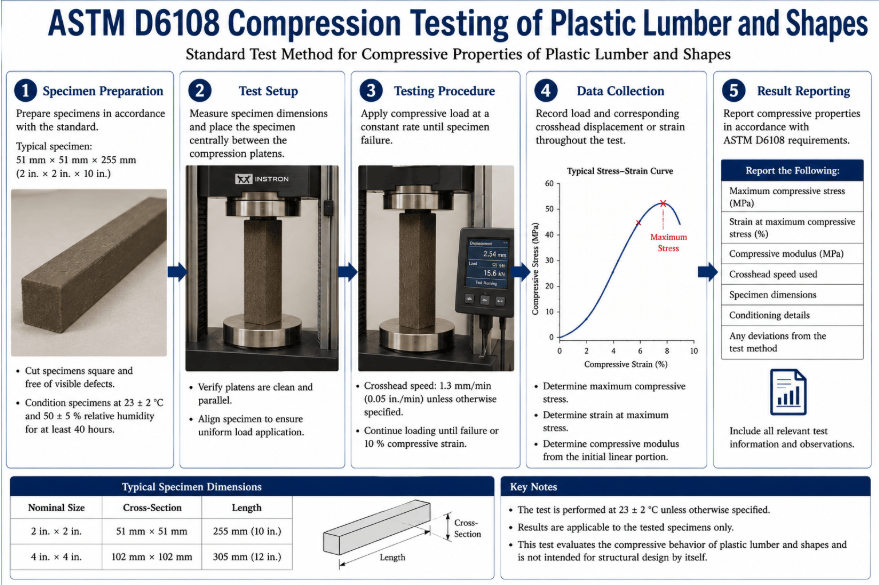
    The technician makes and conditions the specimens as per the applicable requirements. The technician then measures the specimen’s dimensions and slides it between the compression platens. Then the testing machine presses at the set rate; the lab records the deformation and load. The technician uses the recorded data to determine the necessary compression properties.  ASTM D6108 testing process is as follows-

    Read more

    Specimen Preparation Technicians cut specimens to standard dimensions. They measure the dimensions accurately. They condition the specimens at approximately 23°C ± 2°C before testing. 
    Specimen Alignment Technicians carefully align the specimen between the compression platens. They ensure proper centering to achieve consistent testing results. 
    Load Application Technicians apply the compressive load at approximately 1.3 mm/min ± 0.3 mm/min. They record the load and deformation data continuously throughout the test. 
    Deformation Measurement The system measures the strain and deformation during the loading process. Technicians record the data for subsequent stress-strain analysis. 
    Result Calculation Analysts calculate the compressive strength, modulus of elasticity, and stress at the given strain. They report the results in inch-pound units as per the standard. 

    ASTM D6108 Testing Process and Data Collection

    The technician prepares the specimen and measures its relevant dimensions before testing. The technician then places the specimen between the compression platens and keeps it properly aligned. When the test machine applies the required load, the system records the load and deformation response. The data is then analyzed in the laboratory to calculate the appropriate compressive properties. ASTM D6108 provides information for determining compressive strength, modulus of elasticity, secant modulus, and stress at a given strain.

    Plastic lumber specimen positioned between compression platens during compressive property testing according to ASTM D6108.
    ASTM D6108 Compression Testing of Plastic Lumber and Shapes

    Common Challenges and Troubleshooting

    Specimen surfaces may not be flat and even, which can interfere with compression with the platens. So, technicians create appropriate loading surfaces before testing. Specimen alignment can also affect load distribution if it is placed incorrectly. The technician is to ensure that the alignment is good throughout the test. Plastic lumber may have no obvious yield point. Therefore, when the material does not provide a meaningful conventional yield value, the laboratory uses the appropriate stress-strain measurement.

    ASTM D6108 Analysis Results and Interpretation

    The laboratory measures the load, deformation, and dimensions of the specimen, and computes the necessary compressive properties.

    Read more

    • The laboratory reports the compressive stress at the specified failure condition in MPa (N/mm²) or psi, as applicable.
    • The analyst determines the compressive properties from the measured load, deformation, and specimen dimensions, providing a quantitative measure of the product’s response to compression.
    • The laboratory reports the stiffness or modulus obtained from the specified stress-strain range in MPa or psi, as applicable.
    • Engineers compare the compressive results among products or production batches to evaluate material performance and production consistency.

    Link to ASTM D6108

    FAQ

    What properties does ASTM D6108 determine?
    The method measures compressive strength, modulus of elasticity, secant modulus, and stress at a given strain.
    It is used with plastic lumber and shapes made of recycled or virgin plastic. It is used on products having nonhomogeneous cross sections.
    Yes. Results are used for product evaluation, research, quality control, and specification decisions. When actual service conditions vary significantly from the standard test conditions, however, engineers should take into account additional testing.
    Malhar Khole
    About Author
    Malhar Khole
    Malhar Khole is a Material Testing Associate at MaTestLab Inc. and holds a postgraduate degree in Material Science and Technology from IIT (BHU), Varanasi.
    Testimonials
    Real results
    Engineers trust us with what matters most
    Start Your Testing
    Project Today
    Define your requirements and get access to
    specialized laboratories ready to deliver results
    Partners with us
    Clients
    Vendors
    Process for testing
    • STEP 01

      You share your testing requirements

    • STEP 02

      You share your sample(s)

    • STEP 03

      We deliver your test reports

    Get your testing done

    Let us known your testing requirements and we will be right back with a solution.

      Let us root for each other. Collaborate to grow, expand, and accelerate our businesses.

      Partner with us

        Contact Us

        Discover more from MaTestLab

        Subscribe now to keep reading and get access to the full archive.

        Continue reading