
ASTM D6071 Standard Test Method for Low Level Sodium in High Purity Water by Graphite Furnace Atomic Absorption Spectroscopy

    What is ASTM D6071?

    ASTM D6071 is a standard test method for determining low levels of sodium in high-purity water by graphite furnace atomic absorption spectroscopy. A controlled analytical procedure for measuring sodium in water samples with low sodium content, where contamination and measurement accuracy have a significant impact on the results. Technicians collect and prepare representative high-purity water samples while minimizing contamination. The ASTM D6071 test (Standard Test Method for Low Level Sodium in High Purity Water by Graphite Furnace Atomic Absorption Spectroscopy) provides sodium concentration-specific results that are used to monitor the purity of high-purity water by water-treatment facilities, semiconductor and electronics industries, laboratories, manufacturers, and quality-control personnel.

    Read more

    Get Certified ASTM D6071 Low-Level Sodium Testing

    ASTM D6071 testing is valuable for industries and facilities that need high-purity water with controlled sodium levels. Technicians take samples and prepare necessary calibrations and analytical equipment with proper handling procedures. The technician compares water sample to the prepared water sample and analyzes the prepared water sample in a graphite furnace atomic absorption spectrometer, then documents the analytical response and test conditions. Analysts review the calibration data and measured results to determine the sodium concentration. The results assist with water quality monitoring, process control, contamination assessment, quality assurance, and verification of high-purity water systems.

    What is the scope of ASTM D6071?

    ASTM D6071 is a standard for the determination of low-level sodium in high-purity water by graphite furnace atomic absorption spectroscopy.  The standard covers:

    Read more

    • Low Level Sodium Determination: Methods that apply to low concentrations of sodium in high purity water. 
    • High-Purity Water Analysis: Analyzes water samples where low sodium levels can be significant. 
    • Graphite Furnace Atomic Absorption Spectroscopy (GFAAS): Measuring sodium using atomic absorption spectroscopy with graphite furnace. 
    • Calibration: Uses appropriate calibration procedures to relate the measured analytical response to sodium concentration. 
    • Contamination Control: Care must be taken to ensure that samples are handled and prepared in a way that will reduce the risk of contaminating with sodium. 
    • Water Quality Monitoring: Assesses the quality of sodium concentration in suitable high-quality water systems.

    What are the uses of ASTM D6071 testing?

    ASTM D6071 includes low-level sodium concentration data to aid in the judgment of high-purity water quality by technical personnel. The test helps to:

    • Determine low concentrations of sodium in high-purity water. 
    • Monitor high-purity water quality. 
    • Detect changes in sodium concentration. 
    • Support contamination monitoring. 
    • Compare water samples from different production or treatment stages. 
    • Support quality-control and process-monitoring activities. 
    • Provide analytical data for high-purity water management. 

    Which materials can be tested according to ASTM D6071?

    ASTM D6071 applies to high-purity water samples for which low-level sodium determination is required. The method applies to:

    • High-Purity Water: Evaluates applicable high-purity water samples. 
    • Process Water: Supports sodium monitoring in applicable purified-water systems. 
    • Treated Water Samples: Allows evaluation of water following applicable purification or treatment processes. 
    • Quality-Control Samples: Supports monitoring of representative water samples. 
    • Reference and Calibration Solutions: Uses appropriate solutions to establish and verify analytical measurements. 

    Why is ASTM D6071 testing important?

    Sodium is an important parameter in high-purity water because the presence of even small amounts can signify contamination or malfunction of the water purification system. Measurement of low sodium content can therefore aid the monitoring and control of high-purity water systems. The ASTM D6071 standard offers a standardized analytical method with the use of graphite furnace atomic absorption spectroscopy. The results enable technicians and engineers to determine changes in sodium concentration, to provide information on water quality, and to assist with quality-control activities.

    ASTM D6071 Equipment and Sample Preparation Guide

    To accurately determine low-level sodium concentrations, technicians must have high-purity water samples prepared with care and an appropriate analytical instrument. Sample handling and preparation should minimize contamination that could affect the sodium measurement. 

    Read more


    Sample Identification
    Technicians identify the high-purity water source, sample location, sample collection information, and other sample details.
    Sample Collection and PreparationTechnicians gather and prepare representative water samples by collecting them in appropriate clean containers and following appropriate clean sample collection procedures, which minimize sodium contamination.
    Calibration PreparationThe analyst prepares needed calibration solutions and quality control solutions for sodium determination.
    Graphite Furnace AAS EquipmentAnalysts use a suitable graphite furnace atomic absorption spectrometer that can measure low sodium concentrations under the applicable conditions.
    Data RecordingTechnicians are responsible for recording sample information, calibration data, instrument responses, test conditions and analytical observations.

    ASTM D6071 Testing Procedures and Requirements

    Technicians first identify and collect a representative high-purity water sample using procedures designed to minimize contamination. They make necessary calibration standards and ensure analytical equipment is calibrated. The technician injects prepared samples and calibration solutions into the graphite furnace atomic absorption spectrometer. The instrument measures the sodium analytical response, while technicians note the measurements and test conditions. The analytical response and the calibration data are used by the analyst to calculate the sodium concentration of the water sample. The testing process includes the following steps.

    Read more

    Sample Identification and CollectionTechnicians determine the water source and collect water samples representative of the water source with minimal potential sodium contamination.
    Sample and Calibration PreparationTechnicians prepare the water samples, calibration standards, and applicable quality-control solutions.
    Instrument Setup and VerificationAnalysts prepare and verify the graphite furnace atomic absorption spectrometer based on the analytical requirements.
    Sodium Measurement and Data RecordingTechnicians record the instrument response, calibration data, and applicable test conditions for the prepared samples.
    Concentration Determination and ReportingAnalysts use the measured response and calibration data to determine and report the sodium concentration.

    ASTM D6071 Testing Process and Data Collection

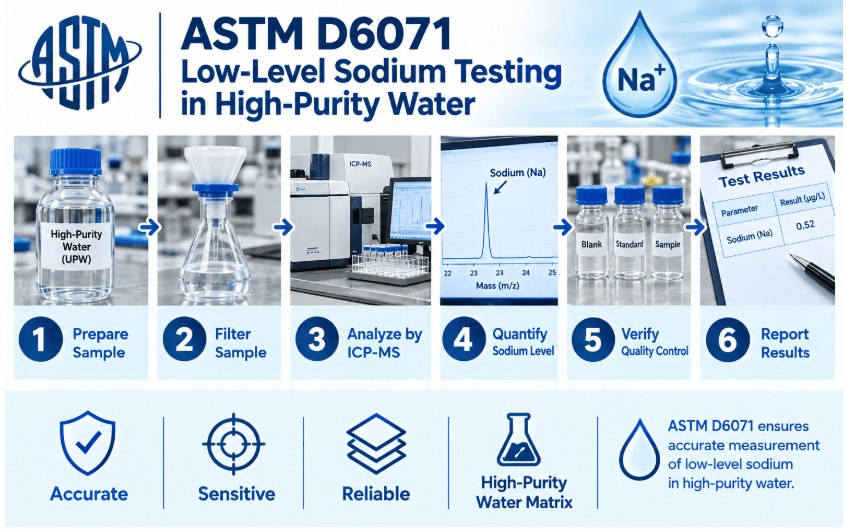
    Technicians first locate the high-purity water source, then sample with clean handling procedures. They make the necessary calibration standards and quality control solutions and check the state of the graphite furnace atomic absorption spectrometer. The technician introduces the prepared sample into the analytical system and performs the sodium measurement under the applicable conditions. It forms an analytical response related to the sodium detected in the sample. Technicians record the sample identification, calibration information, instrument response, and relevant analytical conditions. The calibration data helps analysts to calculate the sodium concentration and review it for reporting.

    ASTM D6071 testing process showing high-purity water sample collection, contamination-controlled sample preparation, calibration standard preparation, graphite furnace atomic absorption spectroscopy analysis, sodium concentration calculation, and recording of test results.
    ASTM D6071 Low-Level Sodium Testing in High-Purity Water

    Common Challenges and Troubleshooting

    ASTM D6071 varies due to sample contamination, improper cleaning of containers, contamination from reagents or equipment, inaccurate calibration, instrument instability, incorrect sample handling, and analytical interference. Technicians will employ proper clean handling techniques and prepare samples and calibration solutions with care. Before analysis, the analysts should check the condition of the graphite furnace of the atomic absorption spectrometer and its calibration. When results are not as expected, technicians should check the sampling procedure, sample container, sodium contamination, preparation of the calibration, instrument performance, analytical conditions, and data calculations.

    Analysis Results and Interpretation

    This report provides a summary of the sodium concentration measured for the sample of high purity water that has been tested. It contains the results obtained from the measurement, the sample identification, the sampling information, calibration data, analytical conditions, and observations. 

    Read more

    • ASTM D6071 gives results based on the concentration of sodium, not one overall water quality value. 
    • Sodium concentration should be reported as noted by the appropriate SI concentration units defined by the selected procedure (µg/L or mg/L, as appropriate). 
    • The report should contain the identification of the water-source or sample and sampling details. 
    • Analysts record calibration and quality control data pertinent to the results.
    • Technicians and analysts can achieve both reliable and comparable results by carefully monitoring contamination, properly calibrating equipment, using proper analytical procedures, and keeping equipment in good condition. 

    Link to ASTM D6071 

    FAQ

    What does ASTM D6071 measure?
    ASTM D6071 is a method for determining low concentrations of sodium in applicable high-purity water samples by graphite furnace atomic absorption spectroscopy.
    This approach involves taking representative water samples with low-level sodium needs.
    ASTM D6071 measures sodium at low concentrations; contamination from containers, equipment, reagents, or sample handling may impact the measured result.
    Analysts employ appropriate sample-handling apparatus, calibration materials, and a graphite furnace atomic absorption spectrometer capable of performing the sodium analysis.

    Updated on September 8, 2026

    Malhar Khole
    About Author
    Malhar Khole is a Material Testing Associate at Matestlab Inc. and holds a postgraduate degree in Material Science and Technology from IIT (BHU), Varanasi.
    Know More
    Testimonials
    Real results
    Engineers trust us with what matters most
    Start Your Testing
    Project Today
    Define your requirements and get access to
    specialized laboratories ready to deliver results
    Partners with us
    Clients
    Vendors
    Process for testing
    • STEP 01

      You share your testing requirements

    • STEP 02

      You share your sample(s)

    • STEP 03

      We deliver your test reports

    Get your testing done

    Let us know your testing requirements and we will be right back with a solution.

      Let us root for each other. Collaborate to grow, expand, and accelerate our businesses.

      Partner with us

        Discover more from Matestlab

        Subscribe now to keep reading and get access to the full archive.

        Continue reading