
ASTM D6055 Mechanical Handling of Utilized Loads and Large Shipping Cases and Crates

    What is ASTM D6055?

    ASTM D6055 is a group of standard test methods used to evaluate the integrity and stability of unitized loads and large shipping cases and crates during mechanical handling. ASTM D6055 (Standard Test Methods for Mechanical Handling of Unitized Loads and Large Shipping Cases and Crates) assesses the ability of shipping units and their contents to withstand normal handling using standard mechanical handling equipment. Technicians subject representative shipping units to applicable mechanical handling operations and inspect the load, packaging, and contents after testing. Analysts evaluate damage, deformation, loss of load integrity, and other relevant observations to determine how effectively the shipping unit withstands mechanical handling.

    Read more

    Get Certified ASTM D6055 Mechanical Handling Testing

    ASTM D6055 testing helps evaluate shipping units for suitability for mechanical handling using user-specified load-handling equipment. The methods can provide information about load integrity and stability and can help identify deficiencies that may require improvements to the shipping-unit design. Technicians select the applicable handling method based on the shipping configuration and anticipated handling equipment. Engineers and analysts then evaluate the condition of the shipping unit and contents following the specified handling sequence.
    What is the scope of ASTM D6055?

    ASTM D6055 covers testing the integrity of unitized loads and large cases and crates, as well as the ability of their contents to endure normal handling with standard mechanical handling equipment. The standard does not apply to individual drums or palletized drums, and not every test method applies to every product, container, or load. ASTM D6055 covers:

    Read more

    • Material Type: Unitized loads and large shipping cases and crates.
    • Purpose: Evaluation of shipping-unit integrity and ability to withstand normal mechanical handling.
    • Property Measured: Load integrity, stability, handling resistance, and observed package or product damage.
    • Method: Mechanical handling using applicable forklift, spade lift, clamp, push-pull, grabhook, or sling operations.
    • Result: Observed condition, damage, stability, and integrity of the shipping unit and contents after handling.
    • Test Limitations: Not all test methods apply to all products, containers, and loads; individual drums and palletized drums are outside the stated scope.
    • Environmental Conditions: Testing is performed under the specified or agreed conditioning and handling conditions applicable to the shipping unit.
    • Applications: Packaging design evaluation, shipping-unit qualification, distribution testing, quality control, and mechanical-handling assessment.

    What are the uses of ASTM D6055 testing?

    ASTM D6055 testing evaluates how a shipping unit responds to handling operations commonly encountered during distribution. The methods can be performed using the actual handling equipment intended for the load or other standard user-specified handling equipment. The testing helps identify weaknesses in packaging and load-unit design before distribution. Damage observed during testing can also provide qualitative information about damage that may occur in actual distribution handling systems. The test helps to:

    • Mechanical Handling Evaluation: Determines whether the shipping unit withstands applicable handling operations.
    • Load Integrity Assessment: Evaluates whether the load remains intact during handling.
    • Stability Evaluation: Identifies movement, instability, or loss of load integrity.
    • Packaging Design Improvement: Helps identify deficiencies that may require design changes.
    • Equipment Compatibility: Evaluates suitability for specified material-handling equipment.
    • Distribution Assessment: Provides information relevant to normal distribution handling.
    • Quality Control: Supports verification of shipping-unit performance.

    Which Materials Can Be Tested According to ASTM D6055?

    ASTM D6055 is intended for unitized loads and large shipping cases and crates that require mechanical handling during distribution. The test methods can be selected according to the handling equipment and configuration applicable to the shipping unit. Technicians prepare representative, fully configured shipping units for the selected mechanical handling procedure. The method applies to:

    • Unitized Loads: Loads assembled into a single handling unit.
    • Large Shipping Cases: Large packaged units designed for mechanical handling.
    • Large Shipping Crates: Crated shipping units subjected to handling operations.
    • Packaged Contents: Products contained within the tested shipping unit.
    • Slip-Sheet Loads: Unitized loads intended for push-pull handling.

    Why is ASTM D6055 Testing Important?

    Mechanical handling can subject shipping units to lifting, squeezing, pulling, compression, and other forces. ASTM D6055 provides defined procedures for evaluating the ability of unitized loads and large shipping cases and crates to withstand these handling operations. The results help users determine load integrity and stability and can provide guidance for improving shipping-unit design when deficiencies are identified. ASTM also indicates that damage observed during testing may correlate qualitatively with damage occurring in actual distribution handling systems.

    ASTM D6055 Equipment and Sample Preparation Guide

    Technicians prepare the complete shipping unit, including the packaging, load, closures, pallet or slip sheet where applicable, and contents required for the selected handling test. They verify the overall configuration and document the condition of the shipping unit before mechanical handling begins.

    Read more

    Test Shipping Unit and Packaged ContentsProvides the representative unitized load, large case, or crate for mechanical handling evaluation.
    Handling Equipment and AttachmentsProvides the applicable fork truck, spade lift, clamp, push-pull, grabhook, or sling handling operation.
    Dimensional and Condition Inspection EquipmentRecords shipping-unit dimensions, configuration, weight, and initial physical condition before testing.
    Inspection and Documentation EquipmentRecords movement, deformation, package damage, load instability, and condition of the contents before and after handling.
    Specimen DimensionsASTM D6055 does not establish one universal specimen dimension because the test applies to different unitized loads and large shipping cases and crates. Technicians should record the actual shipping-unit length, width, height, configuration, and applicable load information before testing.

    ASTM D6055 Testing Procedures and Requirements

    Technicians select the mechanical handling method appropriate to the shipping unit and intended handling equipment. They document the initial condition of the load and then perform the specified handling sequence. Analysts inspect the shipping unit and contents after handling and document any damage or loss of integrity. The testing process includes the following steps:

    Read more

    Initial Shipping-Unit InspectionRecords the configuration, dimensions, load condition, and initial integrity of the shipping unit.
    Mechanical Handling OperationSubjects the shipping unit to the applicable fork truck, spade lift, clamp, push-pull, grabhook, or sling handling procedure.
    Post-Handling InspectionIdentifies deformation, damage, instability, movement, or other changes resulting from handling.
    Integrity and Performance EvaluationEvaluates the shipping unit and contents against applicable requirements or user-defined acceptance criteria.

    ASTM D6055 Testing Process and Data Collection

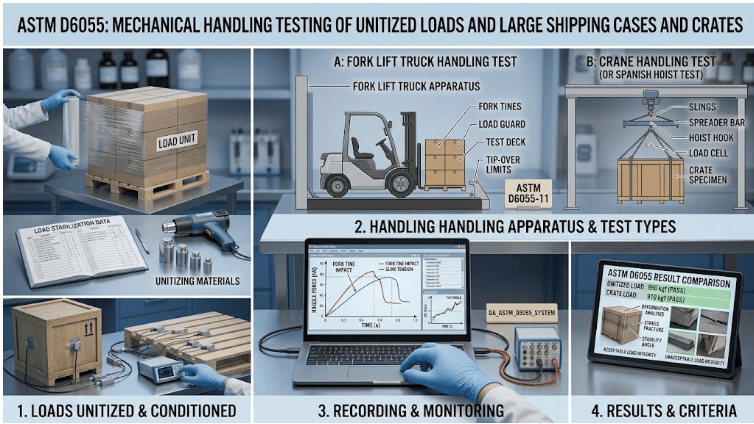
    Technicians first identify the shipping unit, contents, handling construct, and mechanical handling method. Before testing, they examine and record the shipping unit, which covers the size, load state, packaging structure, and visible defects. The mechanical handling operation that is to be carried out is then performed by the handling equipment selected. Depending on the method, this can include repeated fork-truck handling, spade lifting, hydraulic clamp handling, push-pull handling on a slip-sheet, grabhook lifting, or sling lifting. After the handling sequence, technicians inspect the shipping unit and contents. Analysts record package damage, deformation, load movement, loss of stability, handling-component damage, and other relevant observations. Engineers use these findings to evaluate shipping-unit integrity and identify opportunities to improve packaging or load design.

     ASTM D6055 testing process showing preparation and inspection of a large shipping unit, mechanical handling with applicable lifting equipment, post-handling inspection, and evaluation of load integrity and package damage.
    ASTM D6055 Mechanical Handling Testing of Unitized Loads and Large Shipping Cases and Crates

    Common Challenges and Troubleshooting

    The results from ASTM D6055 are subject to change due to different load configurations, load conditions, handling equipment, attachment set-up, and load stability. Technicians need to ensure that the shipping unit they are testing is representative of the shipping configuration. When the handling equipment is positioned incorrectly, it can create conditions that are not reflective of the intended mechanical handling operation. Any pre-existing package damage, package movement, package deformation, or abnormalities due to equipment should also be recorded to affect interpretation.

    Analysis Results and Interpretation

    The report summarizes the mechanical handling performance and integrity of the tested unitized load or large shipping case or crate. It presents the observed handling result together with relevant sample identification, shipping-unit information, dimensions, load condition, handling equipment, test method, and other required test information.

    Read more

    • The laboratory reports the shipping-unit dimensions in mm, overall load mass in kg, and records the observed mechanical handling results according to the applicable procedure.
    • The technician records shipping-unit length, width, and height in mm, load configuration, packaging condition, handling attachment, handling sequence, and initial physical condition.
    • The analyst documents observed deformation, package damage, load movement, loss of stability, handling-component damage, and condition of the contents following mechanical handling.
    • Analysts record shipping-unit identification, preparation details, equipment configuration, pre-test inspection, handling conditions, post-test inspection, and other required test information.
    • Engineers compare the observed mechanical handling results among shipping-unit designs to support packaging qualification, load-unit design, equipment compatibility, distribution performance, and improvements in shipping protection.

    Link to ASTM D6055

    FAQ

    Can ASTM D6055 test individual drums?
    No. Individual drums and palletized drums are excluded from the stated scope.
    Technicians and analysts evaluate load integrity, stability, package condition, deformation, movement, and observed damage to the shipping unit or contents.
    The methods are designed, in most cases, to use the actual equipment intended for load handling or standard user-specified load-handling equipment.
    No. The standard covers different unitized loads and large shipping cases and crates, so the applicable dimensions depend on the shipping unit being evaluated.
    Yes. The test results can help identify deficiencies in shipping-unit design and provide guidance for improvements.
    Yes. ASTM indicates that damage observed during testing may correlate qualitatively with damage occurring in actual distribution handling systems.
    No. ASTM D6055 addresses mechanical handling, while ASTM D6179 addresses rough handling of unitized loads and large shipping cases and crates.

    Updated on September 10, 2026

    Gokula Srinivasan Selvam
    About Author
    Gokula Srinivasan Selvam is a Material Testing Associate at Matestlab Inc. and holds a postgraduate degree in Ceramic Engineering from IIT (BHU), Varanasi. His academic background and professional experience are centered on advanced ceramic materials, their processing, characterization, and performance evaluation.
    Know More
    Testimonials
    Real results
    Engineers trust us with what matters most
    Why Choose Matestlab?
    Matestlab is a unified testing services partner based in the USA. Matestlab offers raw material and product testing services through accredited, expert laboratories primarily based in the USA. Matestlab supports physical, thermal, chemical, electrical, mechanical, environmental, and characterization testing needs through its global network of 2200+ accredited testing laboratories. Matestlab's in-house materials science experts curate and design comprehensive testing programs matched to the sample material and specific testing need, with regulatory requirements and confidentiality in mind.

    If you are looking for a managed and trusted testing partner to achieve your research goals, feel free to schedule a meeting with us or send us a request at connect@matestlabs.com to learn more about our services. For a quick quote, call us at (302)244-7710. We are happy to serve you.
    Start Your Testing
    Project Today
    Define your requirements and get access to
    specialized laboratories ready to deliver results
    Partners with us
    Clients
    Vendors
    Process for testing
    • STEP 01

      You share your testing requirements

    • STEP 02

      You share your sample(s)

    • STEP 03

      We deliver your test reports

    Get your testing done

    Let us know your testing requirements and we will be right back with a solution.

      Let us root for each other. Collaborate to grow, expand, and accelerate our businesses.

      Partner with us