
ASTM D6050 Standard Test Method for Determination of Insoluble Solids in Organic Liquid Hazardous Waste

    What is ASTM D6050?

    ASTM D6050 defines a standard test method for the content of insoluble solids in an organic liquid hazardous waste. The method defines a process for extracting the insoluble solid from a representative sample of liquid waste and quantifying the proportion of solid that is not soluble as per the prescribed test conditions. A sample of organic liquid hazardous waste is collected and prepared by the technicians. The method removes the insoluble solids from the liquid sample. The laboratory personnel then measure the separated material and use the recorded measurements to calculate the insoluble solids content. ASTM D6050 testing (Standard Test Method for Determination of Insoluble Solids in Organic Liquid Hazardous Waste) yields results per composition as opposed to an overall material property value. 

    Read more

    Get Certified ASTM D6050 Insoluble Solids Testing

    ASTM D6050 testing is useful for waste generators, environmental testing organizations, waste-treatment facilities, industrial manufacturers, and technical personnel evaluating the insoluble solids content of organic liquid hazardous waste. Technicians identify and prepare representative waste samples according to the applicable requirements. They filter out the insoluble from the liquid sample they have and calculate the mass of the insoluble solids. Analysts review the recorded measurements and calculate the applicable insoluble solids content. The outcomes may be used to help characterize waste, monitor processes, assess materials, and carry out quality control.

    What is the scope of ASTM D6050?

    ASTM D6050 covers the determination of insoluble solids in applicable organic liquid hazardous waste. The standard covers:

    Read more

    • Organic Liquid Hazardous Waste: Evaluates applicable liquid waste samples containing organic components. 
    • Insoluble Solids: Determines the amount of material that remains insoluble under the specified test conditions. 
    • Sample Separation: Separates insoluble material from the liquid portion of the sample according to the applicable procedure. 
    • Mass Determination: Measures the applicable amount of separated insoluble solids. 
    • Waste Characterization: Provides information about the physical composition of the waste sample. 
    • Process Evaluation: Supports monitoring and evaluation of waste handling or treatment processes. 

    What are the uses of ASTM D6050 testing?

    ASTM D6050 provides information about the insoluble solids content of applicable organic liquid hazardous waste. The test helps to:

    • Determine the insoluble solids content of applicable waste samples. 
    • Support characterization of organic liquid hazardous waste. 
    • Compare insoluble solids content between waste samples. 
    • Monitor variations in waste composition. 
    • Support waste-treatment and handling evaluations. 
    • Assist in process monitoring and quality-control activities. 
    • Provide data for environmental and waste-management assessments. 

    Which materials can be tested according to ASTM D6050?

    ASTM D6050 applies to organic liquid hazardous waste samples for which determination of insoluble solids is required. The method applies to:

    • Organic Liquid Hazardous Waste: Evaluates applicable organic liquid waste materials. 
    • Industrial Waste Samples: Supports testing of representative liquid waste generated by industrial processes. 
    • Waste Streams: Allows comparison of applicable waste samples from different sources or processes. 
    • Production-Related Waste: Supports monitoring of representative waste generated during manufacturing or processing. 
    • Treatment Samples: Provides information for evaluating applicable waste before, during, or after treatment. 

    Why is ASTM D6050 testing important?

    The handling, processing, storage, and treatment of organic liquid hazardous waste may be impacted by insoluble solids. Variations in insoluble solids might reflect changes in waste mix or changes in an industrial process. ASTM D6050 offers a standardized method for measuring the insoluble solids from waste samples that apply. The results can assist technical staff in characterizing waste materials, determining changes in materials between samples, and waste-management and process-evaluation activities.

    ASTM D6050 Equipment and Sample Preparation Guide

    Technicians need representative organic liquid hazardous waste samples and suitable equipment for separating, collecting, and measuring insoluble solids. They carefully prepare and handle the samples according to the applicable procedure to maintain representative test conditions and avoid loss or contamination of the insoluble material.

    Read more

    Sample IdentificationTechnicians identify the organic liquid hazardous waste, waste source, sample batch, collection information, and other relevant sample details before testing.
    Sample PreparationTechnicians prepare representative samples according to the applicable requirements and mix or handle the material as required to maintain sample consistency.
    Insoluble Solid SeparationTechnicians use suitable separation equipment and procedures to isolate the insoluble solids from the liquid portion of the waste sample.
    Mass Measurement EquipmentAnalysts use calibrated weighing equipment to determine the applicable mass of the separated insoluble solids accurately.

    ASTM D6050 Testing Procedures and Requirements

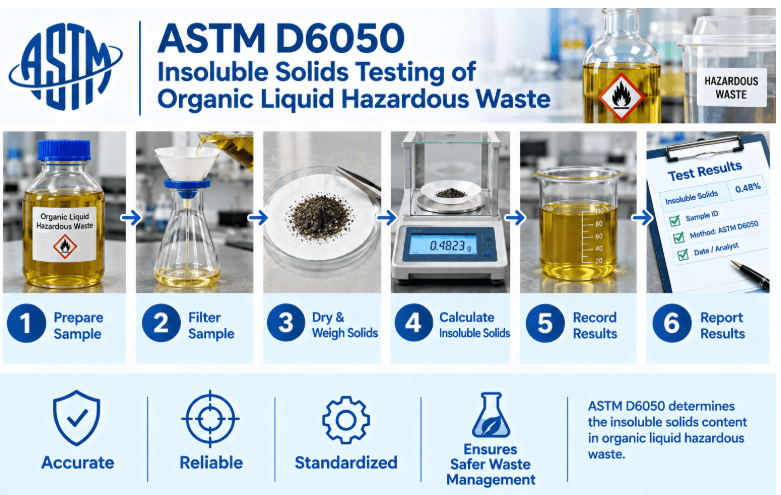
    Technicians first identify and prepare a representative organic liquid hazardous waste sample according to the applicable requirements. They process the sample using the specified procedure to separate the insoluble solids from the liquid portion. The separated insoluble material is collected and prepared for measurement. Analysts determine the required mass and use the recorded measurements to calculate the applicable insoluble solids content. The testing process includes the following steps.

    Read more

    Sample Identification and PreparationTechnicians identify the waste sample and prepare a representative portion according to the applicable requirements.
    Sample Processing and SeparationTechnicians process the sample and separate the insoluble solids from the liquid portion using the required procedure.
    Insoluble Solids CollectionTechnicians collect the separated insoluble material and prepare it for the applicable measurement.
    Mass Measurement and Data RecordingAnalysts determine the required mass and record the applicable sample and measurement information.
    Result Calculation and ReportingAnalysts use the recorded measurements to determine and report the applicable insoluble solids content.

    ASTM D6050 Testing Process and Data Collection

    Technicians identify the organic liquid hazardous waste sample and prepare a representative portion for testing. They process the sample according to the applicable procedure to separate the insoluble solids from the liquid material. The separated solids are collected and measured using suitable calibrated equipment. Technicians record the sample identification, required mass measurements, sample conditions, and other relevant test information. Analysts review the recorded data and calculate the insoluble solids content according to the applicable procedure. 

     ASTM D6050 testing process showing organic liquid hazardous waste sample identification and preparation, separation of insoluble solids from the liquid sample, collection and measurement of separated solids, calculation of insoluble solids content, and recording of test results.
    ASTM D6050 Insoluble Solids Testing of Organic Liquid Hazardous Waste

    Common Challenges and Troubleshooting

    ASTM D6050 results vary due to nonrepresentative sampling and contamination of the sample during sampling or during processing; loss of insoluble material during separation; incomplete separation; loss of mass during measurement; and equipment calibration errors. The technicians should always take and prepare representative samples and always follow the separation procedure that applies. They should ensure the condition and calibration of weighing and separation equipment prior to testing. In the event of the results being unexpected, technicians and analysts should check the sample collection, the sample preparation, separation conditions, possible sample loss, mass measurement, equipment performance, and calculation procedures.

    Analysis Results and Interpretation

    The report summarizes the insoluble solids content of the tested organic liquid hazardous waste. It presents the measured and calculated results together with the relevant units, sample identification, specimen information, sample condition, and other required test information.

    Read more

    • ASTM D6050 produces results specific to the amount of insoluble solids, not an overall material property value.
    • Laboratories usually report the insoluble solids content in terms of the units applicable to the procedure used, which may be mass percent, mg/L, or other applicable units of concentration or mass. 
    • The report contains waste identification, source information, sample conditions, and mass measurements that are necessary for the interpretation of the results and additional information. 
    • Techniques and analysts can generate reliable and comparable results by using consistent sample preparation, representative sampling, controlled separation conditions, accurate mass measurement, and appropriately calibrated equipment.

    Link to ASTM D6050

    FAQ

    What does ASTM D6050 measure?
    ASTM D6050 is used to measure the amount of insoluble solids in applicable organic liquid hazardous waste samples.
    The method applies to organic liquid hazardous waste for which an insoluble solids determination is required.
    Insoluble solids can provide information about waste composition and may affect waste handling, processing, and treatment.
    Dr Ruchika Yogesh
    About Author
    Dr Ruchika Yogesh
    Dr. Ruchika Yogesh is an entrepreneur, science and AI/ML enthusiast, medicinal chemistry subject matter expert (SME), scientific/medical copyeditor, and an independent researcher.
    Testimonials
    Real results
    Engineers trust us with what matters most
    Start Your Testing
    Project Today
    Define your requirements and get access to
    specialized laboratories ready to deliver results
    Partners with us
    Clients
    Vendors
    Process for testing
    • STEP 01

      You share your testing requirements

    • STEP 02

      You share your sample(s)

    • STEP 03

      We deliver your test reports

    Get your testing done

    Let us known your testing requirements and we will be right back with a solution.

      Let us root for each other. Collaborate to grow, expand, and accelerate our businesses.

      Partner with us

        Contact Us

        Discover more from Matestlab Inc

        Subscribe now to keep reading and get access to the full archive.

        Continue reading