
ASTM D6049 Measurement of the Viscous and Elastic Behavior of Unvulcanized Raw Rubbers and Rubber Compounds by Compression Between Parallel Plates

    What is ASTM D6049?

    ASTM D6049 is a standard test method for measuring the viscous and elastic behavior of unvulcanized raw rubbers and rubber compounds by compression between parallel plates. The method evaluates a rubber specimen’s deformation and response under controlled compression. Technicians prepare a representative specimen and place it between parallel plates in suitable test equipment. The specimen is subjected to the required compression conditions, and the resulting deformation and response are measured. Analysts use the recorded measurements to evaluate the viscous and elastic behavior of the unvulcanized rubber or rubber compound. ASTM D6049 testing (Measurement of the Viscous and Elastic Behavior of Unvulcanized Raw Rubbers and Rubber Compounds by Compression Between Parallel Plates) offers only behavior and rheological results. It does not give any overall material property values. 

    Read more

    Get Certified ASTM D6049 Viscous and Elastic Behavior Testing

    ASTM D6049 testing is useful for raw-rubber manufacturers, rubber compounders, material suppliers, engineers, and quality-control personnel evaluating the behavior of unvulcanized rubber materials under controlled compression. Technicians identify the rubber material and prepare representative specimens according to the applicable requirements. They position each specimen between parallel plates and apply the required compression conditions. The testing equipment records the applicable material response during the measurement. Analysts evaluate the resulting data to determine the relevant viscous and elastic behavior of the material. The results assist manufacturers to compare raw rubbers and rubber compounds, to ensure consistency between production batches, to assess processing characteristics, and to aid material development and quality-control work.
    What is the scope of ASTM D6049?

    ASTM D6049 covers the measurement of the viscous and elastic behavior of applicable unvulcanized raw rubbers and rubber compounds by compression between parallel plates. The standard covers:

    Read more

    • Unvulcanized Raw Rubbers: Evaluates the viscous and elastic behavior of applicable raw rubber materials. 
    • Rubber Compounds: Supports evaluation of applicable unvulcanized rubber compounds. 
    • Compression Testing: Subjects the specimen to controlled compression between parallel plates. 
    • Viscous Behavior: Provides information about the time-dependent or flow-related response of the material. 
    • Elastic Behavior: Provides information about the deformation and recovery characteristics of the material under the applicable test conditions. 
    • Material Comparison: Supports comparison of the behavior of different rubber materials or compounds. 
    • Quality Control: Helps manufacturers monitor material consistency and variations between production batches. 

    What are the uses of ASTM D6049 testing?

    ASTM D6049 provides information about the viscous and elastic behavior of unvulcanized rubber materials. The test helps to:

    • Measure the viscous behavior of applicable raw rubbers and rubber compounds. 
    • Measure the elastic behavior of unvulcanized rubber materials. 
    • Compare different raw-rubber materials and compounds. 
    • Monitor consistency between production batches. 
    • Identify changes in material behavior. 
    • Support evaluation of rubber-processing characteristics. 
    • Assist material development and quality-control activities. 

    Which Materials Can Be Tested According to ASTM D6049?

    ASTM D6049 applies to unvulcanized raw rubbers and rubber compounds that can be evaluated under the specified compression conditions. The method applies to:

    • Raw Rubbers: Evaluates applicable unvulcanized rubber materials. 
    • Rubber Compounds: Supports evaluation of applicable unvulcanized rubber compounds. 
    • Different Rubber Formulations: Allows comparison of materials with different compositions or formulations. 
    • Production Samples: Supports evaluation of representative samples from different production batches. 
    • Unvulcanized Materials: Provides information about material behavior before vulcanization. 

    Why is ASTM D6049 testing important?

    The viscous and elastic properties of unvulcanized rubber can affect material handling or processing. Differences in material response can indicate differences in composition, formulation, or processing. ASTM D6049 offers a standardized method for testing these properties by compressing samples between parallel plates. The results are useful for comparing materials, tracking production consistency, investigating changes in material behavior, and development and quality control in rubber compounds.

    ASTM D6049 Equipment and Sample Preparation Guide

    Technicians need representative unvulcanized rubber specimens and suitable equipment for applying controlled compression and measuring the resulting material response. They prepare the specimens according to the applicable requirements and ensure that the material is suitable for testing between parallel plates.

    Read more

    Specimen PreparationTechnicians prepare representative unvulcanized rubber specimens according to the applicable requirements and maintain suitable specimen condition before testing.
    Specimen PositioningTechnicians place the specimen correctly between the parallel plates and ensure suitable alignment before applying compression.
    Compression and Measuring EquipmentAnalysts use suitable equipment capable of applying controlled compression between parallel plates and measuring the resulting deformation and material response.

    ASTM D6049 Testing Procedures and Requirements

    Technicians first identify the rubber material and prepare representative unvulcanized specimens according to the applicable requirements. They position the specimen between parallel plates and prepare the testing equipment for measurement. They compress the specimen under the required conditions while the required response is measured and recorded. Analysts evaluate the collected measurements to determine the applicable viscous and elastic behavior. The testing process includes the following steps.

    Read more

    Sample Identification and Specimen PreparationTechnicians identify the rubber material and prepare representative unvulcanized specimens according to the applicable requirements.
    Specimen Positioning and Test SetupTechnicians position the specimen between the parallel plates and prepare the equipment for controlled compression.
    Compression and Response MeasurementThe equipment applies the specified compression conditions and measures the resulting deformation and material response.
    Data Analysis and Property DeterminationAnalysts evaluate the recorded measurements to determine the applicable viscous and elastic behavior.
    Result Recording and ReportingTechnicians record specimen information, test conditions, measured values, and calculated results.

    ASTM D6049 Testing Process and Data Collection

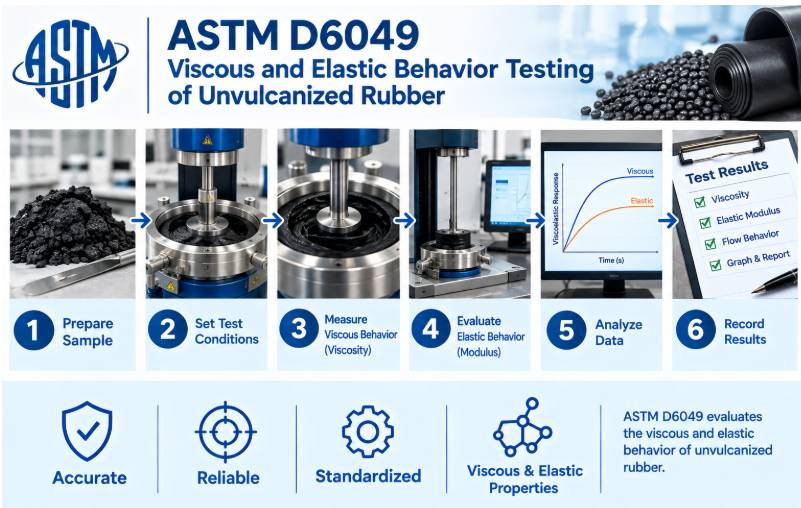
    Technicians identify the raw rubber or rubber compound and prepare a representative unvulcanized specimen. They inspect the specimen and position it correctly between the testing equipment’s parallel plates. The equipment applies the required compression conditions while measuring the material response. Technicians record the applicable test conditions, deformation measurements, response data, and specimen information. Analysts evaluate the collected data to determine the viscous and elastic behavior of the material. 

     ASTM D6049 testing process showing unvulcanized rubber specimen preparation, positioning between parallel plates, controlled compression, measurement of deformation and material response, analysis of viscous and elastic behavior, and recording of test results.
    ASTM D6049 Viscous and Elastic Behavior Testing of Unvulcanized Rubber

    Common Challenges and Troubleshooting

    ASTM D6049 results vary due to specimen condition, specimen preparation, positioning, plate alignment, temperature, equipment calibration, and variations in compression conditions. Technicians should prepare representative samples and adhere to the specimen-preparation procedure for the sample. They should check the parallel plate condition and alignment and ensure that testing equipment is correct and in order. Technicians and analysts should check specimen preparation, material condition, specimen location, compression conditions, equipment performance, calibration, and data calculations if results are not as expected.

    Analysis Results and Interpretation

    The report summarizes the viscous and elastic behavior of the tested unvulcanized raw rubber or rubber compound. It presents the measured and calculated values together with the relevant units, material identification, specimen information, compression conditions, and other required test details.

    Read more

    • ASTM D6049 produces behavior-specific results rather than a single overall material-property value.
    • Laboratories report the applicable viscous and elastic parameters using the units specified by the selected procedure. Depending on the parameter determined, results may include force, deformation, time, stress, strain, or other applicable rheological measurements.
    • The report provides information on material identification, specimen information, compression conditions, and observations relevant to interpreting the results.
    • Technicians and analysts obtain reliable and comparable results through consistent specimen preparation, accurate positioning of the specimen, controlled compression conditions, appropriate calibration, and measurement instruments.

    Link to ASTM D6049 

    FAQ

    What does ASTM D6049 measure?
    ASTM D6049 measures the viscous and elastic behavior of applicable unvulcanized raw rubbers and rubber compounds by compression between parallel plates.
    The method applies to applicable unvulcanized raw rubbers and rubber compounds that can be evaluated under the specified compression conditions.
    These properties give information on the way an unvulcanised rubber material reacts to deformation and compression and can be used to assess differences in material behaviour and processing characteristics.
    Technicians/analysts use appropriate compression-testing devices and instruments for measuring force; these devices employ parallel plates to apply the test conditions, and the instruments can record material responses under the test conditions.

    Updated on September 8, 2026

    Rohit Dhembare
    About Author
    Rohit Dhembare is an Operations Associate at Matestlab Inc., holds a postgraduate degree in Organic Chemistry and is trained in Materials Science testing techniques.
    Know More
    Testimonials
    Real results
    Engineers trust us with what matters most
    Why Choose Matestlab?
    Matestlab is a unified testing services partner based in the USA. Matestlab offers raw material and product testing services through accredited, expert laboratories primarily based in the USA. Matestlab supports physical, thermal, chemical, electrical, mechanical, environmental, and characterization testing needs through its global network of 2200+ accredited testing laboratories. Matestlab's in-house materials science experts curate and design comprehensive testing programs matched to the sample material and specific testing need, with regulatory requirements and confidentiality in mind.

    If you are looking for a managed and trusted testing partner to achieve your research goals, feel free to schedule a meeting with us or send us a request at connect@matestlabs.com to learn more about our services. For a quick quote, call us at (302)244-7710. We are happy to serve you.
    Start Your Testing
    Project Today
    Define your requirements and get access to
    specialized laboratories ready to deliver results
    Partners with us
    Clients
    Vendors
    Process for testing
    • STEP 01

      You share your testing requirements

    • STEP 02

      You share your sample(s)

    • STEP 03

      We deliver your test reports

    Get your testing done

    Let us know your testing requirements and we will be right back with a solution.

      Let us root for each other. Collaborate to grow, expand, and accelerate our businesses.

      Partner with us