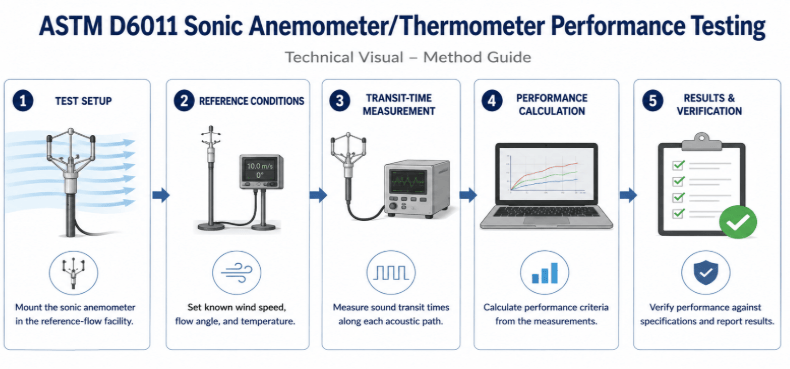
ASTM D6011 is a standard test method for determining the performance of a sonic anemometer/thermometer. This test method covers the dynamic performance of an instrument that uses the inverse-time (transit-time) measurement technique to determine wind velocity, the speed of sound, or both. Manufacturers, instrumentation test facilities, and users use ASTM D6011 (Standard Test Method for Determining the Performance of a Sonic Anemometer/Thermometer) to characterize an array model or probe design across eight performance criteria: acceptance angle, acoustic pathlength, system delay, system delay mismatch, thermal stability range, shadow correction, velocity calibration range, and velocity resolution. Analysts calculate these performance criteria from transit-time measurements under known reference conditions, and engineers use the results to verify that a sonic anemometer/thermometer meets its stated specifications using the same instrumentation and calibration work that satisfies other ASTM performance methods.
Get Certified ASTM D6011 Testing for Reliable Sonic Anemometer Performance
Sonic anemometer/thermometers determine wind velocity components and air temperature by measuring sound pulse travel times along fixed acoustic paths; therefore, drift in the transit-time electronics, the array’s alignment, or the stability of its structure affects the accuracy of the wind data the instrument outputs. ASTM D6011 provides a controlled, repeatable way to characterize that accuracy before an instrument’s deployment. These results support product specification, instrument comparison, and quality control for meteorological and industrial applications where devices measure wind.