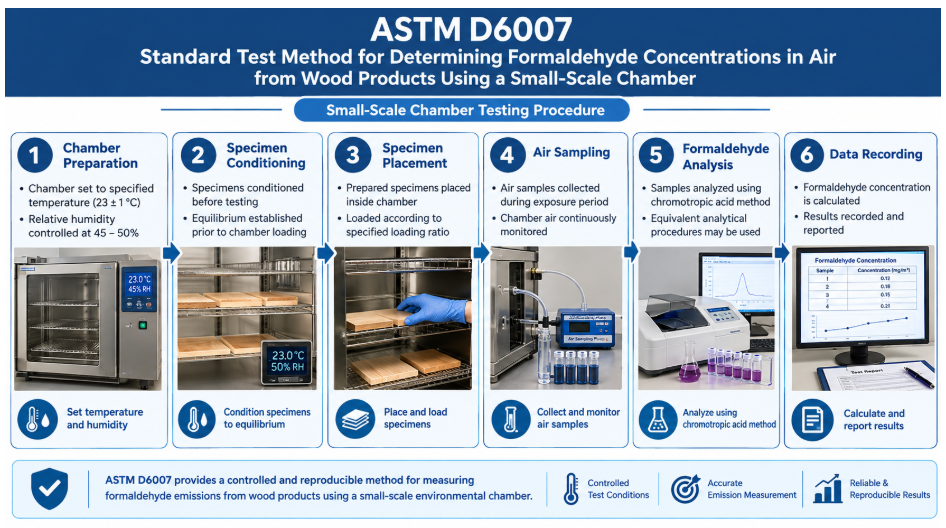
ASTM D6007 determines the amount of formaldehyde released from wood product test samples under specified test conditions, temperature, and relative humidity. The standard addresses the assessment of wood-based panel product properties for applications for which there is a typical loading ratio, and with typical loading ratios, i.e., the assessment of properties that are typically associated with specific applications. The results of this small-scale chamber testing method are to be comparable to the results of ASTM Test Method E1333 testing of larger samples of product. Products that are fairly uniform in their formaldehyde emission properties are good choices for small-scale testing in a chamber.
The scope of ASTM D6007 includes:
- Material type: The material type is wood-based panel products, as specified in ASTM D6007, which includes particleboard, medium-density fiberboard, hardwood plywood, and laminated products.
- Scope: ASTM D6007 is used to assess and regulate the formaldehyde emission concentration of wood products for indoor air quality.
- Property measured: The test is done for the concentration of formaldehyde in the air, usually given in parts per million (ppm) or milligrams per cubic meter (mg/m³).
- Method: ASTM D6007 involves a small-scale environmental chamber with controlled conditions, air sampling, and chromotropic acid analysis.
- Result: The testing laboratory determines the values of formaldehyde concentration from the samples that it tests.
- Test Limitations: Emission rates vary with loading, temperature, humidity, and air exchange and are not necessarily representative of full-scale indoor environments.
- Environmental conditions: Controlled temperature (~23 °C ± 1 ° C), controlled relative humidity (~45 % to 50 %), controlled air exchange rate.
- Applications: Engineers use ASTM D6007 to evaluate wood products for residential construction, furniture manufacturing, and regulatory compliance programs.
What are the Uses of ASTM D6007 Testing?
ASTM D6007 testing helps laboratories produce reliable emission data for wood product quality assessment. These results are utilized by manufacturers and engineers to comply with regulations, develop products, and test for quality control.
This standard-
- Assessing formaldehyde emissions from wood-based panels and composite materials.
- Compliance monitoring of products for compliance with CARB regulations for composite wood products.
- Assisting with compliance with EPA TSCA Title VI 40 CFR Section 770 formaldehyde emission standard
- Evaluating products to meet HUD manufactured housing standards.
- The emission performance of various wood product formulations is compared.
- Data for indoor air quality certification programs
Which materials can be tested under ASTM D6007?
ASTM D6007 covers particleboard, medium-density fiberboard, hardwood plywood, and laminated products constructed with wood. The test method is suitable for evaluating products relatively homogeneous in their formaldehyde release characteristics. The method can be applied for monitoring composite wood products and building materials.
Why is ASTM D6007 Important?
ASTM D6007 allows for testing of smaller samples, and it also saves time in testing versus large chamber methods. The maximum emission rates are set for wood panel building products containing urea-formaldehyde adhesives and permanently installed in residential buildings, and for other industrial wood panel products such as kitchen cabinets. The results from this test method are essential for regulatory compliance and product certification. Concentrations measured from this small-scale test may not necessarily be the same in a full-scale indoor environment, so standardized testing is necessary for a proper material comparison.