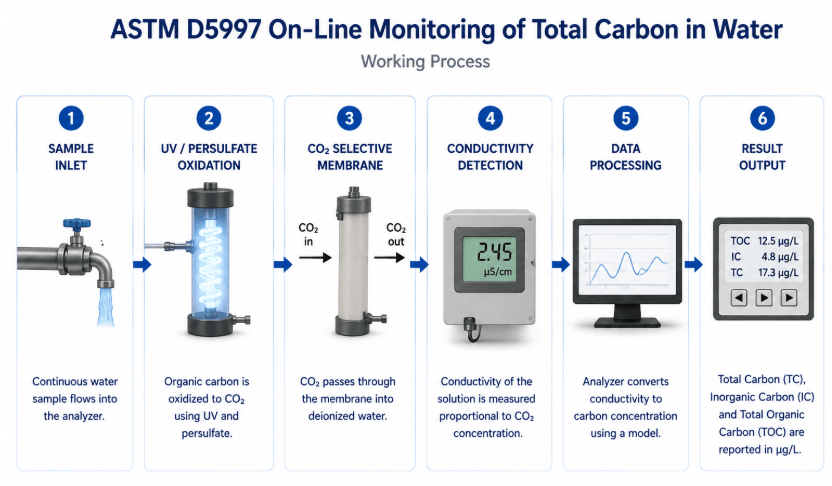
ASTM D5997 describes a standard test method for on-line monitoring of total carbon (TC), inorganic carbon (IC), and total organic carbon (TOC) in water. This monitoring technique oxidizes organic carbon in a continuous water stream using ultraviolet radiation and persulfate, then measures the produced carbon dioxide (CO₂) with a selective membrane and conductivity detector. ASTM D5997 (Standard Test Method for On-Line Monitoring of Total Carbon, Inorganic Carbon in Water by Ultraviolet, Persulfate Oxidation and Membrane Conductivity Detection) measures organic and inorganic carbon contamination in water used in industrial, pharmaceutical, and power-generation processes. Plant operators and analysts use ASTM D5997 to detect carbon impurities, ensure water-purity compliance, and monitor process water quality in real time. Analysts use standard conductivity measurements and compare them against the operating limit for the water system. Engineers interpret the results of an ASTM D5997 test in terms of the purity of the water in a given process that it supports
Get Certified ASTM D5997 Testing for Reliable Water Purity Monitoring
Water used in semiconductor, pharmaceutical, and power-plant boiler and cooling processes has limits on organic and inorganic carbon because trace carbon can destroy ion exchange resins, promote biological growth, or induce corrosion in processing equipment. Continuous, on-line monitoring per ASTM D5997 provides process engineers and analysts a real-time indication of carbon content instead of a measurement after periodic grab sampling. Laboratories running chemical analysis programs use ASTM D5997 data to verify compliance, track water-treatment performance, and flag equipment or process upsets as they happen.