ASTM D578/D578M Standard Specification for Glass Fiber Strands

    What is ASTM D578?

    ASTM D578 is the standard specification for the designation of glass fiber strands that covers strand construction and physical properties for both continuous and staple fiber glass. It applies to single, plied, and multiple-wound (stranded) strands and to textured glass fiber yarns. ASTM D578 (Standard specification for designation of glass fiber strands) covers nomenclature and requirements for yarn number, twist direction and twist level, filament diameter, breaking strength, and ignition loss and identifies the different families of glass fiber by letter designations, which manufacturers frequently use in the designations for use in general and electrical applications. Manufacturers and technicians use these requirements to identify, compare, and verify various glass fiber strand products for mechanical, chemical, moisture, temperature, and electrical stress conditions, giving both parties a common basis for evaluating glass fiber materials for these applications.

    Read more

    Get Certified ASTM D578 Testing for Reliable Glass Fiber Strand Quality

    Glass fiber producers require uniform strand construction, yarn count, filament diameter, twist, and breaking strength to ensure consistent product performance. ASTM D578 defines specifications that producers and testing labs employ to recognize glass fiber strands and assess their physical characteristics. Test outcomes allow manufacturers to verify strand identification, monitor production uniformity, and determine whether their products meet applicable regulations.

    What is the Scope of the ASTM D578 Specification?

    ASTM D578 covers continuous fiber and staple fiber glass strands, including single, plied, and multiple wound strands as well as textured glass fiber yarns. It provides a nomenclature system for features such as the glass family, fiber form, filament diameter, yarn number, strand construction and twist, and physical-property requirements, including applicable test procedures. This specification-

    Read more

    • Covers continuous fiber and staple fiber glass strands, including single, plied, and multiple-wound constructions, as well as textured glass fiber yarns.
    • Identifies families of glass fiber and application categories by letter designations
    • Defines nomenclature by glass family, form of fiber, filament diameter, yarn number, construction of the strand, and twist characteristics
    • Specifies requirements of yarn number, filament diameter, and breaking strength for applicable construction of strand
    • Evaluates construction of strand, twist direction and level according to specification of the applicable strand
    • Determines ignition loss to determine the organic content of the glass fiber strand
    • Controls cleanliness of glass fibers by addressing specified requirements of free alkali metal oxides, foreign particles, dirt, and other impurities
    • Recognizes both SI and inch-pound units for reporting of applicable measurements

    What are the Uses of ASTM D578 Testing?

    ASTM D578 testing provides manufacturing industries, like purchasers, a consistent basis for identifying glass fiber strands and verifying physical properties specified for the applicable construction of the strand. A specification supports glass fiber products that may be subject to mechanical, chemical, moisture, temperature, and electrical service conditions. The applicability of the particular property requirement can vary according to the strand designation, designated application, and buyer-seller agreement. This standard-

    • Identify glass fiber strands according to their material characteristics and construction.
    • Verify yarn number, filament diameter, and construction of the strand against the applicable requirements
    • Evaluate breaking strength and compare individual results with the specified minimum requirement
    • Measure ignition loss to assess the organic content of the strand.
    • Support production control by helping manufacturers check strand consistency across products.
    • Guide towards selection and comparison of glass fiber strands for demanding applications, including electrical, structural, and others.

    Which Materials Can Be Tested Under ASTM D578?

    ASTM D578 applies to continuous fiber and staple fiberglass strands, including single, plied, and multiple-wound strands, and, together with the provisions of designation systems for various families of glass and fiber types, also addresses textured glass fiber yarns. Continuous filament yarns, yarns composed of staple or discontinuous filaments, textured yarns, and other strand configurations provided within the specification are included within the scope of the standard.

    Why is ASTM D578 Important?

    ASTM D578 gives manufacturers, purchasers, and laboratories a common system for identifying and evaluating glass fiber strands. Manufacturers can ensure their strands meet relevant standards and maintain product consistency by controlling yarn quantity, filament diameter, strand construction, twist, and breaking strength. 

    ASTM D578 Equipment and Sample Preparation Guide

    ASTM D578 testing includes representative strand samples, appropriate conditioning, and suitable equipment that corresponds with properties being evaluated. Unless the applicable procedure states otherwise, condition specimens in the atmosphere designated for testing glass textiles for at least 5 hours before preparing them in accordance with the applicable test method and evaluating the qualities needed for the specified strand designation.

    Read more

    Sample and Specimen DetailsTechnicians select representative glass fiber strand packages and prepare specimens for the required construction, physical-property, and workmanship evaluations. 
    Specimen PreparationTechnicians take samples from the selected packages and prepare yarn or strand specimens according to the applicable test procedures. 
    Specimen ConditioningTechnicians condition the laboratory strand samples in the atmospheres specified for testing glass textiles for a minimum of 5 hours
    InstrumentationThe testing uses equipment such as a twist tester, tensile testing machine, filament-diameter measuring system or microprojector, analytical balance, and muffle furnace for the applicable evaluations.

    ASTM D578 Testing Procedure and Requirements

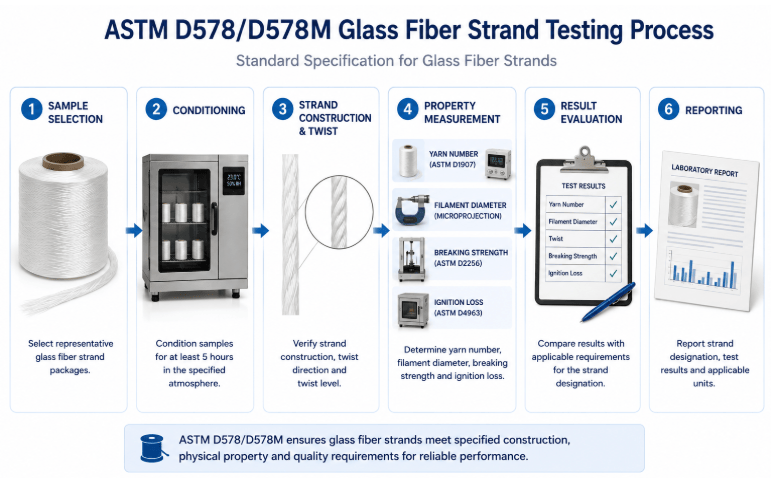
    ASTM D578 assesses glass fiber strands according to their specified structure and associated physical-property standards.  Technicians begin by inspecting the strand and verifying its construction and twist characteristics. They then determine the yarn number and filament diameter and measure the physical properties required for the specified strand designation. The laboratory compares the resulting measurements with the applicable requirements. The ASTM D578 testing procedure comprises the following steps: 

    Read more

    Workmanship EvaluationTechnicians examine the exterior surface of the selected strap packages and identify applicable defects according to the specification requirements of the inspection.
    Strand Construction EvaluationTechnicians verify the number of single, plied, or cabled strands within the applicable strand construction.
    Twist EvaluationTechnicians determine the direction and level of twist using ASTM D1423.
    Yarn Number EvaluationEngineers determine the yarn number of bare glass using ASTM D1907 and express the result in the applicable unit system.
    Filament Diameter EvaluationTechnicians calculate the average filament diameter using the specified microprojection procedure
    Breaking Strength EvaluationTechnicians measure the breaking strength of the applicable strand and compare individual results with the specified minimum requirement.
    Ignition Loss EvaluationAnalysts determine ignition loss as an indication of organic content using ASTM D4963.
    Result EvaluationAnalysts compare the measured properties with the applicable requirements for the specified glass fiber strand designation.

    ASTM D578 Testing Process and Data Collection

    The analyst identifies the glass fiber strand designation and selects the sampling packages the specification requires. Technicians condition the samples, then examine construction, workmanship, twist direction and level, filament diameter, and any other physical properties relevant to the test and report findings against the requirements for that strand designation. Technicians prepare the specimens, identify the specified requirements and physical properties, and run the required test procedures. When needed, they measure breaking strength per procedure, and the analyst determines ignition loss and compares both results to the requirements for the strand designation. Where relevant, technicians record workmanship results, test results, the unit designation, and the procedures used for each test.

    The image shows sampling, conditioning, and assessment of strand construction and twist of filament diameter, yarn number, and breaking strength and ignition loss of glass fiber strands.
    ASTM D578/D578M Glass Fiber Strand Testing and Evaluation

    Common Challenges and Troubleshooting

    Accurate ASTM D578 results depend on representative sample preparation, proper conditioning, specimen preparation, and suitable testing equipment. Variations can occur between the individual packages and specimens in the assessment. Technicians reduce these differences by following the specified requirements of sampling, conditioning the samples before testing, applying the appropriate test method to each property, and controlling the measurement equipment calibration and precision.

    ASTM D578 Analysis Results and Interpretation

    The laboratory testing report summarizes the measured characteristics of a glass fiber strand according to its designated requirements.

    Read more

    • The technician reports the yarn number in the applicable SI or inch-pound unit and compares it with the specified requirement.
    • The analyst reports the filament diameter and verifies that it falls within the applicable designated range.
    • The technician reports the direction and level of twist and checks them against the applicable strand construction.
    • The engineer reports the measured breaking strength and confirms that each applicable individual result compares with the specified minimum
    • The analyst reports ignition loss as the applicable organic-content measurement and compares it with the agreed or specified tolerance.
    • Engineers report the strand construction and workmanship, along with the applicable test results.

    Link to ASTM D578

    FAQ

    Why is ASTM D578 important?
    ASTM D578 provides requirements for identifying and evaluating glass fiber strands and their applicable physical properties. It gives manufacturers, purchasers, and laboratories a consistent basis for checking strand characteristics and comparing results with the applicable requirements.
    ASTM D578 evaluates properties such as yarn number, twist, filament diameter, breaking strength, and ignition loss, as applicable to the specified strand designation.
    The specification covers continuous and staple fiber glass strands, including single, plied, and multiple-wound constructions, as well as textured glass fiber yarns.
    ASTM D578 recognizes both Systems International (SI) and inch-pound units as standard units of measurement. Applicable units of measurement include Tex, yd/lb, μm, in, tpm, tpi, N, and lbf, depending on the property being expressed.

    Updated on September 4, 2026

    Gokula Srinivasan Selvam
    About Author
    Gokula Srinivasan Selvam is a Material Testing Associate at Matestlab Inc. and holds a postgraduate degree in Ceramic Engineering from IIT (BHU), Varanasi. His academic background and professional experience are centered on advanced ceramic materials, their processing, characterization, and performance evaluation.
    Know More
    Testimonials
    Real results
    Engineers trust us with what matters most
    Start Your Testing
    Project Today
    Define your requirements and get access to
    specialized laboratories ready to deliver results
    Partners with us
    Clients
    Vendors
    Process for testing
    • STEP 01

      You share your testing requirements

    • STEP 02

      You share your sample(s)

    • STEP 03

      We deliver your test reports

    Get your testing done

    Let us know your testing requirements and we will be right back with a solution.

      Let us root for each other. Collaborate to grow, expand, and accelerate our businesses.

      Partner with us

        Discover more from Matestlab

        Subscribe now to keep reading and get access to the full archive.

        Continue reading