
ASTM D5630 Standard Test Method for Ash Content in Plastics

    What is ASTM D5630?

    ASTM D5630 is a test method for the ash content of plastics. The process involves controlled heating of a plastic sample to remove the combustible component and quantifying the remaining inorganic component. Ash content is a helpful indicator of inorganic additives, fillers, pigments, and other noncombustible materials in the plastic. Engineers use the results to determine material composition and production consistency. The method determines the inorganic residue left behind when a plastic specimen is subjected to controlled heating and combustion. ASTM D5630 is used in laboratories to characterize plastic materials, assess inorganic filler content, support quality control, and compare material formulations.

    Read more

    Get Certified ASTM D5630 Testing for Reliable Plastic Ash Content

    Ash content can indicate inorganic material in the plastic formulation. Thus, manufacturers can use this measurement to check formulation consistency and detect differences between materials or production batches. ASTM D5630 (Standard Test Method for Ash Content in Plastics) is a standard method for the determination of ash remaining upon controlled heating. These results are used for QC, material comparison, formulation evaluation, and production monitoring.

    What is the Scope of the ASTM D5630 Test Standard?

    ASTM D5630 is a test method for ash content of plastics, which involves heating the sample under controlled conditions and weighing the ash residue. The ASTM D5630 standard-

    Read more

    • Measures the ash content of plastics.
    • Measures inorganic residue that remains after combustion.
    • Helps assess filled and unfilled plastics.
    • Assists with the evaluation of inorganic fillers and additives.
    • Assists in the analysis of material composition.
    • Helps compare different plastic formulations.
    • Involved in quality control and production monitoring.

    What are the Uses of ASTM D5630 Testing?

    Laboratories use ASTM D5630 testing to determine the amount of noncombustible residue in plastic materials. The data are used by engineers to characterize plastic formulations and to check material consistency. This standard-

    • Determines the ash content of plastics.
    • Assists in assessing inorganic filler levels.
    • Supports formulation verification.
    • Assists in the comparison of plastic materials.
    • Helps control production quality.
    • Supports the identification of differences in materials.
    • Supplies information for plastic material characterization.

    Which materials can be tested under ASTM D5630?

    ASTM D5630 is applicable to plastic materials that can be subjected to the prescribed heating and combustion procedure. Plastic specimens can be tested in appropriate form in the laboratory in accordance with the test requirements. Inorganic fillers, pigments, reinforcing materials, or other noncombustible materials may be present in the material and may also account for the measured ash residue.

    Why is ASTM D5630 Important?

    ASTM D5630 determines the ash content of plastics using the following standardized method. Repeat measurements can be used to help manufacturers assess the inorganic content and material composition. The results can also be used by engineers to compare formulations, check the quality of production, and assess the consistency of the plastic materials used in production.

    ASTM D5630 Equipment and Sample Preparation Guide

    ASTM D5630 requires controlled heating equipment and a calibrated balance to accurately measure the specimen and remaining residue. Representative plastic specimens are prepared in the laboratories prior to the heating process.

    Read more

    Sample and Specimen DetailsRepresentative plastic samples can be prepared and heated in accordance with ASTM D5630 and tested in the laboratories.
    Specimen PreparationSamples are carefully taken, weighed, and housed in appropriate containers for controlled heating.
    Specimen DimensionsThe specimen size depends on the material form and the test procedure used, and must provide enough material for accurate residue measurement.
    InstrumentationTest equipment includes a furnace or controlled heating equipment, appropriate crucibles or containers, an analytical balance, a desiccator, and laboratory equipment.

    Testing Procedures and Requirements for ASTM D5630

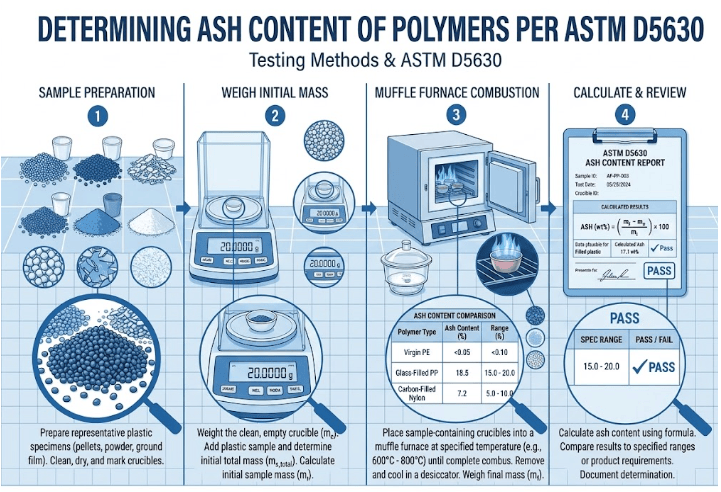
    This standard determines the ash content of plastics by combusting a weighed plastic sample under controlled conditions. The remaining inorganic residue is then cooled and weighed. The complete procedure for the ASTM D5630 test method is as follows-

    Read more

    Specimen PreparationThe plastic specimen is prepared, weighed, and placed in an appropriate container for heating.
    Initial Mass MeasurementThe operator records the initial mass of the plastic specimen before heating.
    Controlled HeatingUnder the specified conditions, technicians heat the specimen to burn off the plastic’s combustible part.
    Residue MeasurementThe operator weighs the remaining ash residue on an analytical balance after it has cooled.
    Result ReportingAsh content is reported as a percentage of the original specimen mass, and the conditions of the test are reported.

    ASTM D5630 Testing Process and Data Collection

    Analysts select representative plastic samples and prepare them for testing. Afterward, the initial mass of the specimen is measured on a calibrated analytical balance. The operator then burns the specimen under controlled conditions until the combustible material is burned out. Technicians measure the mass of the ash residue after cooling under appropriate circumstances. Finally, the mass of the ash is obtained from the mass of the initial specimen and the mass of the residue. Several samples can be tested to determine consistency of the material.

    This image shows a plastic specimen being heated and weighed to determine ash content according to ASTM D5630.
    ASTM D5630 Ash Content Testing of Plastics

    Common Challenges and Troubleshooting

    Representative sampling, accurate weighing, controlled heating, and complete removal of combustibles are all required for accurate ASTM D5630 results. The ash content may be influenced by contamination or by incomplete combustion. Test containers should be cleaned and conditioned by the technician prior to use, and the analytical balance should be checked. Reliable results are also obtained by careful handling and controlled heating of the residue in the laboratory.

    ASTM D5630 Analysis Results and Interpretation

    The report summarizes the ash content of the tested plastic based on the mass of the remaining inorganic residue. The percentage calculated by the laboratories is reported along with the appropriate specimen and test data.

    Read more

    • ASTM D5630 generates the percentage of ash in the original specimen.
    • Ash content is generally expressed as a percentage of mass (%).
    • The higher the percentage of ash, the more inorganic residue will be present.
    • The first specimen mass and final ash mass for calculation is recorded in the laboratories.
    • There are several measurements which can be used to assess material consistency.
    • Laboratories that are consistently heated and weighed accurately yield reliable results.

    Link to ASTM D5630

    FAQ

    Where can I get the astm d5630 tested?
    You can share your astm d5630 testing requirements with MaTestLab. MaTestLab has a vast network of material testing laboratories, spread across the USA and Canada. We support your all material testing needs ranging from specific astm d5630 test to various testing techniques.
    Please contact us for a detailed quote for your astm d5630 testing needs. Cost incurred to carry out different astm d5630 testing methodology depends on the type of raw material; number of samples, coupons, or specimens; test conditions, turn around time etc. Costs of some ASTM testing methods start from $100 and the final value depends upon the factors listed above. Please contact us for the best and latest prices.
    The required number of samples or specimens should comply with the procedure given in the astm d5630 standard. However, the MaTestLab operations team can assist you for your special requirements once you share your testing details with us.
    MaTestLab has a vast testing laboratory network, hence we bring you the best testing facilities in a cost-effective way. We offer considerable discounts (15-20%) to our returning customers based on test volume and frequency.
    The turnaround time for astm d5630 test methodology depends upon the test procedure mentioned in the standard test document. However, we at MaTestLab understand your research requirements and hence try to get your test completed within the least possible time.
    Dr Ruchika Yogesh
    About Author
    Dr Ruchika Yogesh
    Dr. Ruchika Yogesh is an entrepreneur, science and AI/ML enthusiast, medicinal chemistry subject matter expert (SME), scientific/medical copyeditor, and an independent researcher.
    Testimonials
    Real results
    Engineers trust us with what matters most
    Start Your Testing
    Project Today
    Define your requirements and get access to
    specialized laboratories ready to deliver results
    Partners with us
    Clients
    Vendors
    Process for testing
    • STEP 01

      You share your testing requirements

    • STEP 02

      You share your sample(s)

    • STEP 03

      We deliver your test reports

    Get your testing done

    Let us known your testing requirements and we will be right back with a solution.

      Let us root for each other. Collaborate to grow, expand, and accelerate our businesses.

      Partner with us

        Contact Us

        Discover more from MaTestLab

        Subscribe now to keep reading and get access to the full archive.

        Continue reading