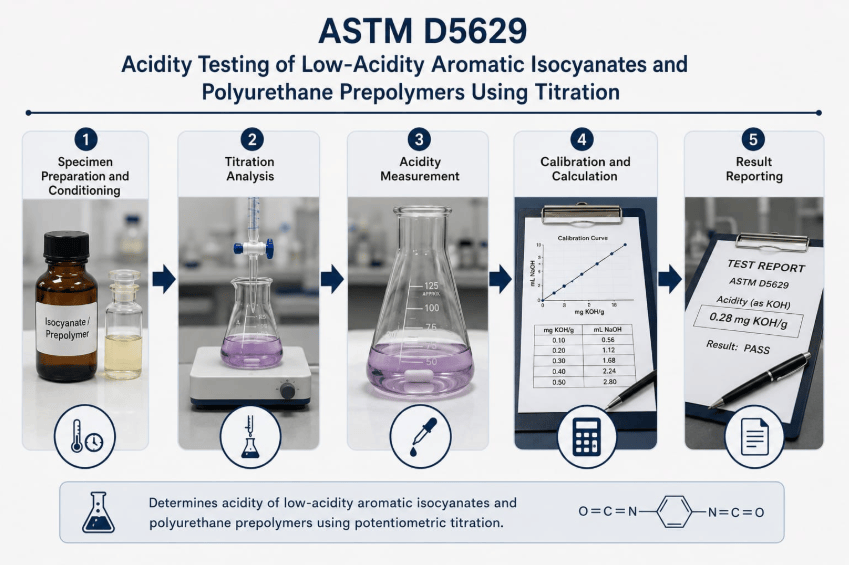
ASTM D5629 test method measures the acidity of low-acidity aromatic isocyanates and polyurethane prepolymers by titration. The standard describes sample preparation, titration, and acidity calculations.The ASTM D25629 standard-
- Analyzes and quantifies acidity in aromatic isocyanates and prepolymers.
- Uses titration methods for quantitative analysis.
- Analyzes materials derived from toluene diisocyanate (TDI) and methylene diphenyl diisocyanate (MDI).
- Applies to materials with acidity below 100 ppm HCl equivalent.
- Uses potentiometric or indicator endpoint detection.
- Provides a consistent approach for laboratories to test the acidity of raw materials used in polyurethane manufacturing.
- Excludes moderate- to high-acidity materials; Test Method D6099 covers these materials.
- Helps laboratories determine the acidity of isocyanate samples.
What are the Uses of ASTM D5629 Testing?
ASTM D5629 is a test used to help laboratories titrate the acidity level of aromatic isocyanates and low-acidic prepolymers. The results help manufacturers and engineers with quality control, material reactivity, and batch-to-batch comparison of isocyanate materials. This standard-
- Measures the acidity in aromatic isocyanates and polyurethane prepolymers.
- Assists in verifying isocyanate material specifications.
- Allows comparison of different isocyanate formulations.
- Helps maintain consistency and quality.
- Helps identify the various states of acidity of isocyanates.
- Assists in the evaluation of the catalytic performance and reaction kinetics.
- Helps evaluate raw materials and finished products of polyurethane systems.
What Materials Can Be Tested Under ASTM D5629?
ASTM D5629 is applicable to low-acid aromatic isocyanates and polyurethane prepolymers that analysts can test by titration. The method is used to test materials from TDI and MDI ranging from trace amounts up to 100 ppm HCl-equivalent acidity. The material that analysts dissolve is compatible with the solvent system. Analysts need to identify the material containing the isocyanate, the likely range of concentration of the acids, and make sure that no other active components in the material will interfere with the titration reading.
Why is ASTM D5629 Important?
ASTM D5629 is a standard titration method for measuring acidity in low-acidity aromatic isocyanates and polyurethane prepolymers. Acidity content can affect reactivity, stability, curing behavior, and the quality of the final polyurethane polymer. Catalysts are sensitive to even small amounts of acid, which can cause inconsistent curing, reduced mechanical properties, and defects in the final polymer. The test results help manufacturers and engineers validate the acidity of isocyanates, compare batches of materials, and make sure that each production batch remains consistent. These results also provide a quantitative measure of the tested isocyanate’s acidity and support process control, quality assurance, and product development.