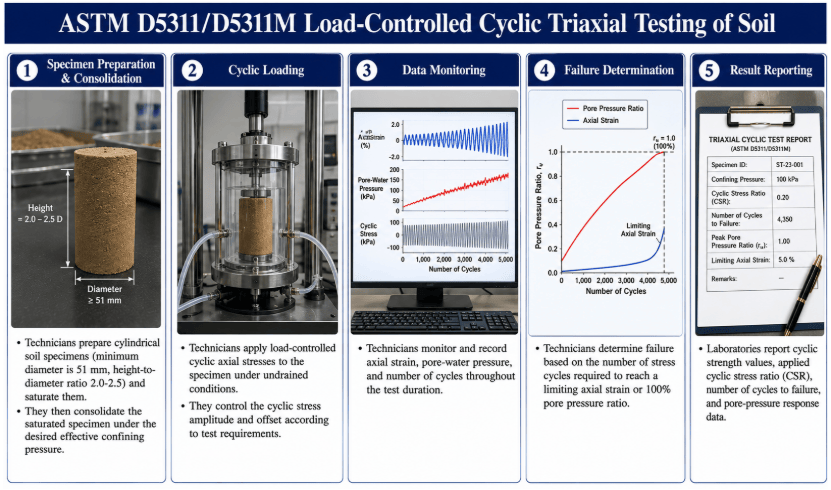
ASTM D5311 specifies load-controlled cyclic undrained triaxial tests for determining the cyclic response of saturated soils in the intact or reconstituted state. The test generally applies to coarser-grained, free-draining soils with relatively high permeability. Technicians measure pore-water pressure at the ends of a specimen for silts, clays, or well-graded materials. The ASTM D5311 standard has scope in-
- Evaluating soil liquefaction potential under cyclic loading.
- Measuring the cyclic strength of saturated soils.
- Measuring the change of pore water in a specimen under cyclic loading.
- Assessing accumulations of strain along the axis of repeated stresses.
- Providing data for seismic stability analysis.
What are the Uses of ASTM D5311Testing?
ASTM D5311 tests help determine soil’s cyclic response to repeated loading. Engineers use the results to determine soil behavior under cyclic loading during earthquakes. This standard-
- Determines the cyclic shear resistance of soils.
- Supplies data to estimate the cyclic behavior of soil.
- Supports assessment of soil dynamic response during an earthquake.
- Assists in comparing cyclic response under various effective confining pressures.
- Describes information related to axial strain and development of excess pore-water pressure.
- Supports laboratory evaluation of cycles of soil behavior.
What Materials Can Be Tested Under ASTM D5311?
This test method applies to saturated soils, either intact or reconstituted. Usually applies to coarser-grained, free-draining soils with relatively high permeability. Technicians measure pore-water pressure at the ends of the specimen when testing well-graded materials, silts, or clays, though the pressure may not be uniform across the specimen. This test is conducted on an isotropically or anisotropically consolidated specimen under different effective confining pressures. Before starting the testing program, an analyst should determine the soil type, consolidation conditions, and cyclic loading parameters.
Why is ASTM D5311 Important?
Cyclic triaxial test results help engineers determine a soil’s resistance to shear stresses caused by earthquakes or other cyclic loading. Many factors influence the cyclic strength of a soil, such as density, effective confining pressure, cyclic applied stress, stress history, soil fabric, age of soil deposit, specimen reconstitution method, etc. Standardized testing provides consistent soil cyclic behavior assessment and aids in seismic design decisions. The standard provides the quality requirements for materials used in geotechnical engineering applications.