
ASTM D5227 Standard Test Method for Measurement of Hexane Extractable Content of Polyolefins

    What is ASTM D5227?

    ASTM D5227 is a standard test method for measuring the extractable hexane content of polyolefin materials. The method determines the amount of material that can be extracted from a representative polyolefin specimen using hexane under specified test conditions. Technicians prepare representative specimens and expose them to the required hexane extraction conditions. After extraction, they separate the extractable material and determine the applicable amount of material removed from the specimen. Analysts use the recorded measurements to calculate the extractable hexane content. ASTM D5227 testing (Standard Test Method for Measurement of Hexane Extractable Content of Polyolefins) provides information about the extractable fraction of applicable polyolefin materials. The results can support material evaluation, product comparison, manufacturing control, and quality-control activities.

    Read more

    Get Certified ASTM D5227 Hexane Extractable Content Testing

    ASTM D5227 testing is useful for polyolefin manufacturers, material suppliers, processors, engineers, and quality-control personnel evaluating the amount of hexane-extractable material in applicable polyolefin samples. Technicians identify and prepare representative specimens and determine the required initial specimen information. The specimens are subjected to the specified hexane extraction procedure under controlled conditions. After extraction, technicians determine the applicable mass measurements required for calculating the extractable content. Analysts review the recorded data and calculate the amount or percentage of hexane-extractable material. The results can help manufacturers compare polyolefin materials, monitor production consistency, evaluate material composition, and support quality-control activities.

    What is the scope of ASTM D5227?

    ASTM D5227 provides a test method for determining the hexane extractable content of applicable polyolefin materials under specified test conditions. The method provides a controlled procedure for extracting and measuring the applicable fraction of material soluble or removable under the specified hexane extraction conditions. The standard covers:

    Read more

    • Polyolefin Materials: Evaluates applicable polyolefin materials for their hexane-extractable content. 
    • Hexane Extraction: Uses specified extraction conditions to separate applicable extractable components from the specimen. 
    • Mass Determination: Determines the amount of extractable material using the required mass measurements. 
    • Extractable Content: Provides information about the amount or proportion of material extracted from the polyolefin specimen. 
    • Material Comparison: Supports comparison of hexane extractable content between applicable materials. 
    • Quality Control: Supports monitoring of material consistency and manufacturing variation. 

    What are the uses of ASTM D5227 testing?

    ASTM D5227 provides information about the hexane-extractable fraction of applicable polyolefin materials. The test helps to:

    • Determine the hexane-extractable content of applicable polyolefins. 
    • Compare extractable content between different materials or grades. 
    • Monitor variations between production batches. 
    • Support evaluation of material composition and consistency. 
    • Assist in quality-control activities. 
    • Support material development and product evaluation. 
    • Help identify changes in manufacturing or processing conditions. 

    Which materials can be tested according to ASTM D5227?

    ASTM D5227 applies to polyolefin materials for which hexane extractable content determination is required. Technicians should verify the material type, specimen condition, and applicable test requirements before testing. The method applies to:

    • Polyolefins: Evaluates applicable polyolefin materials for hexane extractable content. 
    • Different Polyolefin Grades: Supports comparison between applicable material grades. 
    • Polyolefin Formulations: Allows evaluation of differences associated with material composition or formulation. 
    • Production Samples: Supports testing of representative samples from manufacturing or production batches. 

    Why is ASTM D5227 testing important?

    The amount of material extracted from a polyolefin under specified hexane conditions can provide useful information about material composition and consistency. Differences in hexane extractable content may indicate variations in the polymer material, formulation, or manufacturing process. ASTM D5227 provides a standardized procedure for determining the applicable extractable content. The results help manufacturers and engineers compare materials, monitor production consistency, identify variations, and support material evaluation and quality-control activities.

    ASTM D5227 Equipment and Sample Preparation Guide

    Sample IdentificationTechnicians identify the polyolefin material, grade, production batch, and other relevant sample information before testing.
    Specimen PreparationTechnicians prepare representative specimens according to the applicable requirements and avoid contamination or unnecessary material loss.
    Hexane Extraction EquipmentTechnicians use suitable extraction equipment and containers capable of maintaining the required extraction conditions.
    Mass Measurement EquipmentTechnicians use a calibrated analytical balance and suitable drying or conditioning equipment to determine the required specimen or extract mass.

    ASTM D5227 Testing Procedures and Requirements

    Technicians first identify and prepare representative polyolefin specimens according to the applicable requirements. They determine the required initial specimen measurements and expose the specimens to the specified hexane extraction conditions. After the required extraction period, technicians recover or prepare the applicable material for mass determination. Analysts use the recorded measurements to calculate and report the hexane extractable content. The ASTM D5227 testing includes the following steps.

    Read more

    Sample Identification and Specimen PreparationTechnicians identify the polyolefin material and prepare representative specimens according to the applicable requirements.
    Initial Mass DeterminationTechnicians determine the required initial specimen mass using suitable calibrated weighing equipment.
    Hexane ExtractionTechnicians expose the specimen to hexane under the specified extraction conditions.
    Post-Extraction Measurement and Data RecordingTechnicians determine the required post-extraction measurements and record the applicable test information.
    Extractable Content CalculationAnalysts use the required mass measurements to calculate and report the applicable hexane extractable content.

    ASTM D5227 Testing Process and Data Collection

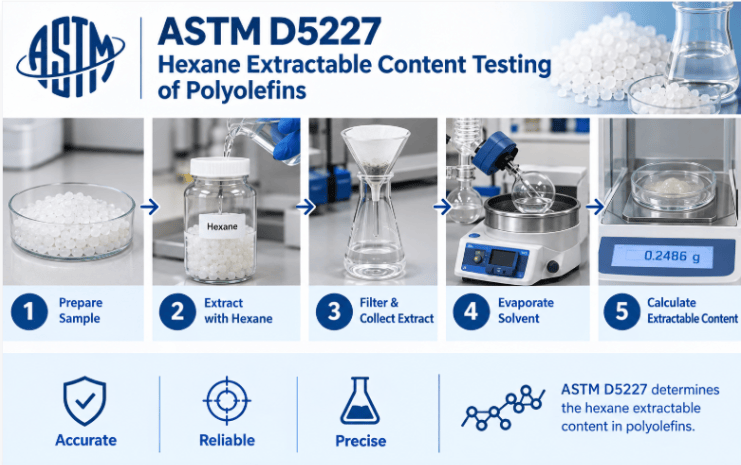
    Technicians determine the material type (polyolefin) and prepare a representative sample. They are able to measure and document the mass of required initial specimens before extraction. Hexane extraction is conducted under the specified conditions on the specified equipment. The required test conditions and duration are maintained during the extraction process by the technicians. Technicians then carry out the necessary steps of recovery, drying, conditioning, or mass determination depending on the procedure required after extraction. They take the necessary mass measurements, record the identification of the specimens, do the extraction, and note the necessary observations. The recorded measurements are analyzed, and it is calculated how much hexane extractable content is in the tested polyolefin material.

    ASTM D5227 testing process showing polyolefin sample identification and preparation, initial specimen mass measurement, controlled hexane extraction, post-extraction mass determination, calculation of hexane extractable content, and recording of test results.
    ASTM D5227 Hexane Extractable Content Testing of Polyolefins

    Common Challenges and Troubleshooting

    ASTM D5227 results may be influenced by sample contamination, measurement of specimen mass, incorrect conditions during extraction, contamination by the solvents used, inadequate extraction, loss of material during handling, improper drying or conditioning, and equipment calibration. Technicians should take representative samples and ensure that the specified extraction conditions are maintained during testing. They need to have appropriate clean equipment and check the weighing equipment calibration prior to making mass measurements. Technicians should check for any discrepancies in their results, including specimen preparation, initial mass determination, extraction parameters, extraction time, solvent parameters, material recovery, drying/conditioning parameters, and calculation techniques.

    Analysis Results and Interpretation

    The report summarizes the hexane extractable content of the tested polyolefin material. It presents the calculated result together with the relevant sample identification, specimen information, mass measurements, extraction conditions, and other required test information.

    Read more

    • ASTM D5227 produces extractable-content-specific results rather than a single general material-property value.
    • Laboratories commonly report hexane extractable content as a percentage by mass (%), or in another unit specified by the selected procedure. Relevant specimen mass measurements may be reported in g or other applicable SI units.
    • The report should contain the following information: identification of polyolefin, specimen data, extraction conditions, extraction time, applicable mass measurements, and calculated hexane extractable content.
    • Technicians and analysts can achieve reliable and comparable results by having well-documented conditions for specimen preparation, extraction, mass measurement, handling of solvents, and calibration of equipment.

    Link to ASTM D5227 

    FAQ

    What does ASTM D5227 measure?
    ASTM D5227 measures the amount of material that is extractable from applicable polyolefin specimens under the specified hexane extraction conditions.
    The method applies to applicable polyolefin materials for which determination of hexane extractable content is required.
    Hexane extractable content can provide information about the composition and consistency of a polyolefin material and can help identify variations between materials or production samples.
    Technicians employ appropriate specimen preparation equipment, controlled hexane extraction equipment, proper drying or conditioning equipment, and calibrated mass-measurement equipment.
    Hexane extractable content is commonly reported as a percentage by mass (%), while specimen mass measurements may be reported in g or other applicable SI units.
    Accurate mass measurements are necessary for calculating the applicable hexane extractable content and obtaining reliable and comparable results.

    Updated on September 8, 2026

    Dr Ruchika Yogesh
    About Author
    Dr. Ruchika Yogesh is a serial entrepreneur, material science and AI/ML enthusiast, medicinal chemistry subject matter expert (SME), scientific/medical copyeditor, and a researcher.
    Know More
    Testimonials
    Real results
    Engineers trust us with what matters most
    Start Your Testing
    Project Today
    Define your requirements and get access to
    specialized laboratories ready to deliver results
    Partners with us
    Clients
    Vendors
    Process for testing
    • STEP 01

      You share your testing requirements

    • STEP 02

      You share your sample(s)

    • STEP 03

      We deliver your test reports

    Get your testing done

    Let us know your testing requirements and we will be right back with a solution.

      Let us root for each other. Collaborate to grow, expand, and accelerate our businesses.

      Partner with us

        Discover more from Matestlab

        Subscribe now to keep reading and get access to the full archive.

        Continue reading