
ASTM D5160 Standard Guide for Gas-Phase Adsorption Testing of Activated Carbon

    What is ASTM D5160?

    ASTM D5160 defines a standard guide for assessing activated carbon’s gas-phase adsorption capacity. The guide explains a procedure for measuring the dynamic adsorption capacity, N0, and critical depth of activated carbon used to remove a given adsorbate from a targeted gas stream under user-selectable conditions. Technicians prepare representative activated carbon samples and expose them to a controlled gas stream containing the selected adsorbate. They monitor the adsorption process and measure the adsorbate’s breakthrough behavior. The procedure is repeated using different quantities of activated carbon to determine the applicable adsorption characteristics. ASTM D5160 testing (Standard Guide for Gas-Phase Adsorption Testing of Activated Carbon) yields data about the gas-phase adsorption capability of activated carbon, and the data may be used in selecting activated carbon, comparing different activated carbons, quality control, and assessing an adsorption system.

    Read more

    Get Certified ASTM D5160 Gas-Phase Adsorption Testing

    ASTM D5160 testing applies to activated carbon manufacturers, providers, engineers, environmental specialists, and quality assurance employees evaluating activated carbon for use in vapor and gas removal. Technicians identify and prepare representative activated carbon samples and establish the selected gas-stream conditions. They introduce the specified adsorbate into the gas stream and pass it through the activated carbon bed under controlled conditions. Analysts use the collected data to determine the applicable dynamic adsorption capacity and critical bed depth. This data helps engineers compare activated carbons and determine their suitability for a specific vapor or gas-removal process.
    What Is the Scope of ASTM D5160?

    ASTM D5160 covers the evaluation of activated carbons for gas-phase adsorption. The guide provides a procedure for determining dynamic adsorption capacity, Nâ‚’, and critical bed depth for activated carbon used to remove a specific adsorbate from a gas stream under conditions selected by the user. The standard covers:

    Read more

    • Gas-Phase Adsorption: Evaluates activated carbon used to remove gases or vapors from gas streams.
    • Dynamic Adsorption Capacity: Determines the adsorption capacity of activated carbon for a selected adsorbate under specified conditions.
    • Critical Bed Depth: Determines the applicable critical depth of the activated carbon bed.
    • Breakthrough Evaluation: Uses breakthrough behavior to evaluate the adsorption performance of the carbon bed.
    • Material Comparison: Supports comparison of activated carbons under relevant operating conditions.
    • Impregnated and Regenerated Carbon: Can also be applied to impregnated, reactivated, or regenerated activated carbons.

    What are the uses of the ASTM D5160 guide?

    ASTM D5160 provides gas-phase adsorption information that helps technical personnel evaluate the performance of activated carbon for a selected application. The guide helps to:

    • Determine the dynamic adsorption capacity of activated carbon.
    • Determine the critical bed depth for a selected adsorbate.
    • Compare activated carbon materials under relevant conditions.
    • Evaluate activated carbon for gas and vapor removal.
    • Support activated carbon selection.
    • Assist in evaluating adsorption-system performance.
    • Support quality control and material evaluation.
    • Provide information useful for adsorption-bed sizing and carbon selection.

    Which materials can be tested according to ASTM D5160?

    ASTM D5160 is for activated carbon materials tested for gas-phase adsorption. Technicians need to confirm the type of carbon, the adsorbate, the parameters of the gas stream, and the test requirements. The guide applies to:

    • Activated Carbon: Evaluates applicable activated carbon used for gas-phase adsorption.
    • Granular or Other Applicable Carbon Forms: Supports evaluation of activated carbon in forms suitable for the selected test arrangement.
    • Impregnated Activated Carbon: Can be used to evaluate applicable carbon treated to improve the removal of certain gases.
    • Reactivated or Regenerated Activated Carbon: Supports evaluation of applicable reactivated or regenerated carbon materials.
    • Production Samples: Allows comparison of representative activated carbon samples from different production batches.

    Why is ASTM D5160 testing important?

    Activated carbon is used extensively to remove gases and vapors from air and other gas streams. The physical and chemical properties of the activated carbon can strongly affect the activated carbon’s ability to absorb a specific adsorbate. ASTM D5160 gives a controlled method of determining the dynamic adsorption properties under the conditions chosen to simulate the application. The outcome can assist engineers in deciding the appropriate activated carbon for adsorption properties and determining the critical activated carbon bed depth. When considering an adsorption system, the pressure drop and adsorption behavior should also be taken into account when comparing carbon materials.

    ASTM D5160 Equipment and Sample Preparation Guide

    Technicians need representative activated carbon samples and suitable equipment for generating the selected gas stream, controlling test conditions, measuring adsorbate breakthrough, and evaluating adsorption performance.

    Read more

    Sample IdentificationTechnicians identify the activated carbon type, particle characteristics, production batch, and other relevant sample information before testing.
    Activated Carbon Bed PreparationTechnicians prepare the required activated carbon bed and establish the specified amount or depth of carbon for testing.
    Gas Stream and Adsorbate PreparationTechnicians prepare the selected gas stream and introduce the required adsorbate concentration under the specified conditions.
    Flow and Measurement EquipmentTechnicians use suitable equipment to control gas flow and monitor adsorbate concentration, breakthrough behavior, temperature, pressure, and other applicable test conditions.

    ASTM D5160 Testing Procedures and Requirements

    Technicians need representative samples of the activated carbon and appropriate test equipment to generate the test gas stream, control the selected test conditions, measure the adsorbate breakthrough, and evaluate the adsorption performance. The ASTM D5160 testing involves the following steps.

    Read more

    Sample Identification and Bed PreparationTechnicians identify the activated carbon and prepare the required carbon bed according to the selected test conditions.
    Gas Stream and Adsorbate PreparationTechnicians establish the required gas flow and adsorbate concentration for the evaluation.
    Adsorption and Breakthrough MonitoringTechnicians pass the gas stream through the activated carbon bed and monitor the adsorbate concentration and breakthrough behavior.
    Data Recording and Result DeterminationAnalysts evaluate the recorded breakthrough data to determine the applicable dynamic adsorption capacity and critical bed depth.

    ASTM D5160 Testing Process and Data Collection

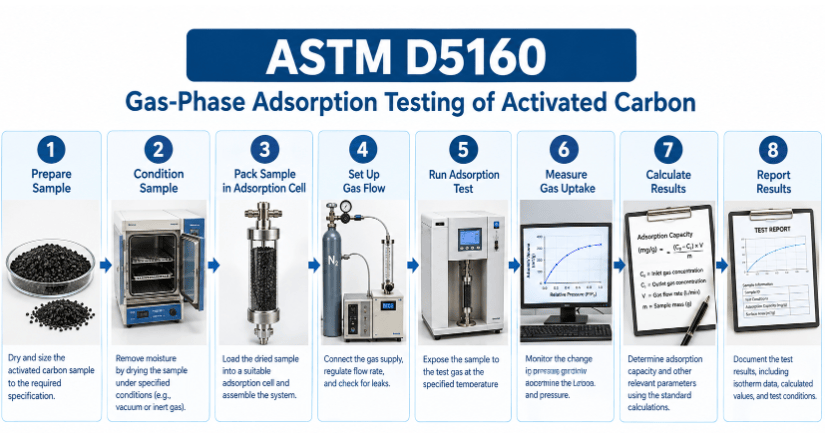
    Technicians start testing by identifying the activated carbon and preparing the required carbon bed. They establish the selected gas-stream conditions, including the applicable flow rate, adsorbate concentration, temperature, pressure, and other relevant parameters. The selected gas stream is passed through the activated carbon bed while technicians monitor the concentration of the adsorbate and determine the applicable breakthrough behavior. The procedure may be repeated with different quantities or bed depths of activated carbon as required for determining the adsorption characteristics. Technicians record the activated carbon information, gas-stream conditions, adsorbate concentration, breakthrough time, bed information, and other applicable observations. Analysts use the recorded measurements to determine the dynamic adsorption capacity and critical bed depth.

    The image shows the testing process for activated carbon sample preparation, packing of an activated carbon adsorption bed, introduction of a controlled gas stream containing an adsorbate, monitoring of adsorbate breakthrough, and determination of dynamic adsorption capacity and critical bed depth.
    ASTM D5160 Gas-Phase Adsorption Testing of Activated Carbon

    Common Challenges and Troubleshooting

    Gas-flow irregularities, inconsistent adsorbate concentration, temperature and pressure fluctuations, humidity fluctuations, improper activation of the carbon bed, breach, errors in measurement, and equipment calibration errors can impact ASTM D5160 results. Technicians should prepare the representative activated carbon bed and carefully maintain the selected test conditions. They should also monitor and verify gas-flow control, adsorbate concentration, temperature, pressure, and the aerosol monitoring equipment before testing. If there are unexpected variations, they should reevaluate the activated carbon sample, carbon bed preparation, gas-stream composition, flow rate, adsorbate concentration, breakthrough measurement, equipment calibration, and other selected test conditions.

    Analysis Results and Interpretation

    The report summarizes the gas-phase adsorption characteristics of the tested activated carbon. It presents the measured adsorption and breakthrough information together with the relevant activated carbon identification, adsorbate information, gas-stream conditions, bed characteristics, and other required test data.

    Read more

    • ASTM D5160 produces adsorption-specific results rather than a single overall material-property value.
    • Laboratories often report dynamic adsorption capacity (Nâ‚’) using the applicable SI-based mass or concentration relationship specified by the selected procedure, while critical bed depth is reported as a length in an SI unit, such as m or mm, as applicable.
    • The report should include applicable test conditions such as gas flow rate, adsorbate concentration, temperature in °C, pressure in Pa or kPa, relative humidity in %, breakthrough time in s or min, and activated carbon bed dimensions in applicable SI units.
    • Consistent carbon-bed preparation, controlled gas-stream conditions, accurate breakthrough measurement, and suitable calibrated equipment help technicians and analysts produce reliable and comparable results.

    Link to ASTM D5160

    FAQ

    What does ASTM D5160 measure?
    ASTM D5160 evaluates activated carbon for gas-phase adsorption and provides procedures for determining dynamic adsorption capacity and critical bed depth for a selected adsorbate.
    Dynamic adsorption capacity describes the adsorption capacity of activated carbon under the selected gas-flow and operating conditions.
    Critical bed depth is an adsorption-bed parameter determined from the applicable test data and can assist in evaluating the effectiveness of activated carbon for the selected application.
    The guide applies to activated carbons evaluated for gas-phase adsorption, including certain impregnated, reactivated, or regenerated activated carbons.
    Breakthrough monitoring provides information about when the selected adsorbate begins to appear at the outlet of the activated carbon bed at the specified concentration, helping technicians evaluate adsorption performance.
    ASTM D5160 specifies SI units as the standard units of measurement, so applicable test conditions and results should be recorded and reported using the required SI units.
    Rohit Dhembare
    About Author
    Rohit Dhembare
    Rohit Dhembare is an Operations Associate at MaTestLab Inc. and holds a postgraduate degree in Organic Chemistry.
    Testimonials
    Real results
    Engineers trust us with what matters most
    Start Your Testing
    Project Today
    Define your requirements and get access to
    specialized laboratories ready to deliver results
    Partners with us
    Clients
    Vendors
    Process for testing
    • STEP 01

      You share your testing requirements

    • STEP 02

      You share your sample(s)

    • STEP 03

      We deliver your test reports

    Get your testing done

    Let us known your testing requirements and we will be right back with a solution.

      Let us root for each other. Collaborate to grow, expand, and accelerate our businesses.

      Partner with us

        Contact Us

        Discover more from Matestlab Inc

        Subscribe now to keep reading and get access to the full archive.

        Continue reading