ASTM D4754 Standard Test Method for Two-Sided Liquid Extraction of Plastic Materials Using FDA Migration Cell

    What is ASTM D4754?

    ASTM D4754 describes a two-sided liquid extraction method for determining individual migrants from plastic materials using an FDA migration cell. The method exposes both surfaces of a plastic specimen to a suitable extracting liquid, including liquid foods and food-simulating solvents, and supports quantitative analysis of released migrants. ASTM D4754 (Standard Test Method for Two-Sided Liquid Extraction of Plastic Materials Using FDA Migration Cell) applies to plastic films, sheets, and disks, and technicians use the resulting migration data for material evaluation and food-contact-related studies. Engineers and manufacturers support these evaluations through polymer and plastics testing services. 

    Read more

    Get Certified ASTM D4754 Testing for Reliable Plastic Migration Data

    When plastic materials come into contact with liquids under controlled circumstances, specific components may be released. In order to provide repeatable migration data that supports studies pertaining to food-contact materials, ASTM D4754 employs a two-sided extraction setup that exposes both surfaces of a plastic specimen to an extracting liquid and collects aliquots for further analysis. 

    What is the Scope of the ASTM D4754 Test Standard?

    ASTM D4754 covers the use of an FDA migration cell to extract and quantify individual migrants from plastic materials using suitable extracting liquids. The method applies to plastic materials that technicians can form into films, sheets, or disks, and it uses two-sided liquid extraction, which means it may not suit multilayer plastics intended for single-sided food contact. This standard-

    Read more

    • Uses an FDA migration cell for two-sided liquid extraction of plastic materials.
    • Quantifies individual migrants released from plastic specimens.
    • Applies to plastic materials formed as films, sheets, or disks.
    • Uses suitable extracting liquids, including liquid foods and food-simulating solvents.
    • Evaluates migrant/polymer systems under controlled extraction conditions.
    • Supports migration studies involving food-contact plastic materials.
    • Provides reproducible results under appropriate conditions used for migration testing.
    • Requires an analytical procedure capable of quantifying the migrant generated during extraction.
    • Excludes reliable use for multilayer plastics intended for single-sided food contact, since the method exposes both sides.
    • Limits total nonvolatile extractives determination in some cases because of the FDA migration cell size.

    What are the Uses of ASTM D4754 Testing?

    ASTM D4754 testing helps laboratories and manufacturers obtain migration data from plastic materials under controlled liquid-extraction conditions. The results can support evaluations related to food-contact applications and provide quantitative information about individual migrants released from the tested plastic. This standard:

    • Evaluates the migration of individual components from plastic materials.
    • Quantifies selected migrants in extraction liquids.
    • Supports food-contact material evaluations.
    • Generates migration data for different migrant/polymer systems.
    • Assists research involving plastic materials and food simulants.
    • Helps manufacturers evaluate potential migrant release from plastic materials.
    • Informs regulatory evaluations when the appropriate analytical procedures and regulatory criteria apply. 

    Which Materials Can Be Tested Under ASTM D4754?

    ASTM D4754 applies to plastic materials that can be formed into films, sheets, or disks for two-sided liquid extraction. The standard also identifies pellets, powders, and, in some cases, actual end-use articles as suitable sample forms for selecting representative material. Technicians prepare the test specimens as round disks for the migration cell, covering plastic films, sheets, disks, pellets, and powders once formed into suitable test specimens, along with plastic taken from actual end-use articles when appropriate. 

    Why is ASTM D4754 Important?

    ASTM D4754 provides a controlled approach for extracting and quantifying individual migrants from plastic materials. The method places prepared plastic disks in an FDA migration cell, exposes the specimens to a selected extraction liquid at a controlled temperature, and lets analysts determine the migrant concentration in collected liquid aliquots, generating comparable migration data for suitable plastic and migrant systems. 

    ASTM D4754 Equipment and Sample Preparation Guide

    ASTM D4754 uses an FDA migration cell and related apparatus to maintain the extraction conditions and collect liquid for analytical evaluation. For the migration-cell setup, the standard calls for 23-mL glass vials, Mininert slide-valve caps, stainless-steel wire, 5-mm glass beads, and a hot-air oven or static thermostatted water bath capable of maintaining the chosen extraction temperature within ±1°C. 

    Read more

    Sample and Specimen DetailsTechnicians select representative plastic samples and prepare round disk specimens for two-sided extraction.
    Specimen PreparationTechnicians prepare round plastic disks measuring 11 mm in diameter × 1 mm thick using suitable cutting, pressing, or forming techniques.
    Specimen ArrangementTechnicians alternate plastic disks and glass-bead spacers on stainless-steel wire, then place the assembly into the migration vial.
    InstrumentationThe test uses an FDA migration cell, 23-mL glass vials, Mininert slide-valve caps, stainless-steel wire, 5-mm glass beads, a thermostatted oven or water bath, liquid syringes, and analytical instrumentation appropriate for the selected migrant.

    Testing Procedures and Requirements for ASTM D4754

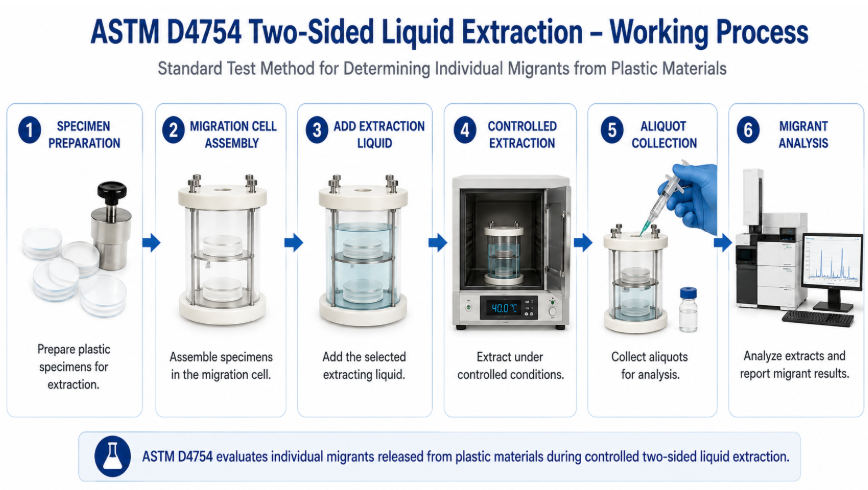
    STM D4754 places prepared plastic specimens in a migration-cell arrangement, adds the selected extraction liquid, maintains the vials at the desired extraction temperature, and removes liquid aliquots for migrant analysis. The ASTM D4754 testing procedure comprises the following steps-

    Read more

    Sample PreparationTechnicians select representative plastic material and prepare the required disk specimens.
    Migration Cell AssemblyTechnicians alternate plastic disks and glass-bead spacers on stainless-steel wire and place the assembly in the glass vial.
    Extraction Liquid AdditionTechnicians add the selected extraction liquid to the vial and secure the Mininert cap. The described setup uses 22 mL of extraction liquid in a 23-mL vial.
    Temperature-Controlled ExtractionTechnicians maintain the prepared vials at the selected extraction temperature in a thermostatted oven or bath.
    Aliquot CollectionAnalysts remove liquid aliquots from the migration cells at selected times to determine migrants.
    Migrant AnalysisAnalysts determine the selected migrant using an appropriate analytical procedure and quantify the amount present in the extraction liquid. 

    ASTM D4754 Testing Process and Data Collection

    The analyst first selects representative plastic material and prepares the required disk specimens. Technicians arrange the disks with glass-bead spacers inside the migration cell and add the selected extraction liquid. The prepared cells then remain at the selected extraction temperature while analysts collect liquid aliquots at appropriate intervals. The analytical method determines the selected migrant in each aliquot, and analysts use the resulting measurements to characterize migration from the plastic material. 

    The image shows the ASTM D4754 testing procedure for two-sided liquid extraction of plastic materials, which includes aliquot collection, controlled liquid extraction, migration-cell assembly, specimen preparation, and migrant analysis.
    ASTM D4754 Two-Sided Liquid Extraction of Plastic Materials Using FDA Migration Cell

    Common Challenges and Troubleshooting

    ASTM D4754 requires clean specimen preparation, regulated extraction conditions, representative sampling, and suitable analytical measurement, which are all necessary for accurate results. Temperature fluctuations can affect extraction behavior, whereas surface pollution or migratory bloom can impact migration results. When testing material from real end-use items, analysts should additionally take specimen edges into account. Technicians should take migrant volatility into consideration while choosing extraction conditions because testing over 50°C for longer than two weeks may result in significant migration loss through volatility. 

    ASTM D4754 Analysis Results and Interpretation

    ASTM D4754 does not prescribe one universal analytical technique or one universal reporting unit for every migrant. Instead, analysts use an analytical procedure suitable for the migrant generated during extraction, and the standard requires that procedure to quantify the migrant in the extraction liquid. Results can include: 

    Read more

    • The laboratory reports the migrant concentration in mg/L or µg/L, depending on the analytical method used.
    • The analyst reports migration normalized to the exposed surface area, when required, in mg/cm² or µg/cm².
    • The technician records the exposure duration and extraction temperature in hours (h) and degrees Celsius (°C), respectively.
    • Engineers record the specimen dimensions and extraction-liquid volume in millimeters (mm) and milliliters (mL), respectively.

    Link to ASTMD4754

    FAQ

    What is ASTM D4754 used for?
    ASTM D4754 evaluates individual migrants extracted from plastic materials using an FDA migration cell and suitable extracting liquids, most often to study how a plastic behaves in contact with food or food-simulating solvents.
    The method uses round plastic disks, with the specimen size measuring 11 mm in diameter × 1 mm thick, threaded onto stainless-steel wire with alternating glass-bead spacers inside the migration vial.
    ASTM D4754 uses two-sided liquid extraction, exposing both surfaces of the plastic specimen to the extraction liquid inside a sealed 23-mL glass vial held at a controlled temperature.

    Updated on September 2, 2026

    Dr Ruchika Yogesh
    About Author
    Dr. Ruchika Yogesh is a serial entrepreneur, material science and AI/ML enthusiast, medicinal chemistry subject matter expert (SME), scientific/medical copyeditor, and a researcher.
    Know More
    Testimonials
    Real results
    Engineers trust us with what matters most
    Why Choose Matestlab?
    Matestlab is a unified testing services partner based in the USA. Matestlab offers raw material and product testing services through accredited, expert laboratories primarily based in the USA. Matestlab supports physical, thermal, chemical, electrical, mechanical, environmental, and characterization testing needs through its global network of 2200+ accredited testing laboratories. Matestlab's in-house materials science experts curate and design comprehensive testing programs matched to the sample material and specific testing need, with regulatory requirements and confidentiality in mind.

    If you are looking for a managed and trusted testing partner to achieve your research goals, feel free to schedule a meeting with us or send us a request at connect@matestlabs.com to learn more about our services. For a quick quote, call us at (302)244-7710. We are happy to serve you.
    Start Your Testing
    Project Today
    Define your requirements and get access to
    specialized laboratories ready to deliver results
    Partners with us
    Clients
    Vendors
    Process for testing
    • STEP 01

      You share your testing requirements

    • STEP 02

      You share your sample(s)

    • STEP 03

      We deliver your test reports

    Get your testing done

    Let us know your testing requirements and we will be right back with a solution.

      Let us root for each other. Collaborate to grow, expand, and accelerate our businesses.

      Partner with us