ASTM D4671 Standard Test Method for Polyurethane Raw Materials: Determination of Unsaturation of Polyols

    What is ASTM D4671?

    ASTM D4671 is the standard test method for measuring the degree of unsaturation in polyether polyols used to manufacture polyurethane. In base-catalyzed propoxylation, small quantities of allyl-ether (mono-functional) species are also formed, and ASTM D4671 measures unsaturated groups by the titration of mercuric acetate. ASTM D4671 (Standard Test Method for Polyurethane Raw Materials: Determination of Unsaturation of Polyols) is run to assist polyol QC, incoming material acceptance, and development of flexible foam, rigid foam, elastomers, and CASE (coatings, adhesives, sealants and elastomers) polyurethane systems. The unsaturation value is then calculated using titration values for the sample before and after the reaction with mercuric acetate, and compared with the desired value.

    Read more

    Get Certified ASTM D4671 Testing for Reliable Polyol Quality Control 

    Unsaturated (mono-ol) species lower the average functionality and molecular weight of a polyol batch while broadening the molecular-weight distribution, which changes network crosslink density, cure behavior, and mechanical performance in the finished polyurethane. ASTM D4671 gives formulators and quality teams a controlled, repeatable titration procedure to detect and quantify these species. Laboratories that run polymer material testing programs use ASTM D4671 results to accept or reject incoming polyol lots, compare suppliers, and support new-grade development.

    What is the Scope of the ASTM D4671 Test Standard? 

    ASTM D4671 measures the unsaturation content of polyether polyols in milliequivalents of unsaturation per gram (meq/g). The standard covers two titration procedures, and an analyst picks one based on the expected unsaturation level and the available sample size. The ASTM D4671 standard-

    Read more

    • Uses Test Method A, the High-Volume Reagent Method, with about 50 mL of 0.1 M mercuric acetate reagent in methanol and a sample of 15 g or more, read to a colorimetric indicator endpoint.
    • Recommends Test Method A for polyols with unsaturation below 0.01 meq/g, where a larger sample improves measurement sensitivity.
    • Uses Test Method B, the Low-Volume Reagent Method, with about 2 mL of 0.05 M mercuric acetate reagent in methanol and a sample of 1 g or less, read to a potentiometric endpoint.
    • Reports unsaturation in milliequivalents per gram (meq/g).
    • Applies to polyether polyols used as polyurethane raw materials.
    • Provides comparative, quantitative data for evaluating unsaturation across polyol samples.

    What are the Uses of ASTM D4671 Testing? 

    ASTM D4671 testing helps manufacturers and analysts to evaluate unsaturation in polyether polyols. The results support quality control, material comparison, specification evaluation, and research involving polyurethane raw materials. 

    • Determines the concentration of allyl-ether and other unsaturated species in a polyol sample.
    • Supports incoming raw-material inspection for polyurethane manufacturers.
    • Helps suppliers and buyers compare polyol batches and grades against a specification limit. 
    • Confirms whether a polyol batch meets the low-unsaturation requirements of high-performance flexible foam or elastomer formulations. 
    • Supports troubleshooting when a polyurethane product turns out unexpectedly soft, cures poorly, or shows inconsistent mechanical properties. 
    • Helps research chemists study how catalyst selection and process conditions affect polyol side-reaction chemistry. 

    Which materials can be tested under ASTM D4671? 

    ASTM D4671 applies to polyether polyols manufactured for use in polyurethane systems, including polyols intended for flexible foam, rigid foam, elastomer, and CASE applications. The method uses liquid polyol samples that a technician can weigh and dissolve directly into the mercuric acetate reagent. Before starting, a chemist picks Test Method A or B based on the polyol’s expected unsaturation range and how much sample is available. 

    Why is ASTM D4671 Important? 

    ASTM D4671 gives the polyurethane industry a standardized way to track a property that directly shapes finished-product performance. Unsaturated mono-ol species break up the crosslink network, and even a small rise in unsaturation can soften a foam, weaken an elastomer’s tensile strength, or slow the cure. The test lets suppliers certify batches against a numeric limit and lets manufacturers confirm incoming material meets that same limit before it reaches production. 

    ASTM D4671 Equipment and Sample Preparation Guide 

    ASTM D4671 requires wet-chemistry titration equipment and the mercuric acetate reagent system for the selected test method. A representative polyol sample is prepared, and the quantity of sample is selected according to the procedure applied.

    Read more

    Sample and Specimen DetailsTechnicians test liquid polyether polyol samples representative of the production batch or incoming shipment under evaluation.
    Specimen PreparationA chemist weighs the polyol sample directly into a titration flask, adds the mercuric acetate reagent, and allows the reaction to proceed for the time specified in the method before titration.
    Specimen DimensionsThe chemist selects about 15 g or more of sample for Test Method A or about 1 g or less for Test Method B, based on the polyol’s expected unsaturation level. 
    InstrumentationThe test uses a mercuric acetate reagent system in methanol, a standardized sodium methoxide titrant, a burette or automatic titrator, a potentiometric electrode assembly for Test Method B, and a colorimetric indicator for Test Method A.

    Testing Procedures and Requirements for ASTM D4671

    ASTM D4671 follows a titration sequence in which the polyol sample reacts with the mercuric acetate reagent before the chemist titrates the liberated acid to an endpoint. The ASTM D2565 test methods comprise the following test procedure-

    Read more

    Sample SelectionThe chemist selects Test Method A or Test Method B according to the polyol’s expected unsaturation level and the available sample mass.
    Reagent AdditionThe chemist adds mercuric acetate reagent in methanol to the weighed polyol sample and lets the mixture react for the specified time.
    Acid LiberationThe reaction releases acetic acid in an amount proportional to the polyol’s unsaturated (allyl-ether) content. 
    TitrationThe chemist titrates the liberated acid with standardized sodium methoxide solution to a colorimetric indicator endpoint (Method A) or a potentiometric endpoint (Method B).
    CalculationThe chemist calculates the unsaturation value in meq/g from the titrant volume, titrant normality, and sample mass.
    Result ReportingThe analyst reports the unsaturation value, the test method used (A or B), and the applicable sample information.

    ASTM D4671 Testing Process and Data Collection

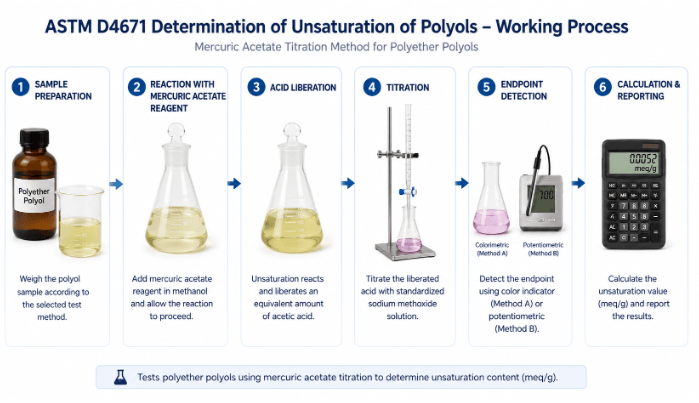
    A chemist takes a representative sample of the polyol, determines the test method for the type of unsaturation they expect, weighs the sample, drips in the mercuric acetate reagent, and allows the reaction to proceed for the indicated time. The chemist then titrates the liberated acid with standard sodium methoxide solution and notes the volume of the titrant used at the endpoint. Finally, the chemist determines the unsaturation value in meq/g and compares it to the specification limit or to past data.

    This image shows the ASTM D4671 testing process for determining unsaturation in polyether polyols, showing sample preparation, mercuric acetate reaction, acid liberation, titration, endpoint detection, and final calculation and reporting. 
    ASTM D4671 Unsaturation Titration Sequence for Polyether Polyols 

    Common Challenges and Troubleshooting 

    The accuracy of ASTM D4671 results is dependent on reagent standardization, a uniform reaction time, and clean endpoint determination. Moisture in the sample or reagent may affect the titration and skew results toward higher apparent unsaturations. The sodium methoxide titrant is standardized regularly, and the performance of the electrodes and indicator is checked prior to each titration series to ensure the results are accurate and repeatable.

    ASTM D4671 Analysis Results and Interpretation 

    The report expresses the tested polyol’s unsaturation content relative to the applicable specification or comparison batch.

    Read more

    • The analyst reports the unsaturation value in milliequivalents per gram (meq/g), the SI unit specified by the standard.
    • The report identifies which test method (A or B) generated the result, since the two procedures apply to different unsaturation ranges.
    • The report compares the measured value against a supplier specification limit, an internal quality-control target, or a prior batch result, rather than assigning a single pass/fail grade independent of the intended application. 

    FAQs

     What is ASTM D4671 used for?

    ASTM D4671 measures the unsaturation content of polyether polyols so suppliers and manufacturers can verify polyol quality for polyurethane production. 

    What does ASTM D4671 measure? 

    The test measures unsaturated (allyl-ether) species in a polyol sample and reports the result in milliequivalents per gram (meq/g).

    Which test method should a lab choose under ASTM D4671? 

    A lab chooses Test Method A for polyols with unsaturation below 0.01 meq/g and a larger available sample, or Test Method B for smaller samples with a potentiometric endpoint.

    Is ASTM D4671 limited to one polyol type? 

    ASTM D4671 applies to polyether polyols used in polyurethane foam, elastomer, and CASE systems; it does not cover polyester polyols.

    Link to ASTM D4671

    FAQ

    Where can I get the astm d4671 tested?
    You can share your astm d4671 testing requirements with MaTestLab. MaTestLab has a vast network of material testing laboratories, spread across the USA and Canada. We support your all material testing needs ranging from specific astm d4671 test to various testing techniques.
    Please contact us for a detailed quote for your astm d4671 testing needs. Cost incurred to carry out different astm d4671 testing methodology depends on the type of raw material; number of samples, coupons, or specimens; test conditions, turn around time etc. Costs of some ASTM testing methods start from $100 and the final value depends upon the factors listed above. Please contact us for the best and latest prices.
    The required number of samples or specimens should comply with the procedure given in the astm d4671 standard. However, the MaTestLab operations team can assist you for your special requirements once you share your testing details with us.
    MaTestLab has a vast testing laboratory network, hence we bring you the best testing facilities in a cost-effective way. We offer considerable discounts (15-20%) to our returning customers based on test volume and frequency.
    The turnaround time for astm d4671 test methodology depends upon the test procedure mentioned in the standard test document. However, we at MaTestLab understand your research requirements and hence try to get your test completed within the least possible time.
    Rohit Dhembare
    About Author
    Rohit Dhembare
    Rohit Dhembare is an Operations Associate at MaTestLab Inc. and holds a postgraduate degree in Organic Chemistry.
    Testimonials
    Real results
    Engineers trust us with what matters most
    Start Your Testing
    Project Today
    Define your requirements and get access to
    specialized laboratories ready to deliver results
    Partners with us
    Clients
    Vendors
    Process for testing
    • STEP 01

      You share your testing requirements

    • STEP 02

      You share your sample(s)

    • STEP 03

      We deliver your test reports

    Get your testing done

    Let us known your testing requirements and we will be right back with a solution.

      Let us root for each other. Collaborate to grow, expand, and accelerate our businesses.

      Partner with us

        Contact Us

        Discover more from MaTestLab

        Subscribe now to keep reading and get access to the full archive.

        Continue reading