
ASTM D4669 Standard Test Method for Polyurethane Raw Materials: Determination of Specific Gravity of Polyols

    What is ASTM D4669?

    ASTM D4669 is a set of standardized procedures for measuring the specific gravity of polyols utilized as polyurethane raw materials. Specific gravity indicates the density properties of a polyol by categorizing a ratio of its density to the density of the reference material at a specified set of test conditions. Technicians prepare a representative polyol sample and determine the required mass or density measurements using suitable equipment. The recorded measurements are used to calculate the specific gravity of the material according to the applicable procedure. ASTM D4669 testing(Standard Test Method for Polyurethane Raw Materials: Determination of Specific Gravity of Polyols) provides specific-gravity information that can support material identification, production monitoring, material comparison, quality control, and evaluation of polyurethane raw materials.

    Read more

    Get Certified ASTM D4669 Specific Gravity Testing of Polyols

    ASTM D4669 testing is useful for polyurethane manufacturers, polyol suppliers, material producers, engineers, and quality-control personnel evaluating the specific gravity of applicable polyol materials. Technicians identify and prepare representative polyol samples and perform the required measurements under controlled conditions. They maintain the applicable test temperature and use suitable calibrated equipment to determine the required density or mass information. Analysts review the recorded data and then determine the applicable specific gravity value. The outcomes assist manufacturers in cross-comparing materials, monitoring consistency of production, detecting batch-to-batch variations, and conducting quality-control checks.
    What is the scope of ASTM D4669?

    ASTM D4669 provides a test method for the evaluation of the specific gravity of applicable polyols utilized as polyurethane raw materials. The test method directs technicians in sample preparation, adherence to test conditions, and the determination of applicable specific gravity values. The standard covers-

    Read more

    • Specific Gravity Determination: Determines the specific gravity of applicable polyol materials.
    • Polyol Evaluation: Supports the evaluation of density characteristics of polyurethane raw materials.
    • Controlled Test Conditions: Requires appropriate sample handling and controlled measurement conditions.
    • Material Comparison: Helps compare specific gravity values between applicable polyol samples.
    • Quality Control: Supports monitoring of material consistency and production variations.

    What are the uses of ASTM D4669 testing?

    ASTM D4669 provides specific-gravity information that helps manufacturers and technical personnel evaluate applicable polyol materials. The test helps to-

    • Determine the specific gravity of applicable polyols.
    • Compare density characteristics between polyol materials.
    • Monitor consistency between production batches.
    • Identify variations in material composition or processing.
    • Support raw-material quality control.
    • Assist in material comparison and evaluation.
    • Support polyurethane manufacturing and product-development activities.

    Which materials can be tested according to ASTM D4669?

    ASTM D4669 applies to polyol materials for which specific-gravity determination is required. Technicians should verify the material type, sample condition, and applicable test requirements before testing. The method applies to:

    • Polyols: Evaluates applicable polyol materials used as polyurethane raw materials.
    • Polyurethane Raw Materials: Supports physical-property evaluation of applicable materials used in polyurethane production.
    • Different Polyol Grades: Allows comparison of applicable polyol grades and formulations.
    • Production Samples: Supports testing of representative samples from manufacturing or production batches.

    Why is ASTM D4669 testing important?

    Specific gravity allows an engineer to evaluate physical characteristics and properties of polyol additives. Deviations in specific gravity could be a sign of composition variances, formulation errors, temperature deviation, or other production indicators. ASTM D4669 introduces a standardized methodology for measuring the specific gravity of applicable polyols. Cross-compared materials can be evaluated for batch-to-batch differences and quality-control reasons. 

    ASTM D4669 Equipment and Sample Preparation Guide

    Engineers need representative polyol samples and suitable, calibrated equipment to prepare the sample and determine its specific gravity under the applicable test conditions.

    Read more

    Sample IdentificationTechnicians identify the polyol material, grade, production batch, and other relevant sample information before testing.
    Sample PreparationTechnicians prepare a representative polyol sample according to the applicable test requirements and avoid contamination, air bubbles, or other conditions that could affect the measurement.
    Temperature ControlTechnicians maintain the required sample and measurement temperature because temperature can influence density and specific gravity.
    Specific Gravity Measurement EquipmentTechnicians use suitable, calibrated equipment to determine the mass or density measurements used to calculate specific gravity.

    ASTM D4669 Testing Procedures and Requirements

    Technicians first identify and prepare a representative polyol sample according to the applicable requirements. They prepare the measurement equipment and establish the required temperature conditions before determining the specific gravity of the sample. The ASTM D4669 testing process includes the following steps. 

    Read more

    Sample Identification and PreparationTechnicians identify the polyol material and prepare a representative sample according to the applicable requirements.
    Temperature Control and Equipment PreparationTechnicians prepare the required measurement equipment and maintain the specified test temperature.
    Specific Gravity Measurement and Data RecordingAnalysts determine the required mass or density measurements and record the applicable sample and test information.
    Specific Gravity Calculation and Result EvaluationAnalysts use the recorded measurements to calculate and report the applicable specific gravity result.

    ASTM D4669 Testing Process and Data Collection

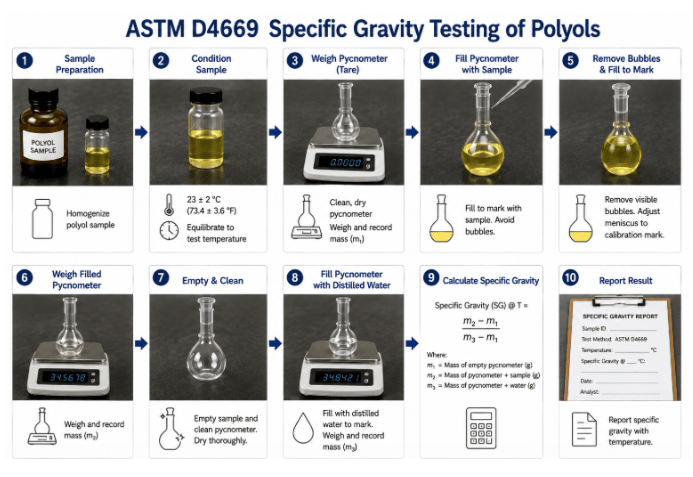
    The first step in the testing process is identifying the polyol material technicians should begin with and preparing a composite sample for testing. They check the sample and make sure that no contamination, air bubbles, or other factors that might affect the measurement are present. The technician sets up the necessary measurement equipment and adjusts the appropriate temperature. A mass/density measurement is then made to the desired level based on the chosen procedure. Technicians document sample identification, measurement values, test temperature, and other pertinent test information. The recorded data is analyzed, and the specific gravity of the tested polyol material is calculated.

    ASTM D4669 testing process showing polyol sample identification and preparation, controlled temperature conditioning, specific gravity measurement using suitable calibrated equipment, data recording, and calculation of the specific gravity result.
    ASTM D4669 Specific Gravity Testing of Polyols

    Common Challenges and Troubleshooting

    Variations in test results are caused by departures from the normal test temperature, contamination of samples with foreign matter, air bubbles, inability to correctly read the weight, improper handling of equipment, an excessive amount of light or dark system temperature, and errors in the calibration of the equipment. They are supposed to keep the temperature, and before testing, they should make sure the condition and calibration of the measuring instruments are correct. The technician should check the condition of the samples, temperature, measurement method, the calibration of the measuring device, air bubbles, and recorded measurements if the result has not been obtained as expected.

    Analysis Results and Interpretation

    The report summarizes the specific gravity characteristics of the tested polyol material. It presents the measured values together with the relevant sample identification, material information, test temperature, measurement conditions, and other required test information.

    Read more

    • ASTM D4669 produces specific-gravity results rather than a single strength or performance value.
    • Laboratories typically report specific gravity as a dimensionless value, since it represents the ratio of the density of the tested material to the density of the applicable reference material under specified conditions.
    • The report should contain the respective test temperature with Celsius measurements and other necessary measurement data. 
    • Consistent sample preparation, proper equipment handling, measured data, correct system temperature, and calibrated equipment produce trustworthy and accurate data.

    FAQs

    What does ASTM D4669 measure?

    ASTM D4669 establishes the specific gravity of applicable polyols used as polyurethane raw materials.

    What is specific gravity?

    Specific gravity is a dimensionless ratio that compares the density of a material with the density of an applicable reference material under specified conditions.

    Why is temperature important in specific gravity testing?

    The density of liquid materials can change with temperature. Maintaining the specified test temperature helps technicians obtain consistent and comparable specific-gravity results.

    What units are used for ASTM D4669 results?

    Specific gravity is reported as a dimensionless value. The applicable test temperature is generally recorded in °C according to the selected procedure.

    Link to ASTM D4669

    FAQ

    Where can I get the astm d4669 tested?
    You can share your astm d4669 testing requirements with MaTestLab. MaTestLab has a vast network of material testing laboratories, spread across the USA and Canada. We support your all material testing needs ranging from specific astm d4669 test to various testing techniques.
    Please contact us for a detailed quote for your astm d4669 testing needs. Cost incurred to carry out different astm d4669 testing methodology depends on the type of raw material; number of samples, coupons, or specimens; test conditions, turn around time etc. Costs of some ASTM testing methods start from $100 and the final value depends upon the factors listed above. Please contact us for the best and latest prices.
    The required number of samples or specimens should comply with the procedure given in the astm d4669 standard. However, the MaTestLab operations team can assist you for your special requirements once you share your testing details with us.
    MaTestLab has a vast testing laboratory network, hence we bring you the best testing facilities in a cost-effective way. We offer considerable discounts (15-20%) to our returning customers based on test volume and frequency.
    The turnaround time for astm d4669 test methodology depends upon the test procedure mentioned in the standard test document. However, we at MaTestLab understand your research requirements and hence try to get your test completed within the least possible time.
    Rohit Dhembare
    About Author
    Rohit Dhembare
    Rohit Dhembare is an Operations Associate at MaTestLab Inc. and holds a postgraduate degree in Organic Chemistry.
    Testimonials
    Real results
    Engineers trust us with what matters most
    Start Your Testing
    Project Today
    Define your requirements and get access to
    specialized laboratories ready to deliver results
    Partners with us
    Clients
    Vendors
    Process for testing
    • STEP 01

      You share your testing requirements

    • STEP 02

      You share your sample(s)

    • STEP 03

      We deliver your test reports

    Get your testing done

    Let us known your testing requirements and we will be right back with a solution.

      Let us root for each other. Collaborate to grow, expand, and accelerate our businesses.

      Partner with us

        Contact Us

        Discover more from MaTestLab

        Subscribe now to keep reading and get access to the full archive.

        Continue reading