
ASTM D4661 Standard Test Methods for Polyurethane Raw Materials: Determination of Total Chlorine in Isocyanates

    What is ASTM D4661?

    ASTM D4661 is a standard test method for determining the total chlorine content of isocyanates used as raw materials for producing polyurethanes. The method provides a controlled way to evaluate chlorine content in suitable isocyanate materials. A sample of the isocyanate is collected, and the required analytical procedure is carried out to quantify the sample’s total chlorine content. Recorded analytical measurements provide information about the material’s composition and quality and can help analysts assess variations in raw materials or production processes. ASTM D4661 testing (Standard Test Methods for Polyurethane Raw Materials: Determination of Total Chlorine in Isocyanates) provides chlorine content data for material evaluation, production monitoring, quality control, and comparison of isocyanate materials.

    Read more

    Get Certified ASTM D4661 Total Chlorine Testing in Isocyanates

    ASTM D4661 testing is useful for polyurethane manufacturers, isocyanate suppliers, material producers, engineers, and quality-control personnel evaluating the total chlorine content of applicable isocyanate materials. Technicians identify and prepare representative samples according to the applicable procedure. They perform the required analytical measurements and record the relevant test information. They conduct necessary analytical tests and report the corresponding test data. Analysts review the recorded data to determine the total chlorine content. The results help the manufacturer track material consistency, detect variations in chlorine content, compare isocyanate materials, and support quality control and material evaluation.

    What is the scope of ASTM D4661?

    ASTM D4661 offers test methods for measuring the total chlorine content of isocyanates that may be used as raw materials for polyurethanes. The methods offer a standardized sample preparation technique, analysis, and calculation of the total chlorine content. The standard covers:

    Read more

    • Total Chlorine Determination: Determines the total chlorine content of applicable isocyanate materials.
    • Isocyanate Analysis: Supports analytical evaluation of applicable polyurethane raw materials.
    • Material Composition: Provides information about chlorine present in the tested material.
    • Material Comparison: Helps compare chlorine-content results between applicable isocyanate samples.
    • Quality Control: Supports monitoring of material consistency and production variations.

    What are the uses of ASTM D4661 testing?

    ASTM D4661 provides total chlorine information that helps manufacturers and technical personnel evaluate applicable isocyanate materials. The test helps to-

    • Determine the total chlorine content of applicable isocyanates.
    • Compare chlorine content between material samples.
    • Monitor consistency between production batches.
    • Identify variations in raw-material composition.
    • Support quality-control activities.
    • Assist in material evaluation and specification compliance.
    • Support polyurethane raw-material assessment.

    Which materials can be tested according to ASTM D4661?

    ASTM D4661 applies to isocyanate materials for which total chlorine determination is required. Technicians should verify the material type, sample condition, and applicable analytical requirements before testing. The methods apply to-

    • Isocyanates: Evaluates applicable isocyanate materials used as polyurethane raw materials.
    • Polyurethane Raw Materials: Supports analytical evaluation of applicable isocyanates used in polyurethane production.
    • Different Material Grades: Allows comparison of applicable isocyanate grades and production materials.
    • Production Samples: Supports testing of representative samples from manufacturing or production batches.

    Why is ASTM D4661 testing important?

    The total chlorine content of an isocyanate can give useful information on the composition and consistency of the material. Chlorine variations may result from raw material differences, manufacturing processes, or material quality. ASTM D4661 offers a recommended method to measure total chlorine in the appropriate isocyanate product. These findings help manufacturers and engineers maintain material consistency, compare samples, identify composition variations, and support quality-control activities. 

    ASTM D4661 Equipment and Sample Preparation Guide

    Technicians need representative isocyanate samples and suitable analytical equipment for preparing and analyzing the material according to the applicable procedure.

    Read more

    Sample IdentificationTechnicians identify the isocyanate material, grade, production batch, and other relevant sample information before testing.
    Sample PreparationTechnicians prepare a representative isocyanate sample according to the applicable analytical requirements and avoid contamination or conditions that could affect the analysis.
    Analytical PreparationAnalysts prepare the required analytical system, reagents, standards, or other materials according to the selected procedure.
    Analytical InstrumentationAnalysts use suitable, calibrated analytical equipment to determine the total chlorine content of the applicable isocyanate sample.

    ASTM D4661 Testing Procedures and Requirements

    Technicians first identify and prepare a representative isocyanate sample according to the applicable requirements. They prepare the required analytical system and perform the analysis under the specified conditions. Technicians then evaluate the recorded analytical information to determine the total chlorine content.

    Read more

    Sample Identification and PreparationTechnicians identify the isocyanate material and prepare a representative sample according to the applicable analytical requirements.
    Analytical System PreparationTechnicians prepare the required analytical equipment and materials and establish the applicable test conditions.
    Chlorine Analysis and Data RecordingTechnicians perform the required analysis to determine total chlorine and record the analytical measurements and test information.
    Result Calculation and EvaluationAnalysts review the analytical data and determine and report the applicable total chlorine content.

    ASTM D4661 Testing Process and Data Collection

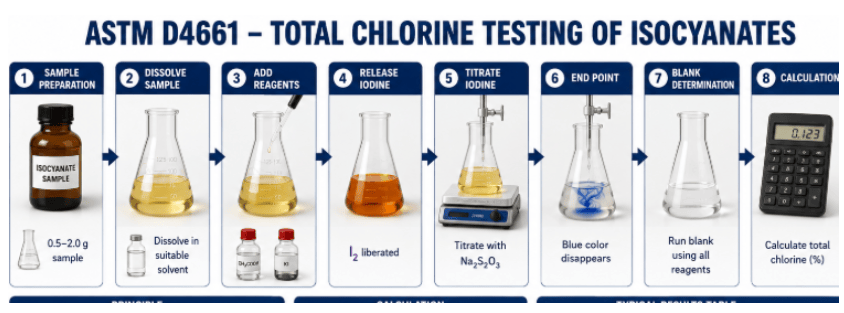
    Engineers identify the isocyanate material and prepare a representative sample for analysis. They prepare the required analytical equipment and establish the specified operating conditions. Technicians analyze the prepared sample according to the applicable procedure to determine the total chlorine content. They record analytical measurements, sample identification, test conditions, and other required information. Analysts review the recorded data and determine the total chlorine content of the tested material. The results can be used to compare isocyanate samples, monitor production consistency, and evaluate applicable material requirements.

    ASTM D4661 testing process showing isocyanate sample identification and preparation, analytical system preparation, total chlorine analysis, recording of analytical measurements, and calculation of total chlorine results.
    ASTM D4661 Total Chlorine Testing of Isocyanates

    Common Challenges and Troubleshooting

    ASTM D4661 results may be affected by the possibility of sample contamination, sample preparation, inaccurate calibration, unstable analytical conditions, reagent quality, equipment performance, or incorrect data interpretation. Technicians should take representative samples and always use the analytical procedure that applies to them. Analysts need to check the condition and calibration of the analytical equipment before testing. If results are not as expected, technicians should review sample preparation, analytical conditions, calibration, reagent preparation, instrument performance, and data-calculation procedures.

    Analysis Results and Interpretation

    The report summarizes the total chlorine content of the tested isocyanate material. It presents the measured analytical values together with the relevant sample identification, material information, analytical conditions, and other required test information.

    Read more

    • ASTM D4661 yields composition-specific results, not an overall material property value.
    •  The total chlorine content is generally expressed in a mass fraction or concentration (mg/kg, mg/g, mass percent, % as appropriate) with respect to the selected procedure. 
    • Engineers generate reliable, reproducible analytical results by consistently preparing samples, using appropriate analytical equipment, calibrating appropriately, employing controlled test conditions, and following appropriate analytical procedures. 

    Link to ASTM D4661

    FAQ

    What does ASTM D4661 measure?
    ASTM D4661 determines the total chlorine content of applicable isocyanate materials.
    Total chlorine content provides information about the composition and consistency of an isocyanate material and can help identify variations between materials or production batches.
    The methods apply to representative samples of applicable isocyanate materials used as polyurethane raw materials.
    The total chlorine content can be presented in either SI-compatible concentration units or mass-fraction units, e.g., mg/kg, mg/g, or % depending on the analytical procedure.
    Good sample preparation ensures that the sample tested is representative and that it is not contaminated or that other conditions have occurred that might influence the analytical results.
    Malhar Khole
    About Author
    Malhar Khole
    Malhar Khole is a Material Testing Associate at MaTestLab Inc. and holds a postgraduate degree in Material Science and Technology from IIT (BHU), Varanasi.
    Testimonials
    Real results
    Engineers trust us with what matters most
    Start Your Testing
    Project Today
    Define your requirements and get access to
    specialized laboratories ready to deliver results
    Partners with us
    Clients
    Vendors
    Process for testing
    • STEP 01

      You share your testing requirements

    • STEP 02

      You share your sample(s)

    • STEP 03

      We deliver your test reports

    Get your testing done

    Let us known your testing requirements and we will be right back with a solution.

      Let us root for each other. Collaborate to grow, expand, and accelerate our businesses.

      Partner with us

        Contact Us

        Discover more from MaTestLab

        Subscribe now to keep reading and get access to the full archive.

        Continue reading