
ASTM D4647 Standard Test Method for Identification and Classification of Dispersive Clay Soils by the Pinhole Test

    What is ASTM D4647?

    ASTM D4647 defines a standard test method for identifying and classifying dispersive clay soils using the pinhole test. A technician prepares and compacts a soil sample with a small hole in the center, then passes water through the sample under specific conditions. The test measures the flow properties, soil erosion, and effluent properties. ASTM D4647 (Standard Test Method for Identification and Classification of Dispersive Clay Soils by the Pinhole Test) outcomes help identify whether the clay soil exhibits dispersive behavior and classify it based on the soil’s response during the pinhole test. These results support soil selection, quality control, and earth structure evaluations that could otherwise lead to erosion issues caused by dispersive soil.

    Read more

    Get Certified ASTM D4647 Dispersive Clay Soil Testing

    ASTM D4647 testing assists geotechnical engineers, construction laboratories, and quality-control teams to assess the dispersibility of clay soils. Technicians prepare representative soil samples, compact them under controlled conditions, make the required pinhole in the sample, and add water to flow through it. During testing, the analyst monitors how the soil reacts and measures the flow and effluent properties. These results assist engineers in detecting and categorizing dispersive clay soils and evaluating their suitability for use in appropriate construction applications.

    What Is the Scope of ASTM D4647?

    ASTM D4647 is a standard for identifying and classifying dispersive clay soils, using the pinhole test. The method determines the susceptibility of a compacted clay soil to erosion and dispersion under controlled test conditions by passing water through a small opening. The standard covers:

    Read more

    • Dispersive Clay Soil: A clay soil that is prone to flowing and dispersing when wet. 
    • Pinhole Test: Water is passed through a small hole in a small compacted soil sample in the laboratory. 
    • Erosion Behavior: Technicians watch the water flow and how it affects the pinhole and soil. 
    • Effluent Evaluation: The laboratory observes the appearance and characteristics of water leaving the specimen. 
    • Soil Classification: Engineers use the test results to identify and classify the soil’s dispersive behavior. 

    What are the uses of ASTM D4647 testing?

    ASTM D4647 contains details regarding the dispersive properties of clayey soils in a specified water flow. The result provides engineers and laboratories with the information needed to assess soil suitability and to aid in geotechnical design and quality control. The standard:

    • Identifies dispersive clay soils. 
    • Classifies soil based on its pinhole-test response. 
    • Evaluates soil erosion caused by flowing water. 
    • Supports evaluation of soils for embankments and earth dams. 
    • Helps engineers compare different clay soil samples. 
    • Supports geotechnical investigation and material selection. 
    • Helps identify soils that may require additional evaluation or treatment. 

    Which materials can be tested according to ASTM D4647?

    ASTM D4647 applies to clay soils that need to be assessed for dispersive properties. Before testing, the soil type, condition of the specimen, compaction requirements, and the conditions under which it was tested should be confirmed in the laboratory. The standard applies to:

    • Clay Soils: Evaluates clay soils for dispersive behavior. 
    • Compacted Soil: Tests prepared soil specimens under controlled compaction conditions. 
    • Natural Soil Samples: Allows evaluation of representative soil samples that meet the applicable requirements. 
    • Construction Soil Materials: Supports evaluation of suitable clay soils considered for earthwork applications. 

    Why is ASTM D4647 testing important?

    When water flows through or over dispersive clay soils, it can erode. This can cause issues in earth dams, embankments, channels, and other structures that rely on soil stability and resistance to internal erosion. ASTM D4647 offers a specified procedure for assessing this behavior. The results help engineers identify potentially dispersive soils before construction. They can use the findings to compare soil materials, support material selection, and determine whether additional investigation or treatment may be necessary.

    ASTM D4647 Equipment & Sample Preparation Guide

    Technicians need suitable soil specimens, compaction equipment, a pinhole-testing apparatus, and controlled water-flow equipment. They prepare the soil carefully to obtain a representative compacted specimen and create the required pinhole before testing.

    Read more

    Sample IdentificationTechnicians identify the soil type, sample location or source, condition, and relevant project information before testing.
    Specimen PreparationTechnicians prepare and compact the soil specimen according to the applicable requirements and form the required pinhole.
    Test ApparatusLaboratories use a suitable pinhole apparatus with controlled water supply and flow conditions.
    Observation EquipmentAnalysts use suitable measuring and observation equipment to monitor water flow, effluent, and changes in the pinhole during testing.
    InstrumentA Pinhole Test Apparatus (or Pinhole Dispersion Device), which typically includes a cylindrical test chamber, a 1.0 mm wire punch/needle, a constant-head water reservoir, connecting tubing, and graduated cylinders.

    ASTM D4647 Testing Procedures and Requirements

    Technicians first prepare and compact the soil specimen and form the required pinhole. They place the specimen in the pinhole apparatus and introduce water under the specified test conditions. The laboratory observes the water flow and soil response throughout the test. The ASTM D4647 involves the following steps-

    Read more

    Specimen PreparationTechnicians prepare and compact a representative clay soil specimen and form the required pinhole.
    Specimen Placement and Water FlowTechnicians place the specimen in the apparatus and apply water through the pinhole under controlled conditions.
    Erosion and Effluent ObservationTechnicians observe the pinhole, water flow, and effluent characteristics during testing.
    Classification and Result DeterminationEngineers evaluate the test response to identify and classify the dispersive behavior of the soil.

    ASTM D4647 Testing Process and Data Collection

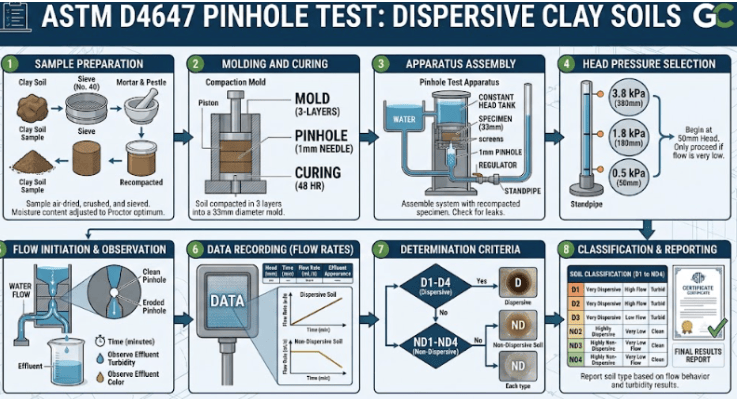
    Engineers start testing by preparing and compacting a representative clay soil specimen. They form the required pinhole and place the specimen in the testing apparatus. The laboratory then introduces water through the pinhole under the specified conditions. Technicians monitor the water flow, pinhole condition, soil erosion, and effluent characteristics during testing. They record the relevant observations and test conditions. Engineers use these data to identify and classify the dispersive behavior of the soil.

     ASTM D4647 testing process showing clay soil specimen preparation and compaction, formation of a pinhole, controlled water flow through the specimen, observation of soil erosion and effluent, and classification of dispersive soil behavior.
    ASTM D4647 Pinhole Test for Dispersive Clay Soil Testing Process

    Common Challenges and Troubleshooting

    ASTM D4647 results vary due to specimen preparation, compaction, pinhole size, water-flow conditions, soil condition, and observation technique. The technician should prepare representative samples and standardize compaction and testing conditions. Laboratories should test the pinhole apparatus and water-flow system before testing. The technician should also confirm that the specimen is in good condition and closely watch the effluent. When results deviate from normal, the laboratory should check the following: specimen preparation, compaction, condition of the apparatus, water flow, and procedures of observation. 

    Analysis Results and Interpretation

    ASTM D4647 results provide information about the dispersive behavior of clay soil based on its response to controlled water flow through a pinhole. Laboratories should report the observed values and classifications together with specimen details and test conditions so engineers can accurately interpret and compare the results.

    Read more

    • ASTM D4647 provides dispersive soil classification based on the specimen response during the pinhole test. 
    • Laboratories report water flow rate in mL/min or the applicable unit. 
    • Laboratories record test pressure in kPa or MPa, as applicable. 
    • The report includes the soil identification, specimen condition, compaction details, test conditions, effluent appearance, and erosion response. 
    • Stable preparation, compaction of the specimen, controlled water flow, formation of pinholes, and suitable testing equipment assist laboratories in achieving reliable and comparable results. 

    Link to ASTM D4647 

    FAQ

    What type of soil does ASTM D4647 test?
    The method focuses on clay soils that require evaluation for dispersive behavior.
    A pinhole test passes water through a small opening in a compacted soil specimen and evaluates the soil’s response to the water flow.
    Technicians observe water flow, changes in the pinhole, soil erosion, and the characteristics of the effluent.
    Soil condition, specimen preparation, compaction, pinhole formation, water-flow conditions, test pressure, and observation technique can affect the results.

    Updated on September 2, 2026

    Dr Ruchika Yogesh
    About Author
    Dr. Ruchika Yogesh is a serial entrepreneur, material science and AI/ML enthusiast, medicinal chemistry subject matter expert (SME), scientific/medical copyeditor, and a researcher.
    Know More
    Testimonials
    Real results
    Engineers trust us with what matters most
    Start Your Testing
    Project Today
    Define your requirements and get access to
    specialized laboratories ready to deliver results
    Partners with us
    Clients
    Vendors
    Process for testing
    • STEP 01

      You share your testing requirements

    • STEP 02

      You share your sample(s)

    • STEP 03

      We deliver your test reports

    Get your testing done

    Let us know your testing requirements and we will be right back with a solution.

      Let us root for each other. Collaborate to grow, expand, and accelerate our businesses.

      Partner with us

        Discover more from Matestlab

        Subscribe now to keep reading and get access to the full archive.

        Continue reading