ASTM D4585 Standard Practice for Testing Water Resistance of Coatings Using Controlled Condensation

    What is ASTM D4585?

    ASTM D4585 is a standard practice that sets out the operating principles and equipment procedures for running a single-sided controlled condensation test on coated materials. A technician mounts a coated specimen so that a heated, moisture-saturated atmosphere contacts the coated face while ordinary room-temperature air cools the uncoated back, and this temperature difference drives continuous condensation onto the coating’s surface. ASTM D4585 (Standard Practice for Testing Water Resistance of Coatings Using Single-Sided Controlled Condensation) grew out of research from the Cleveland Society for Coatings Technology and gives technicians a repeatable way to produce this condensation exposure, without dictating how a specimen gets prepared or how results get judged, which is left to the coating specification or test program applying this practice. Coating manufacturers use this exposure to observe how their coatings hold up against sustained moisture contact, watching for blistering, softening, embrittlement, color change, or adhesion loss.

    Read more

    Get Certified ASTM D4585 Testing for Reliable Coating Water Resistance Data

    Coatings degrade when water reaches the coating film over time, so understanding how a coating handles sustained moisture exposure gives a useful early read on its expected service life. ASTM D4585 allows technicians to recreate this stress in a controlled chamber environment, generating a reproducible condensation environment that a lab can duplicate across specimens and over time.

    What is the Scope of the ASTM D4585 Standard? 

    ASTM D4585 establishes the basic principles and operating procedures for testing the water resistance of coatings using single-sided controlled condensation. The practice exposes one surface of a coated specimen to a heated, saturated mixture of air and water vapor while room-temperature air cools the reverse side, generating condensation on the coated surface. The practice deals with obtaining, measuring, and controlling the conditions of the condensation exposure, while it does not specify specimen preparation, specific test conditions, or evaluation criteria. The scope of ASTM D4585 includes

    Read more

    • Material type: Coated metal, plastic, or wood specimens.
    • Purpose: Producing and controlling a single-sided condensation environment for coating water-resistance evaluation.
    • Exposure mechanism: A heated, saturated air-and-water-vapor mixture contacts the coated face while ambient room air cools the reverse side, driving condensation onto the coating.
    • Properties observed: Water-related coating changes such as blistering, softening, embrittlement, color change, and adhesion loss.
    • Testing conditions: The practice covers obtaining, measuring, and controlling the conditions of controlled condensation exposure. 
    • Test limitations: ASTM D4585 covers the condensation apparatus and procedure only; it does not define specimen preparation, exposure duration, or how to judge results.
    • Applications: Specification acceptance, quality control, and research and development of coatings and substrate treatments 

    What are the Uses of ASTM D4585?

    ASTM D4585 provides coating developers and manufacturers with a repeatable means for exposing a coated specimen to sustained condensation, observing how the coating responds to such exposure. Formulators, applicators, and quality teams use the resulting observations to judge a coating’s durability against moisture. The practice-

    • Supports specification acceptance testing for coatings and substrate treatments.
    • Assists quality control programs that need repeatable moisture-exposure conditions.
    • Aids research and development work comparing coating formulations.
    • Reveals blistering, softening, embrittlement, color change, and adhesion loss under sustained moisture contact.
    • Adapts to corrosion-focused testing when specimens are dried periodically between exposure cycles.

    Which Materials Can Be Tested Under ASTM D4585?

    ASTM D4585 applies to coated metal, plastic, and wood specimens, with the coated surface typically facing the chamber’s interior. Technicians can also mount a wood specimen with the uncoated face toward the chamber interior when the goal is to test a house paint’s blister resistance on the reverse, uncoated wood surface, as moisture reaching wood from the back can raise blisters in the coating on the front. 

    Why is ASTM D4585 Important?

    Water reaching a coating film over time can trigger degradation through a coating deficiency, substrate contamination, or inadequate surface preparation, and ASTM D4585 gives technicians a controlled way to force this exposure and observe the outcome well before a coating reaches field service. As the practice deliberately narrows its focus to the condensation apparatus and procedure, it supports the specification requirements that a coating actually requires maintaining the exposure conditions themselves consistent across labs.

    ASTM D4585 Equipment and Sample Preparation Guide

    ASTM D4585 requires a condensation chamber capable of maintaining a heated, saturated air-and-water-vapor mixture against the coated face of a specimen while the reverse side remains exposed to ambient room air.

    Read more

    Sample and Specimen DetailsTechnicians mount coated metal, plastic, or wood specimens with the coated surface facing the chamber interior, unless the test specifically calls for the reverse orientation.
    Specimen Dimensions Technicians prepare specimens according to the applicable coating specification or test program, as ASTM D4585 does not specify specimen preparation, specimen dimensions, or specific test conditions. 
    Specimen OrientationTechnicians position the specimen so the coated face contacts the heated vapor while the uncoated back stays exposed to room-temperature air.
    InstrumentationThe apparatus uses a controlled-condensation chamber and associated equipment for generating and maintaining the heated, saturated air-and-water-vapor environment required for the exposure. 

    ASTM D4585 Testing Procedure and Requirements

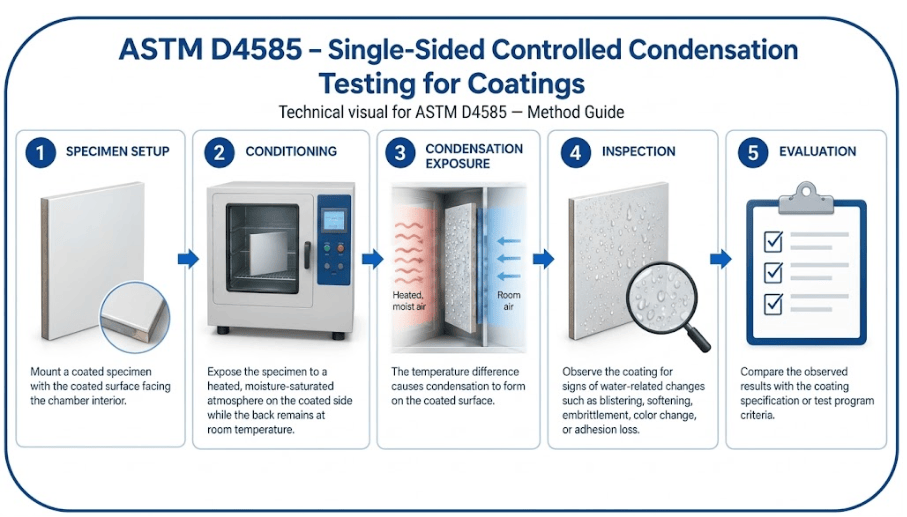
    ASTM D4585 holds a coated specimen at the boundary of a heated, saturated vapor environment and room-temperature air, ensuring a continuous formation of condensation on the coated surface throughout the exposure. Other referenced ASTM documents include ASTM D870, D1735, and D2247. The ASTM D4585 procedure comprises the following steps: 

    Read more

    Chamber PreparationTechnicians heat the water reservoir to generate a saturated air-and-water-vapor mixture inside the chamber.
    Specimen MountingTechnicians mount the coated specimen with the coated face toward the chamber interior and the reverse face exposed to room air.
    Condensation ExposureThe chamber maintains the heated vapor against the coated face while ambient air cools the reverse side, producing continuous condensation on the coating.
    Periodic DryingTechnicians periodically dry the specimen between exposure cycles when the practice supports a corrosion-focused test. 
    Result ObservationTechnicians examine the specimen for blistering, softening, embrittlement, color change, or adhesion loss following the exposure period a governing specification defines.

    ASTM D4585 Testing Process and Data Collection

    A technician mounts the coated specimen at the chamber boundary, the coated face towards the heated vapor and the reverse face towards ambient room air, and heats the water reservoir until the chamber contains a stable, saturated condensation environment. The technician monitors the exposure throughout the duration a governing coating specification sets, and periodically dries the specimen if the test is being adapted for corrosion evaluation. After exposure, the technician examines the coated surface for blistering, softening, embrittlement, color change, or adhesion loss, and an analyst records these observations against the coating specification’s evaluation criteria.

     The image shows a coated specimen mounted in a condensation chamber with the coated face exposed to heated vapor and the reverse face cooled by room air according to ASTM D4585.
    ASTM D4585 Single-Sided Controlled Condensation Testing of Coatings

    Common Challenges and Troubleshooting

    Accurate ASTM D4585 results depend on holding the chamber’s heated, saturated vapor steady against the coated face while the reverse side stays properly cooled by room air. Uneven heating or a specimen mounted with inconsistent orientation can distort the condensation pattern and give an unrepresentative result. Technicians reduce this risk by verifying the water reservoir stays adequately heated throughout the exposure and confirming specimen orientation before starting each run.

    ASTM D4585 Analysis Results and Interpretation

    ASTM D4585 itself does not specify how to score a specimen’s results; a governing coating specification sets the evaluation criteria applied to what technicians observe following the exposure. Analysts document the visible changes in the coating and compare them against the requirements the specification defines.

    Read more

    • Technicians document visible changes such as blistering, softening, embrittlement, and color change after exposure
    • Analysts record any loss of coating adhesion and other visible signs of coating deterioration.
    • The laboratory reports a Pass/Fail outcome or a numerical degree of coating failure when the governing specification defines the applicable evaluation criteria.
    • Technicians record the exposure duration in hours or days, along with relevant chamber conditions such as temperature in °C and humidity in %, as specified by the governing requirements.
    • Engineers compare the observed coating changes with the applicable specification or acceptance criteria to evaluate the coating’s resistance to the specified exposure conditions.

    Link to ASTM D4585

    FAQ

    What does ASTM D4585 cover?
    ASTM D4585 covers the apparatus and procedure for producing a single-sided controlled condensation environment on a coated specimen, without specifying specimen preparation or evaluation criteria.
    ASTM D4585 testing can reveal blistering, softening, embrittlement, color change, and adhesion loss on a coated surface exposed to sustained condensation.
    Yes. Technicians can adapt ASTM D4585 for corrosion testing by periodically drying the specimen between condensation exposure cycles.
    Rohit Dhembare
    About Author
    Rohit Dhembare
    Rohit Dhembare is an Operations Associate at MaTestLab Inc. and holds a postgraduate degree in Organic Chemistry.
    Testimonials
    Real results
    Engineers trust us with what matters most
    Start Your Testing
    Project Today
    Define your requirements and get access to
    specialized laboratories ready to deliver results
    Partners with us
    Clients
    Vendors
    Process for testing
    • STEP 01

      You share your testing requirements

    • STEP 02

      You share your sample(s)

    • STEP 03

      We deliver your test reports

    Get your testing done

    Let us known your testing requirements and we will be right back with a solution.

      Let us root for each other. Collaborate to grow, expand, and accelerate our businesses.

      Partner with us

        Contact Us

        Discover more from MaTestLab

        Subscribe now to keep reading and get access to the full archive.

        Continue reading