ASTM D446 Specifications and Operating Instructions for Glass Capillary Kinematic Viscometers 

    What is ASTM D446? 

    ASTM D446 is a standard that defines the design and operating procedures of glass capillary kinematic viscometers. The standard details three types of viscometers: modified Ostwald viscometers, suspended-level viscometers, and reverse-flow viscometers (each in its own annex). These viscometers are used in laboratories to measure the kinematic viscosity by measuring the time it takes for a fixed amount of liquid to flow through a capillary in the presence of gravity. Test Method D445 (Standard Test Method for Standard Specifications and Operating Instructions for Glass Capillary Kinematic Viscometers) specifies kinematic viscosities of transparent and opaque liquids using these types of viscometers. The standard also specifies the conditions for calibration of the viscometer and only gives results in SI units. 

    Read more

    Get Certified ASTM D446 for Uncompromising Quality and Project Success

    If the viscometer is out of spec or improperly calibrated, the flow-time reading will be distorted, and the calculated viscosity will be wrong. The certified ASTM D446 testing verifies that a glass capillary viscometer will perform within its design and calibration standards prior to routine use. For this reason, a laboratory ensures the accuracy of all kinematic viscosity results obtained from that instrument. 

    What is the Scope of ASTM D446? 

    ASTM D446 specifies the design requirements and operating procedures for glass capillary kinematic viscometers employed in the measurement of viscosity using Test Method D445. It is used to evaluate and standardize three types of modified Ostwald, suspended-level, and reverse-flow viscometers listed as annexes of the standard. This standard offers a uniform approach to the design, calibration, and operation of viscometers, which guarantees that the flow-time measurement is converted into a reliable, repeatable value of kinematic viscosity. The purpose of ASTM D446 is to establish a standard design and calibration of glass capillary viscometers to help keep kinematic viscosity results comparable across laboratories. Industries use this standard for reliability checks, performance evaluation, and specification compliance. The scope of ASTM D446 includes-

    Read more

    • Material type: Glass capillary viscometers (modified Ostwald, suspended-level, and reverse-flow). 
    • Purpose: Standardization of viscometer design, dimensions, and operating instructions. 
    • Property measured: Flow time of a liquid flowing under gravity through a capillary, a measure used to obtain the kinematic viscosity. 
    •  Method: Testing consists of selection of the correct type of viscometer, calibration, and operation according to the instructions set forth in the attached procedure in conjunction with Test Method D445. 
    • Result: Report the calculated kinematic viscosity, in SI units. 
    • Test Limitations: The standard covers only glass capillary viscometer types described in its annexes; no other units of measurement apply. 
    • Environmental conditions: Temperature control/correction is necessary because even slight temperature changes can influence flow time and viscosity. 
    • Applications: Petroleum, chemical, food/beverage, and pharmaceutical laboratories testing oils, fuels, lubricants, and other Newtonian liquids.

    What are the Uses of ASTM D446 Testing?

    ASTM D446 testing helps laboratories ensure a glass capillary viscometer is designed and calibrated to provide the accuracy required to measure the kinematic viscosity of the fluid being analyzed. In addition, standardized specifications allow different laboratories to compare results and be confident in the results. This standard – 

    • Facilitates the measurement of kinematic viscosity that is accurate and repeatable.
    • Helps laboratories to determine the proper type of viscometer to use with a particular liquid.
    • Verifies that the viscometer meets design and calibration standards.
    • Supports keeping the values of Test Method D445 consistent
    • Supplies a documented basis for instrument qualification and quality control.

    What Materials Can Be Tested Under ASTM D446? 

    ASTM D446 is applicable for transparent and opaque Newtonian liquids in glass capillary viscometers. These viscometers are often used in the laboratory to assess the viscosity of petroleum oils, synthetic lubricants, edible oils, resins, and other organic liquids of low to moderate viscosity. Properly specified viscometers are used to evaluate fuel, lubricant, paint, coatings, adhesives, syrup, and sauces for consistent flow behavior, among other industries. 

    Why is ASTM D446 Important? 

    ASTM D446 sets the standard for consistency in the design, dimensions, and calibration of glass capillary viscometers prior to use in the laboratory for kinematic viscosity testing. These viscometers are used exclusively in Test Method D445 and, consequently, an unknown or poorly calibrated instrument would be an impediment to the precision to which the industry relies. Standardization of the design and operation of the viscometer, as outlined in ASTM D446, enables the manufacturer to control the flow properties of the product, which aids in quality, uniformity, and regulatory compliance in the production of petroleum, chemicals, and food products.

    ASTM D446 Equipment and Sample Preparation Guide

    ASTM D446 requires particular calibration tools and viscometer parameters. Technicians prepare viscometers for testing according to the following specifications:

    Read more

    Sample and Specimen DetailsLaboratories test glass capillary viscometers of the modified Ostwald, suspended-level, or reverse-flow type, selected according to the liquid’s viscosity range 
    Specimen PreparationTechnicians clean the viscometer thoroughly and prepare the liquid sample as required before each measurement, since residue or contamination can distort flow time. 
    Specimen DimensionsAcceptable viscometer size and capillary bore vary with the expected viscosity range of the liquid under test, as specified in the standard’s annexes. 
    InstrumentationThe test uses a glass capillary viscometer of the selected type, a constant-temperature bath, and a timing device to record flow time per Test Method D445. 

    Testing Procedures and Requirements for ASTM D446

    To begin, technicians choose the viscometer type best suited to the liquid’s viscosity range, then clean and calibrate the instrument according to the standard’s specifications. The prepared liquid sample is placed into the viscometer and maintained at a constant temperature. Gravity draws the liquid through the capillary, and technicians record the flow time to calculate kinematic viscosity. 

    Read more

    Viscometer Selection Technicians choose a modified Ostwald, suspended-level, or reverse-flow viscometer based on the liquid’s viscosity range. 
    Calibration The viscometer’s constant is established through calibration, as described in the standard. 
    Temperature Control The sample and viscometer are held at a controlled, corrected temperature throughout the test. 
    Flow-Time MeasurementTechnicians record the time the liquid takes to flow through the capillary under gravity. 

    ASTM D446  Testing Process and Data Collection

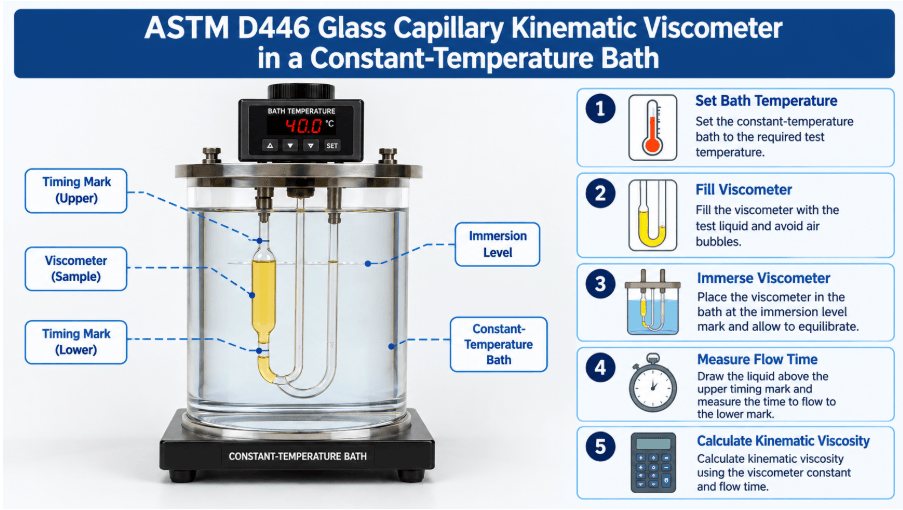
    The first step in using the viscometer is to determine the correct type for the liquid being measured and check the calibration constant. Then, the technicians clean the viscometer, load the sample, and put it in a temperature-controlled bath. Technicians measure this flow very precisely as the liquid flows by gravity through the capillary. Finally, the kinematic viscosity is calculated from the time of flow, viscometer constant, and test temperature, and recorded.

    The image shows a glass capillary viscometer holding a liquid sample in a constant-temperature bath as per ASTM D446.
    ASTM D446 Glass Capillary Kinematic Viscometer in a Constant-Temperature Bath

    Common Challenges and Troubleshooting

    One of the most common problems with ASTM D446 testing is the inclusion of air bubbles in the sample, which affect the flow-time measurement. Another common problem is temperature control failure, as a slight change in temperature will change the viscosity and therefore the results. In addition, the residues left on the viscometer by improper cleaning or handling affect the subsequent samples. The answer is to verify the cleanliness of the viscometer, to verify the temperature stability during the test, and to recalibrate the viscometer if the readings vary from the initial reading.

    ASTM D446 Analysis Results and Interpretation

    ASTM D446 results validate that the design and calibration of a viscometer can enable accurate measurement of kinematic viscosity in accordance with Test Method D445. Laboratories use flow-time and viscosity readings to compare against expected values to ensure instrument reliability.

    Read more

    • The flow time, viscometer constant, and test temperature are used to calculate kinematic viscosity.
    • The results are presented in SI units only.
    • Repeat trials provide consistent flow-time readings, indicating the viscometer is properly calibrated.
    • Deviations from expected values signal contamination, temperature instability, or a calibration issue that requires troubleshooting.
    • Results are reliable, which supports quality control, formulation, and regulatory compliance in various industries that use the tested liquids. 

    Link to ASTM D446

    FAQ

    What is the ASTM D446 testing?
    This test method covers the design, dimensions, and operating procedure of glass capillary kinematic viscometers used in conjunction with Test Method D445 for measuring kinematic viscosity.
    There are several types of modified Ostwald viscometers, suspended-level viscometers, and reverse-flow viscometers described in separate annexes of ASTM D446.
    Typical transparent or opaque Newtonian liquids that are tested in the laboratory include petroleum oils, synthetic lubricants, edible oils, resins, fuels, and more.
    Malhar Khole
    About Author
    Malhar Khole
    Malhar Khole is a Material Testing Associate at MaTestLab Inc. and holds a postgraduate degree in Material Science and Technology from IIT (BHU), Varanasi.
    Testimonials
    Real results
    Engineers trust us with what matters most
    Start Your Testing
    Project Today
    Define your requirements and get access to
    specialized laboratories ready to deliver results
    Partners with us
    Clients
    Vendors
    Process for testing
    • STEP 01

      You share your testing requirements

    • STEP 02

      You share your sample(s)

    • STEP 03

      We deliver your test reports

    Get your testing done

    Let us known your testing requirements and we will be right back with a solution.

      Let us root for each other. Collaborate to grow, expand, and accelerate our businesses.

      Partner with us

        Contact Us

        Discover more from MaTestLab

        Subscribe now to keep reading and get access to the full archive.

        Continue reading