ASTM D4440 Standard Test Method for Plastics: Dynamic Mechanical Properties Melt Rheology
What is ASTM D4440?
ASTM D4440 is a standard test method that determines the rheological properties of polymer melts using dynamic mechanical instrumentation. This method applies to thermoplastics and thermoplastic elastomers in a molten state and uses non-resonant forced vibration. Polymer producers, compounders, and engineers use the ASTM D4440 (Plastics – Dynamic Mechanical Properties – Melt Rheology) standard to determine how a melt behaves under oscillatory deformation. Fillers and other additives affect rheological properties; therefore, this method covers samples with additives. Analysts determine rheological properties, including complex viscosity, storage modulus, loss modulus, and loss factor (Tan Delta), based on the testing conditions. Engineers also consider plastic testing methods when assessing material properties and processing behavior.
Get Certified ASTM D4440 Testing for Reliable Polymer Melt Rheology Data
How a polymer melt flows decides how it fills a mold, passes through an extruder, and forms a film. Even if two resins have the same flow rate, they can behave differently within the machine. A single-point test does not tell you why. A dynamic test shows how it behaves at different frequencies. ASTM D4440 gives polymer producers and processors a method to determine this. The results help compare resins, study the effects of additives, and design processes.
What is the Scope of the ASTM D4440 Standard?
ASTM D4440 is a standard test method that identifies the rheological properties of polymer melts using dynamic mechanical instrumentation. This covers thermoplastics and thermoplastic elastomers in their molten form using non-resonant forced vibrations. This method can be applied to a range of frequencies, commonly between 0.01Hz and 100Hz. It can also be applied to homogeneous and heterogeneous polymer melts and composites containing additives. These systems typically have viscosities below 10⁶ Pa·s (10⁷ poise) when in a molten state. The data obtained from testing can be used for engineering design. SI units are standard, and the standard states that the method is equivalent to ISO 6721, Part 10.
Material type: Molten thermoplastics and thermoplastic elastomers, including systems with fillers and other additives.
Purpose: Determination of the rheological properties of a polymer melt.
Properties evaluated: Dynamic mechanical rheological properties of the melt.
Testing method: Technicians use dynamic mechanical instrumentation with nonresonant, forced-vibration techniques.
Results: Melt rheology data across the test frequencies, relevant to engineering design.
Test limitations: The method is intended for molten polymer systems with viscosities typically below 10⁶ Pa·s (10⁷ poise).
Use conditions: The method is valid for frequencies typically from 0.01 Hz to 100 Hz. SI units are standard.
Applications: Resin comparison, additive studies, and processing design for molten polymers.
What are the Uses of ASTM D4440 Testing?
ASTM D4440 testing shows how a polymer melt responds to oscillating deformation at different frequencies. Processors use the data to choose and tune resins, and engineers use it in design. This testing:
Determines rheological properties of polymer melts.
Covers thermoplastics and thermoplastic elastomers.
Applies to systems with fillers and other additives.
Works over frequencies typically from 0.01 Hz to 100 Hz.
Provides data suitable for engineering design.
Which Materials Can Be Tested Under ASTM D4440?
ASTM D4440 covers molten polymers such as thermoplastics and thermoplastic elastomers. It can be applied to homogeneous and heterogeneous systems, including composites containing additives. The molten viscosity of these systems is typically below 10⁶ Pa·s (10⁷ poise). Technicians test a specimen of the polymer and melt it in the instrument.
Why is ASTM D4440 Important?
A melt does not behave like a simple liquid because it has both viscous and elastic character. A dynamic test separates these two parts across a range of frequencies, which a single viscosity number cannot do. ASTM D4440 provides a common method for measuring melt rheology, while complete reporting of test conditions helps engineers interpret and compare results from different instruments or sites. Engineers can then compare resins, see the effect of fillers and additives, and use the data in design. The method also matches ISO 6721, Part 10, which helps when suppliers work under both standards.
ASTM D4440 Equipment and Specimen Preparation Guide
ASTM D4440 uses a dynamic mechanical instrument, also called a dynamic spectrometer, to apply a small oscillating deformation to a polymer melt. The instrument works by nonresonant, forced vibration. Technicians set the frequency, temperature, and strain amplitude for the test.
Specimen Details
Technicians use a representative amount of thermoplastic or another suitable molten polymer. The material may be supplied as powder, pellets, or a solid preformed specimen, including formulations with fillers and additives.
Specimen Dimensions
The typical specimen is approximately 25–50 mm in diameter and 1–3 mm thick, with a mass of about 3–5 g. Applicable material specifications take precedence over these default dimensions when they provide different requirements.
Instrumentation
Technicians use a dynamic mechanical instrument that applies nonresonant, forced vibration to the melt. It records the response of the polymer.
Test Variables
Technicians set the frequency, typically from 0.01 Hz to 100 Hz, and the temperature range for the test. They also select the strain amplitude.
Testing Procedures and Requirements for ASTM D4440
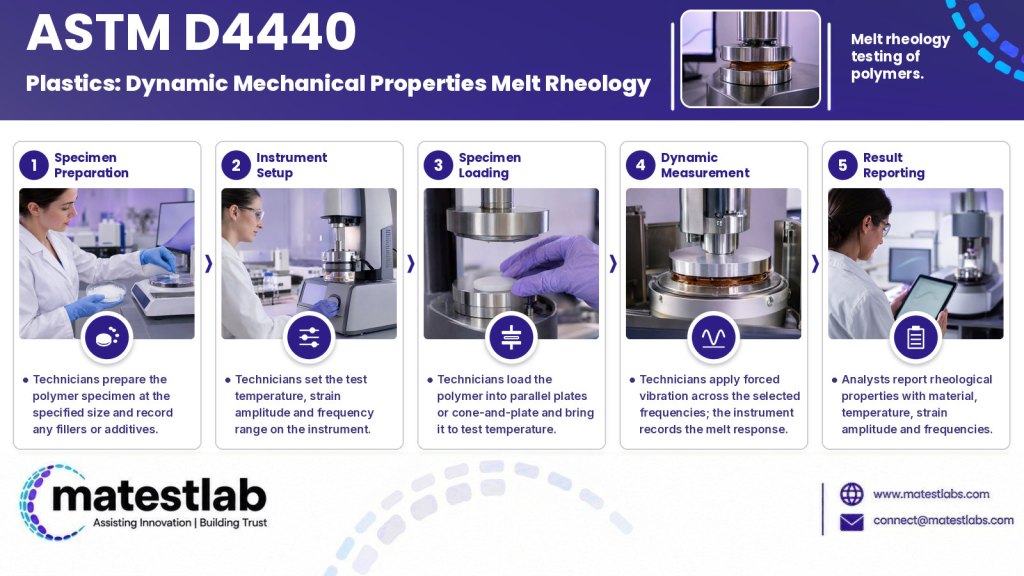
ASTM D4440 describes how technicians determine the rheological properties of polymer melts with dynamic mechanical instruments. The standard states that it is equivalent to ISO 6721, Part 10. The ASTM D4440 test method comprises the following steps:
Technicians prepare the polymer specimen at the size the method specifies. They record the material and any fillers or additives.
Instrument Setup
Technicians set the test temperature, the strain amplitude, and the frequency range in the dynamic mechanical instrument.
Specimen Loading
Technicians load the polymer into the selected test fixture, such as parallel plates or a cone-and-plate arrangement, and bring it to the required test temperature.
Dynamic Measurement
Technicians apply nonresonant, forced vibration across the selected frequencies. The instrument records the response of the melt.
Result Reporting
Analysts report the rheological properties with the material, temperature, strain amplitude, and frequency range. Engineers use the data for design and comparison.
ASTM D4440 Testing Process and Data Collection
Technicians prepare the specimen and set the temperature, strain amplitude, and frequencies on the instrument. They load the specimen, bring it to a melt, and apply the oscillating deformation. Analysts record the response across the frequencies and report the rheological properties with the test conditions. Analysts report the rheological properties together with the material details and relevant test conditions, including temperature, strain amplitude, frequency, and time where applicable. Engineers consider these conditions and any formulation differences when interpreting and comparing results.
ASTM D4440 Dynamic Mechanical Melt Rheology Test of a Polymer Specimen
Common Challenges and Troubleshooting
To achieve accurate ASTM D4440 results, the sample must be fully melted, and testing conditions must be consistent. If air bubbles are trapped or there is poor contact between the melted sample and the instrument surfaces, this will affect the response. Therefore, great care is taken when loading the sample. As the response can be affected by the temperature, strain, frequency, and time, the relevant testing conditions are documented by the analyst. Fillers and other additives will impact the rheological behavior, so they are documented with the sample. The method suits systems with molten viscosities typically below 10⁶ Pa·s (10⁷ poise).
ASTM D4440 Analysis Results and Interpretation
ASTM D4440 evaluates the rheological and viscoelastic properties of molten polymers under oscillatory deformation. Analysts report the measured properties with the relevant material details and test conditions. Engineers use the results to assess processing behavior, compare formulations, and support material selection and design.
Analysts report complex viscosity, storage modulus, loss modulus, and loss factor (tan delta) under the selected test conditions, as measured or determined.
Analysts document the frequency, strain amplitude, temperature, and time with the results.
Analysts record the filler and additive content with the specimen, since they affect rheological behavior.
Technicians document how the specimen was loaded and confirm the melt is bubble-free and in full contact with the fixture, because trapped air or poor contact affects the response.
Engineers consider the reported properties, test conditions, and formulation differences when comparing materials or supporting processing decisions. The method suits systems with molten viscosities typically below 10⁶ Pa·s.
ASTM D4440 determines the rheological properties of polymer melts with dynamic mechanical instruments, using nonresonant, forced-vibration techniques. It measures properties such as complex viscosity, storage modulus, and loss modulus under specified test conditions.
What frequency range does ASTM D4440 cover?
ASTM D4440 is valid for a wide range of frequencies, typically from 0.01 Hz to 100 Hz. The selected frequency range depends on the material and the purpose of the evaluation.
Which polymer systems does ASTM D4440 cover?
ASTM D4440 covers molten thermoplastics and thermoplastic elastomers. It applies to homogeneous and heterogeneous systems and composites with additives that have molten viscosities typically below 10⁶ Pa·s.
How does ASTM D4440 relate to ISO 6721?
ASTM D4440 states that it is equivalent to ISO 6721, Part 10. Both address the dynamic mechanical characterization of polymers, although users should consult the applicable standard for specific requirements.
Zunaira Tehseen is a scientific content specialist who bridges interdisciplinary research across biochemistry, molecular genetics, and materials science with technical content management. Leveraging expertise in bio-interface characterization, advanced materials evaluation, and AI-driven workflows, she curates, structures, and communicates complex technical data. At Matestlab, she leads content strategy and documentation for metallographic testing, mechanical characterization, and compliance with international standards such as ASTM and ISO, delivering precise, high-impact technical assets for industrial and scientific audiences. Know More
Testimonials
Real results
Engineers trust us with what matters most
“We had a great experience working with this company for our ASTM E84 testing. They were the first company to respond to our inquiry within just a few minutes of submitting it. From start to finish, the communication was excellent, and the entire process was swift, straightforward, and hassle-free.”
Ivars FancyWalls
United States
“Very good communication, testing associates were very patient with delays on our end. Reasonable turnaround time for results and nicely detailed report. Analysts were also quick to answer any follow-up questions. Happy with results.”
Skye Henderson
United States
“Matestlab connected us with an accredited lab within days, cutting weeks off our product validation timeline.”
Rebecca Kozodoy-Pins
United States
Why Choose Matestlab?
Matestlab is a unified testing services partner based in the USA. Matestlab offers raw material and product testing services through accredited, expert laboratories primarily based in the USA. Matestlab supports physical, thermal, chemical, electrical, mechanical, environmental, and characterization testing needs through its global network of 2200+ accredited testing laboratories. Matestlab's in-house materials science experts curate and design comprehensive testing programs matched to the sample material and specific testing need, with regulatory requirements and confidentiality in mind.
If you are looking for a managed and trusted testing partner to achieve your research goals, feel free to schedule a meeting with us or send us a request at connect@matestlabs.com to learn more about our services. For a quick quote, call us at (302)244-7710. We are happy to serve you.
Start Your Testing Project Today
Define your requirements and get access to specialized laboratories ready to deliver results