MaTestLab > Test Standards > ASTM D4355 Standard Test Method for Deterioration of Geotextiles by Exposure to Light, Moisture, and Heat
Last updated 20th November 2025
ASTM D4355 Standard Test Method for Deterioration of Geotextiles by Exposure to Light, Moisture, and Heat
ASTM D4355 is a standard procedure for testing the degradation of geotextiles due to exposure to light, moisture, and heat using a xenon arc apparatus. It simulates property changes under end-use conditions. However, it does not replicate deterioration from localized weather. After exposure intervals, specimens undergo a tensile test to create a degradation curve, indicating the material's propensity to degrade under various conditions. For UV exposure and saltwater testing, consider ASTM D5894.
Read More
GET STARTED
ASTM D4355 Introduction
ASTM D4355 involves exposing geotextiles to xenon arc radiation, moisture, and heat to determine their deterioration in tensile strength. The apparatus utilizes a xenon-arc light source for light and water exposure.
D4355 aims to replicate property changes similar to those experienced under end-use conditions, such as solar radiation, moisture, and heat. However, it does not simulate deterioration from localized weather phenomena like atmospheric pollution, biological attack, or saltwater exposure. This test is essential for determining the durability of geotextiles in construction, erosion control, and other applications in the open environment. It involves exposing specimens of geotextiles to controlled ultraviolet (UV) radiation and moisture in a laboratory setting, thereby simulating outdoor weathering conditions. After this exposure period, the tensile strength of the material is determined to assess the degree of degradation. The results help engineers, manufacturers, and researchers understand the longevity and performance of geotextiles in outdoor environments, ensuring their suitability for various applications.
Service Name
Remarks
ASTM D4355 Testing
Contact US
Get Certified ASTM D4355 for Uncompromising Quality and Project Success
ASTM D4355 certification is used to ensure that both the laboratory and manufacturers are using the same time-tested methods to determine the weathering characteristics of geotextiles. Certification ensures adherence to the international exposure-testing practices, enhancing the reliability of the product durability tests. Using the approaches certified by the ASTM D4355-2014, businesses will be able to determine the presence of UV-sensitive materials, test manufacturing batches, and ensure that geotextiles can perform according to expectations in the field. This builds engineering confidence, long-term project reliability, and trust across the environmental, civil, and geotechnical applications.
ASTM D4355 Testing Procedure and Requirements
Exposure of the Specimen to Xenon Arc
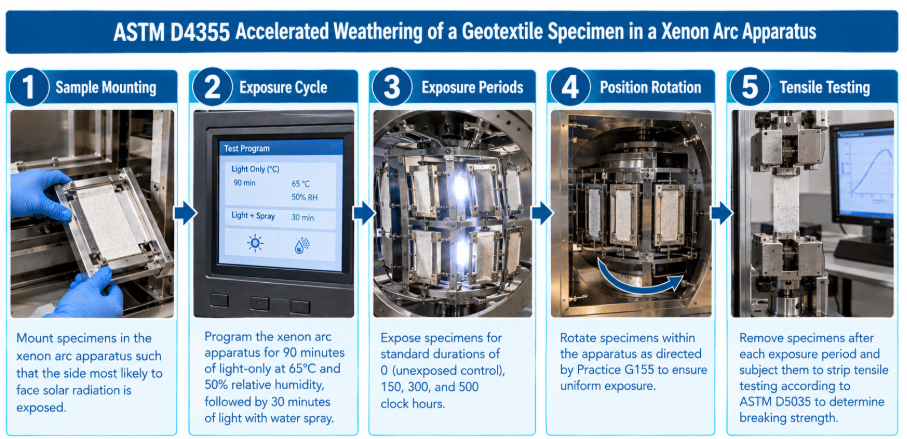
For each machine direction and cross-machine direction, five geotextile specimens are exposed in a xenon arc device for different durations. The exposure includes cycles lasting 120 minutes, comprising light exposure, humidity, and water spray exposure.
Cut or Ravel Strip Tensile Test
The specimens are tested after exposure using a tensile test. Their strength is compared to the control. The retained strength is plotted against exposure time to create a degradation curve.
Scope of ASTM D4355
Gives a universal way of measuring the degradation of geotextiles when they are exposed to light, moisture, and heat.
Applicable to woven, nonwoven, knitted, and composite geotextiles that comprise polymers like polypropylene, polyester, and polyethylene.
Helps evaluate product durability and product development, and predict long-term performance.
Allows for comparison of various types of geotextiles, formulations, and manufacturing batches.
ASTM D4355 Equipment and Sample Preparation
Specimen Details
Fabric rolls are selected according to the specification or agreement for acceptance testing. Rolls serve as the primary sampling units. If necessary, during manufacturing, rolls are chosen uniformly throughout the production period.
Specimen Size
One-metre square portions are taken from the laboratory sample. Each is positioned no closer to the hem than 1/10th of the sample width.
Use of ASTM D4355
Screening – UV resistance before installation in the field, screen materials are screened.
Assuring the usual quality in the manufacturing procedures of the geotextiles.
Comparison of the performance of different polymer formulations or additives.
Validating adherence to specifications of erosion control, drainage, and soil stabilization initiatives.
Common Challenges and Troubleshooting in ASTM D4355
The difficulty usually entails uneven exposure because of improper mounting of the specimens, wrong distance of lamps, or uneven spraying patterns of moisture. When used for an extended period, the lamp may decrease UV intensity and thus give false degradation values. Polymer stability can also be influenced by variations in temperature, and tensile strength measurements may vary due to improper conditioning of the polymer before or after being exposed to an external factor. Troubleshooting must be properly equipped with calibration of equipment, lamp replacement, and positioning of the specimen, and exposure cycles must be followed strictly.
ASTM D4355 Testing Technique, Process, and Data Collection
The test is conducted under controlled conditions of UV exposure and moisture application, and the temperature is kept constant during the test. Tensile testing of specimens is done after the intended period of exposure to measure the loss of strength. The data will be collected by taking note of the duration of exposure, the type of UV lamp, cycle settings, moisture spray settings, tensile strengths before and after exposure, and the percentage of retained strength. The comparison between the materials is supported by the detailed documentation and allows tracing the quality control or research.
Analysis Results and Interpretation for ASTM D4355
The most notable finding is the percent tensile strength retained after exposure, which shows the resistance of the geotextile to UV and weathering. A high strength retention indicates a good level of durability and retention of the product in a long-term outdoor application, whereas a large loss of strength indicates a poor level of UV stabilization or degradation of the polymer. The outcomes of these studies are used to assist engineers in choosing the right geotextiles to use in a particular environment, authenticate the quality of products, and optimise the formulation additives of UV protection.
Problem & The Solution for ASTM D4355
Problem: Significant strength loss caused by poor UV resistance, improper exposure setup, or aged UV lamps producing inadequate intensity.
Solution: Use UV-stabilised polymers or additives, ensure correct specimen placement, maintain consistent lamp output, and verify exposure cycle parameters. The adherence to ASTM D4355-compliant practices is the guarantee of the successful evaluation of the geotextile’s weathering resistance.
Factors to Consider for ASTM D4355
Speed Automated exposure chambers and programmable cycles improve testing efficiency and enable simultaneous evaluation of multiple specimens.
Expert Correct specimen mounting, cycle programming, and interpretation of data on strength are performed under the supervision of trained professionals.
Cost ASTM D4355 testing is economical in terms of durability testing and helps avoid premature failure of geotextiles, minimize maintenance, and help maintain the reliability of the project on a long-term basis.
Related
FAQ's
Where can I get the astm d4355 tested?
You can share your astm d4355 testing requirements with MaTestLab. MaTestLab has a vast network of material testing laboratories, spread across the USA and Canada. We support your all material testing needs ranging from specific astm d4355 test to various testing techniques.
How much do I need to pay for the astm d4355 test?
Please contact us for a detailed quote for your astm d4355 testing needs. Cost incurred to carry out different astm d4355 testing methodology depends on the type of raw material; number of samples, coupons, or specimens; test conditions, turn around time etc. Costs of some ASTM testing methods start from $100 and the final value depends upon the factors listed above. Please contact us for the best and latest prices.
How many samples are required for astm d4355?
The required number of samples or specimens should comply with the procedure given in the astm d4355 standard. However, the MaTestLab operations team can assist you for your special requirements once you share your testing details with us.
How much discount can I get on the astm d4355 test?
MaTestLab has a vast testing laboratory network, hence we bring you the best testing facilities in a cost-effective way. We offer considerable discounts (15-20%) to our returning customers based on test volume and frequency.
How many days will it take to complete the astm d4355 test?
The turnaround time for astm d4355 test methodology depends upon the test procedure mentioned in the standard test document. However, we at MaTestLab understand your research requirements and hence try to get your test completed within the least possible time.
Where can I get the astm d4355 tested?
You can share your astm d4355 testing requirements with MaTestLab. MaTestLab has a vast network of material testing laboratories, spread across the USA and Canada. We support your all material testing needs ranging from specific astm d4355 test to various testing techniques.
MaTestLab Inc. offers accessible, quick, and affordable material testing, product testing, and failure analysis services. We support your on-demand testing and expert consultation needs with the help of our extensive network of material testing laboratories situated in the US and other parts of the world.
MATERIAL TESTING
We offer destructive and non-destructive tests over a range of mechanical, electrical, chemical, thermal, optical, corrosion, radiation, and biological testing methodologies defined by ASTM, ISO and other organizations.
PRODUCT TESTING
We help you evaluate and ensure your product quality and performance with standard and custom-made testing solutions. All the tests are done at well-equipped testing laboratories using standard testing methods for best output and satisfaction.
FAILURE ANALYSIS
Failure analysis ensures high levels of quality in every manufacturing process. We help you with getting the best failure or root cause analysis to determine the cause of the failure. The results help you identify means to prevent failure recurrences.