ASTM D4294 Standard Test Method for Sulfur in Petroleum and Petroleum Products by Energy Dispersive X-ray Fluorescence Spectrometry

    What is ASTM D4294?

    ASTM D4294 is the standard that uses energy-dispersive X-ray fluorescence spectrometry to determine the total sulfur content in petroleum and petroleum products. The method involves exposing a liquid sample prepared for this purpose to X-rays and measuring the characteristic sulfur fluorescence emitted by the sample. Using calibration standards with matched matrices, technologists are able to quickly and easily measure sulfur concentration with minimal sample preparation. The range of sulfur concentrations covered by ASTM D4294 (Standard Test Method for Sulfur in Petroleum and Petroleum Products by Energy Dispersive X-ray Fluorescence Spectrometry) is 17 mg/kg to 4.6% by mass.

    Read more

    Get Certified ASTM D4294 Testing for Reliable Sulfur Content Evaluation

    ASTM D4294 testing is performed to measure the total sulfur content of petroleum products for processing, quality control, specification, and regulatory assessment. Hence, the results can be used to confirm sulfur limits and to characterize petroleum materials where the sulfur concentration impacts product requirements.

    What is the Scope of the ASTM D4294 Test Standard?

    ASTM D4294 is the method of analysis used for total sulfur in single-phase petroleum and petroleum products which are liquid at ambient temperature or liquefiable with moderate heat or soluble in hydrocarbon solvents. The method applies to a pooled measurement range of 17 mg/kg to 4.6% sulfur by mass; samples containing concentrations greater than 4.6% can be diluted to the applicable measurement range. The SI system of units is used as the standard system of units. The scope of ASTM D4294 includes:

    Read more

    • Material: Single-phase petroleum and petroleum products suitable for analysis by energy-dispersive X-ray fluorescence.
    • Test method: Determination of total sulfur by energy-dispersive X-ray fluorescence spectrometry.
    • Applicable products: Diesel fuel, jet fuel, kerosene, distillate oils, naphtha, residual oil, lubricating base oil, hydraulic oil, crude oil, unleaded gasoline, gasoline-ethanol blends, biodiesel, and similar petroleum products.
    • Concentration range: Approximately 17 mg/kg to 4.6% sulfur by mass within the stated precision scope.
    • Sample condition: Samples must be liquid at ambient conditions, liquefiable with moderate heat, or soluble in hydrocarbon solvents.
    • Dilution: Samples containing more than 4.6% sulfur may be diluted to bring the concentration within the applicable range.
    • Measurement: Sulfur concentration is determined from the characteristic X-ray fluorescence response of the sample.

    What are the Uses of ASTM D4294 Testing?

    ASTM D4294 is a fast test for total sulfur in petroleum and petroleum products that requires little sample preparation. Thus, technicians can apply the information for product evaluation, processing, and sulfur requirement verification. The ASTM D4294 standard-

    • Determines the total sulfur concentration in petroleum products.
    • Assesses sulfur content of fuels and petroleum-based materials.
    • Aids in evaluations for petroleum processing and quality control.
    • Assists with checking sulfur specifications for products as applicable.
    • Helps evaluate regulatory sulfur limits.
    • Compares the sulfur content of petroleum products.
    • Offers fast sulfur analysis with minimum sample preparation.
    • Assists in the assessment of products containing sulfur content in the measurable range.

    Which materials can be tested under ASTM D4294?

    ASTM D4294 can be used for single-phase petroleum and petroleum products, such as diesel fuel, jet fuel, kerosene, distillate oils, naphtha, residual oil, lubricating base oil, hydraulic oil, crude oil, unleaded gasoline, gasoline-ethanol blends, biodiesel, and related products. High-oxygen-content materials may need to be diluted or matrix-matched to obtain accurate results.

    Why is ASTM D4294 Important?

    ASTM D4294 is important since the concentration of sulfur in petroleum products has an impact on quality and processing properties. In addition, there are limits for sulfur in some fuels and petroleum products, and the accurate measurement of sulfur is critical for specification and regulatory assessments. The method is fast and requires little sample preparation, but matrix variability between the standards and samples can affect the results.

    ASTM D4294 Equipment and Sample Preparation Guide

    ASTM D4294 uses an energy-dispersive X-ray fluorescence spectrometer, prepared sample cells, X-ray film, calibration standards, and suitable petroleum samples. Surface contamination, wrinkles, and film variations can impact sulfur measurements, so technicians need to keep sample cells clean and film taut and uncontaminated.

    Read more

    Sample and Specimen DetailsTechnicians use representative single-phase petroleum or petroleum-product samples that are suitable for transfer into the X-ray sample cell and analysis.
    Specimen PreparationAnalysts collect samples following the appropriate sampling protocol, transfer them to clean sample containers, remove air bubbles created during mixing, and process the samples as soon as possible.
    Specimen DimensionsASTM D4294 does not specify a particular specimen length, width, or thickness; it requires the sample cell to conform to the geometry requirements of the X-ray fluorescence spectrometer.
    InstrumentationThe equipment includes an energy-dispersive X-ray fluorescence spectrometer, suitable sample cells, X-ray window film, calibration standards, and supporting equipment for preparing and handling petroleum samples.

    Testing Procedures and Requirements for ASTM D4294

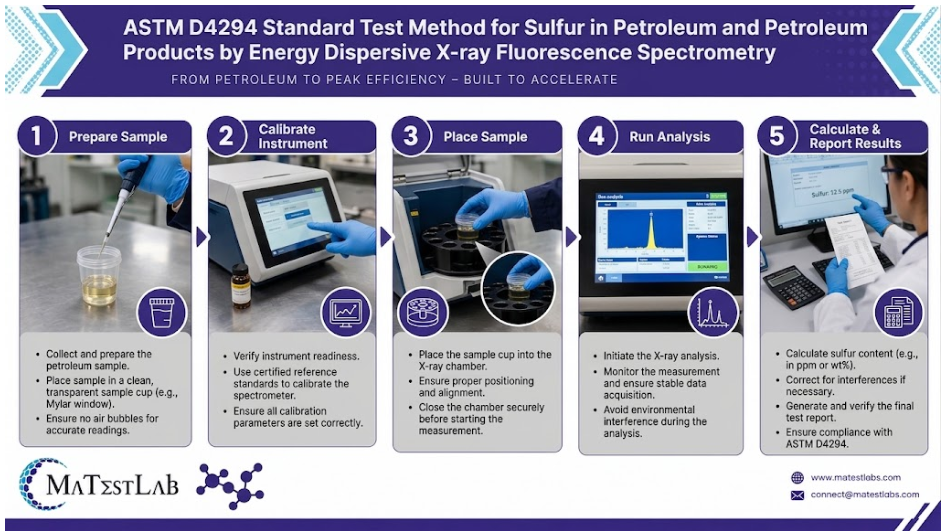
    ASTM D4294 states that technicians set up the X-ray fluorescence analyzer, prepare calibration standards, collect a representative sample of petroleum, and measure the sulfur response from the prepared sample cell. The calibration should be designed to consider the sample matrix to avoid significant measurement error arising from differences in carbon-to-hydrogen ratio and other heteroatoms. The procedure outlined in ASTM D4294 is as follows-

    Read more

    Calibration PreparationTechnicians prepare or select sulfur calibration standards that appropriately represent the matrix and concentration range of the samples being tested.
    Instrument SetupAnalysts set up the energy-dispersive X-ray fluorescence spectrometer according to the instrument manufacturer’s instructions and establish the required operating conditions.
    Sample PreparationThe technician collects a representative sample of petroleum, mixes the sample as necessary, and places the sample in a clean sample cell without contamination or air bubbles.
    Sample Cell PreparationAnalysts use clean sample cells with taut X-ray film and do not touch the exposed film or surfaces that could affect low-level sulfur measurements.
    X-ray MeasurementThe prepared sample is then positioned in the spectrometer, and the characteristic sulfur X-ray fluorescence response is measured by the spectrometer.
    Result reportingThe measured fluorescence response is compared with the established calibration to determine and report the sulfur concentration of the petroleum sample.

    ASTM D4294 Testing Process and Data Collection

    ASTM D4294 involves loading a representative petroleum sample into a pre-prepared X-ray sample cell, which is then placed in the energy-dispersive X-ray fluorescence spectrometer. Operators measure the characteristic response to sulfur under the calibration conditions that are established. The measured response and calibration relationship are used to calculate the total sulfur content of the sample. A typical analysis requires approximately 1 to 5 minutes per sample.

    Petroleum sample in an X-ray fluorescence sample cell during ASTM D4294 sulfur measurement.
    ASTM D4294 energy-dispersive X-ray fluorescence analysis of sulfur in petroleum products.

    Common Challenges and Troubleshooting

    Common challenges in ASTM D4294 include matrix mismatch, contaminated sample cells, wrinkled or damaged X-ray film, air bubbles, volatile sample losses, and calibration instability. Thus, the calibration, sample-cell condition, film quality, sample homogeneity, and matrix compatibility must be verified prior to the measurement. Light components can also be selectively lost during analysis, which can lead to reduced precision for volatile samples.

    ASTM D4294 Analysis Results and Interpretation

    The results of ASTM D4294 sulfur are reported as the total sulfur content in the petroleum or petroleum product analyzed. The measured concentration is interpreted with respect to the corresponding product specification, processing requirement, or regulatory limit, and calibration and matrix compatibility are taken into account.

    Read more

    • The laboratory records the sulfur concentration determined from the X-ray fluorescence measurement.
    • The analyst compares the result to the appropriate calibration range and measurement capability.
    • The laboratory takes into account differences in matrices between the sample and the calibration standards for interpretation of the result.
    • Engineers compare the amount of sulfur in petroleum products tested under the same conditions.
    • Analysts apply these results to processing decisions, quality control, specification verification, and sulfur-limit evaluations where applicable.

    Link to ASTM D4294

    FAQ

    Why is ASTM D4294 important?
    ASTM D4294 is important as it is a quick test for the determination of total sulfur in petroleum and petroleum products for processing, specification, and regulatory considerations.
    ASTM D4294 is applicable for the measurement of total sulfur in petroleum products, including fuels, crude oil, lubricating base oil, hydraulic oil, and other petroleum materials.
    ASTM D4294 is the determination of total sulfur content of petroleum and petroleum products by energy-dispersive X-ray fluorescence spectrometry.

    Updated on September 24, 2026

    Dr Ruchika Yogesh
    About Author
    Dr. Ruchika Yogesh is a serial entrepreneur, material science and AI/ML enthusiast, medicinal chemistry subject matter expert (SME), scientific/medical copyeditor, and a researcher.
    Know More
    Testimonials
    Real results
    Engineers trust us with what matters most
    Why Choose Matestlab?
    Matestlab is a unified testing services partner based in the USA. Matestlab offers raw material and product testing services through accredited, expert laboratories primarily based in the USA. Matestlab supports physical, thermal, chemical, electrical, mechanical, environmental, and characterization testing needs through its global network of 2200+ accredited testing laboratories. Matestlab's in-house materials science experts curate and design comprehensive testing programs matched to the sample material and specific testing need, with regulatory requirements and confidentiality in mind.

    If you are looking for a managed and trusted testing partner to achieve your research goals, feel free to schedule a meeting with us or send us a request at connect@matestlabs.com to learn more about our services. For a quick quote, call us at (302)244-7710. We are happy to serve you.
    Start Your Testing
    Project Today
    Define your requirements and get access to
    specialized laboratories ready to deliver results
    Partners with us
    Clients
    Vendors
    Process for testing
    • STEP 01

      You share your testing requirements

    • STEP 02

      You share your sample(s)

    • STEP 03

      We deliver your test reports

    Get your testing done

    Let us know your testing requirements and we will be right back with a solution.

      Let us root for each other. Collaborate to grow, expand, and accelerate our businesses.

      Partner with us