
ASTM D3985 Determination of Oxygen Gas Transmission Rate (OTR) through Plastic Film and Sheeting

    What is ASTM D3985?

    ASTM D3985 measures the steady-state oxygen gas transmission rate (OTR) of plastic film and sheeting under controlled conditions. The method uses a coulometric sensor to measure the amount of oxygen that permeates through a specimen and can be used by laboratories to assess the barrier properties of plastic materials. ASTM D3985 (Determination of Oxygen Gas Transmission Rate (OTR) through Plastic Film and Sheeting Using a Coulometric Sensor) applies to plastic films, sheets, laminates, coextrusions, and plastic-coated papers or fabrics. From these measurements, engineers can compare oxygen barrier properties, aid in packaging material selection, assess product performance, and ensure accurate product quality in the development and production of packaging materials.

    Read more

    Get Certified ASTM D3985 Testing for Reliable Oxygen Barrier Performance

    Plastic films and sheets used for packaging need suitable resistance to oxygen transmission. Thus, oxygen transmission testing is performed to assess the barrier performance and to compare the different plastic materials. Controlled testing to measure oxygen transmission is available as per ASTM D3985. The results help select materials, develop products, ensure quality control, and evaluate packaging performance.

    What is the Scope of the ASTM D3985 Test Standard?

    ASTM D3985 determines the steady-state rate of oxygen gas transmission through plastic film and sheeting under specified test conditions. It can also be used for laminates, coextrusion, plastic-coated papers, or fabrics. This standard-

    Read more

    • Determines the oxygen gas transmission rate (OTR).
    • Assesses oxygen barrier properties.
    • Measures oxygen permeance.
    • Helps to measure oxygen permeability for relevant materials.
    • Use for plastic films and sheeting.
    • Supports the evaluation of laminates and coextrusions.
    • Assists with comparing oxygen barrier properties.
    • Assists with quality control of packaging materials.

    What are the Uses of ASTM D3985 Testing?

    ASTM D3985 testing helps laboratories evaluate the ability of plastic materials to resist oxygen transmission. Engineers then use the results to compare packaging materials and determine if they are adequate for oxygen-sensitive applications. This standard-

    • Measures the oxygen transmission rate.
    • Assesses oxygen barrier properties.
    • Assists in comparing plastic packaging films.
    • Supports material selection.
    • Helps evaluate laminate and coextruded structures.
    • Helps to manage packaging QA.
    • Supplies information for material development.

    Which materials can be tested under ASTM D3985?

    ASTM D3985 is for plastic film and sheeting products, such as laminates, coextrusions, and plastic-coated papers or fabrics. Oxygen permeability of homogeneous materials can be determined in laboratories where applicable. The material structure, thickness, surface condition, and desired test conditions should be known by the technicians prior to specimen preparation.

    Why is ASTM D3985 Important?

    ASTM D3985 is a standard test for measuring the oxygen transmission rate of plastic. Regular measurements enable manufacturers to gain an understanding of the barrier performance of films and sheets. The results also enable material comparisons and the selection of appropriate packaging structures when oxygen resistance is a critical factor.

    ASTM D3985 Equipment and Sample Preparation Guide

    An oxygen transmission testing system with a coulometric sensor is required for the ASTM D3985 test. Representative specimens are prepared and sealed properly in the test cell so that oxygen does not circumvent the material.

    Read more

    Sample and Specimen DetailsOperators test representative plastic films, sheets, laminates, coextrusions, or plastic-coated materials suitable for oxygen transmission testing.
    Specimen PreparationTechnicians cut and condition specimens to the specified test conditions and maintain clean and damage-free test surfaces.
    Specimen DimensionsSpecimen dimensions depend on the test cell and exposed test area required by the testing equipment.
    InstrumentationThe test is performed on an oxygen transmission analyzer that includes a coulometric sensor, test cell, gas supply system, temperature-control equipment, and data acquisition system.

    Testing Procedures and Requirements for ASTM D3985

    ASTM D3985 involves exposing one side of the plastic specimen to oxygen and detecting the oxygen that passes through the material by means of a coulometric sensor. Technicians provide controlled test conditions until the desired steady-state response is obtained. The procedure outlined in ASTM D3985 is as follows-

    Read more

    Specimen PreparationThe technician prepares and conditions the plastic specimen before placing it in the oxygen transmission test cell.
    Test Cell InstallationThe operator encloses the specimen in the test cell and ensures that the area exposed is isolated correctly.
    Oxygen ExposureTechnicians expose one side of the specimen to oxygen under the test conditions.
    Coulometric DetectionThe sensor measures the flow of oxygen through the specimen, and the system calculates the oxygen transmission rate.
    Result ReportingLaboratories report OTR, test conditions, specimen information, and applicable permeance/permeability results.

    ASTM D3985 Testing Process and Data Collection

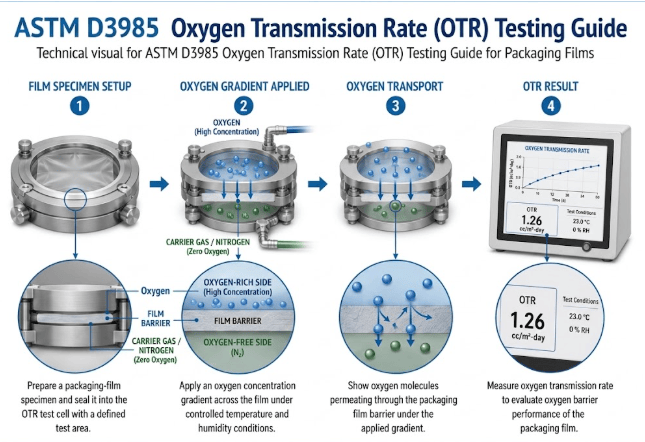
    Analysts select representative plastic samples and specify the test conditions. Afterward, the specimens are prepared and conditioned prior to being securely mounted in the test cell. The operator then exposes one side of the specimen to oxygen, and the other side to the coulometric sensor. The system measures the oxygen passing through the material as steady-state conditions are established. Finally, the collected measurements are used to calculate the oxygen transmission rate. Laboratories can also measure oxygen permeance and, if applicable, oxygen permeability.

    This image shows a plastic film specimen sealed inside an oxygen transmission test cell for measuring oxygen transmission rate according to ASTM D3985.
    ASTM D3985 Oxygen Transmission Rate Testing

    Common Challenges and Troubleshooting

    Accurate ASTM D3985 results require properly sealed specimens, controlled test conditions, and stable sensor operation. Leaks in the specimen may occur, and the measured transmission rate may be influenced by oxygen passing through the leaks. It is important for the technician to check for any signs of damage and confirm that the seal of the test cell is intact prior to testing. Laboratories also need reliable results when proper conditioning, stable temperatures, and gas conditions are met.

    ASTM D3985 Analysis Results and Interpretation

    The report provides a summary of the barrier performance to oxygen of the tested plastic material under the specified conditions. Laboratories report OTR in conjunction with the pertinent temperature, gas conditions, specimen data, and test parameters.

    Read more

    • The results are oxygen transmission and related permeabilities produced by ASTM D3985.
    • OTR can be reported in cm³(STP)/(m²·day).
    • OTR may also be given in units of mol/m²·s.
    • The oxygen permeance can be described in mol/(m²·s·Pa).
    • Oxygen permeability can be reported in mol/(m·s·Pa).
    • Lower OTRs are normally associated with higher resistance to oxygen transmission.
    • Laboratories can achieve consistent results when they prepare specimens similarly and control test conditions.

    Link to ASTM D3985

    FAQ

    Where can I get the astm d3985 tested?
    You can share your astm d3985 testing requirements with MaTestLab. MaTestLab has a vast network of material testing laboratories, spread across the USA and Canada. We support your all material testing needs ranging from specific astm d3985 test to various testing techniques.
    Please contact us for a detailed quote for your astm d3985 testing needs. Cost incurred to carry out different astm d3985 testing methodology depends on the type of raw material; number of samples, coupons, or specimens; test conditions, turn around time etc. Costs of some ASTM testing methods start from $100 and the final value depends upon the factors listed above. Please contact us for the best and latest prices.
    The required number of samples or specimens should comply with the procedure given in the astm d3985 standard. However, the MaTestLab operations team can assist you for your special requirements once you share your testing details with us.
    MaTestLab has a vast testing laboratory network, hence we bring you the best testing facilities in a cost-effective way. We offer considerable discounts (15-20%) to our returning customers based on test volume and frequency.
    The turnaround time for astm d3985 test methodology depends upon the test procedure mentioned in the standard test document. However, we at MaTestLab understand your research requirements and hence try to get your test completed within the least possible time.
    Dr Ruchika Yogesh
    About Author
    Dr Ruchika Yogesh
    Dr. Ruchika Yogesh is an entrepreneur, science and AI/ML enthusiast, medicinal chemistry subject matter expert (SME), scientific/medical copyeditor, and an independent researcher.
    Testimonials
    Real results
    Engineers trust us with what matters most
    Start Your Testing
    Project Today
    Define your requirements and get access to
    specialized laboratories ready to deliver results
    Partners with us
    Clients
    Vendors
    Process for testing
    • STEP 01

      You share your testing requirements

    • STEP 02

      You share your sample(s)

    • STEP 03

      We deliver your test reports

    Get your testing done

    Let us known your testing requirements and we will be right back with a solution.

      Let us root for each other. Collaborate to grow, expand, and accelerate our businesses.

      Partner with us

        Contact Us

        Discover more from MaTestLab

        Subscribe now to keep reading and get access to the full archive.

        Continue reading