
ASTM D3983 Standard Test Method for Measuring Strength and Shear Modulus of Nonrigid Adhesives by the Thick-Adherend Tensile-Lap Specimen

    What Is ASTM D3983? 

    ASTM D3983 describes a standard test method for measuring the shear modulus and rupture stress in shear of nonrigid adhesives used in bonded joints. The method uses thick-adherend lap-shear specimens with wood, metal, or composite adherents. The test applies tensile loading to the bonded specimen and measures the resulting load and adherend slip. Laboratories evaluate adhesives with shear moduli up to 700 MPa (100,000 psi) when the method requirements apply. Engineers use ASTM D3983 (Standard Test Method for Measuring Strength and Shear Modulus of Nonrigid Adhesives by the Thick-Adherend Tensile-Lap Specimen) to compare adhesive systems, study load-deformation behavior, support adhesive development, and obtain data for designing bonded building assemblies. 

    Read more

    Get Certified ASTM D3983 Testing for Reliable Adhesive Bond Performance 

    When engineers rely on nonrigid adhesives for bonded assemblies, the adhesive must provide strong bonding and resist deformation. ASTM D3983 uses thick-adherend tensile lap-shear specimens to evaluate the strength and shear modulus of nonrigid adhesives. Laboratories use ASTM D3983 testing to assess adhesive properties under controlled tensile loading. Technicians prepare the bonded specimens, control the adhesive layer overlap, apply the tensile load, and measure the load and adherend slip. Engineers use the results to determine shear modulus and shear strength and compare different adhesive systems. Manufacturers can use the data to support adhesive development, quality control, material selection, and the design of adhesive-bonded assemblies.
    What Is the Scope of ASTM D3983?

    ASTM D3983 provides a method for measuring the shear modulus and rupture stress in shear of adhesives in bonded joints. The standard:

    Read more

    • Measures the shear modulus of nonrigid adhesives.
    • Determines rupture stress in shear.
    • Uses lap-shear specimens with wood, metal, or composite adherends.
    • Covers adhesives with shear moduli up to 700 MPa (100,000 psi).
    • Applies generally when the ratio of adhesive tensile modulus to adhesive shear modulus exceeds 300:1.
    • Uses thick adherends to improve stress uniformity within the bonded joint.
    • Supports the evaluation of adhesive load-deformation behavior.
    • Excludes high-shear-modulus adhesives that require removing volatile constituents during curing.

    What Are the Uses of ASTM D3983 Testing? 

    ASTM D3983 testing determines key shear characteristics of nonrigid adhesives in a controlled laboratory loading environment. Engineers use the results to analyze adhesive systems and examine their load-deformation characteristics. The standard-

    • Calculates the measures of adhesion shear modulus and adhesion shear strength.
    • Helps compare various kinds of adhesives.
    • Assists in adhesive research and product development.
    • Supplies mechanical-property data to design engineers.
    • Helps study short- and long-term load-deformation behavior.
    • Assists with the design and analysis of bonded building assemblies.
    • Contributes to quality-control and comparative adhesive testing

    Which Materials Can Be Tested Under ASTM D3983? 

    ASTM D3983 tests nonrigid adhesives applied to wood, metal, or composite adherends. The standard specifies hard maple as the standard wood adherend, and requires a minimum specific gravity of 0.60. Laboratories use cold-rolled steel or aluminum-alloy adherends for adhesives that fall within the required shear-modulus range. Aluminum applies to adhesives with shear moduli from 50 to 250 MPa (7,000 to 36,000 psi), while steel applies to adhesives with shear moduli from 250 to 700 MPa (36,000 to 100,000 psi). Hard maple applies to adhesives with a maximum shear modulus of 50 MPa (7,000 psi)

    Why Is ASTM D3983 Important? 

    ASTM D3983 measures the mechanical performance of nonrigid adhesive bonds under controlled conditions. The thick-adherend configuration promotes a relatively even stress distribution and allows engineers to obtain reliable measurements of shear modulus and shear strength. Engineers can use the method during R&D processes for adhesive formulation, and design engineers use the results to assess building assemblies that use adhesive bonding. The method does not measure true pure shear strength because tensile, compressive, and stress-concentration effects remain present in the joint. Therefore, the measured shear-strength value represents a minimum shear-strength value. 

    ASTM D3983 Equipment and Sample Preparation Guide 

    ASTM D3983 specifies the use of thick adherends, controlled adhesive bondlines, tensile-loading equipment, and displacement-measurement devices. Technicians must carefully prepare and align the specimens because rotation in the bondline can affect the measured deformations

    Read more

    Sample and Specimen Details Technicians prepare lap-shear specimens with wood, metal, or composite adherents. They bond the selected adherends with the nonrigid adhesive under evaluation, and control the joint geometry. 
    Specimen Preparation Technicians prepare the bonding surfaces according to the applicable adherend procedure and apply the adhesive under controlled conditions. They use shims or a suitable gluing jig to control the adhesive-layer thickness, and maintain proper alignment. 
    Specimen Dimensions Technicians prepare the standard adherend as a 150 × 16 × 20 mm (5.9 × 0.63 × 0.79 in.) block. They bond the 20-mm face with overlap lengths ranging from 4 to 50 mm (0.16 to 1.97 in.), and cut the bonded blocks into 20-mm-wide specimens. 
    Instrumentation Technicians use a tensile testing machine with an electronic load cell and suitable in-line tension grips. They use a slip gage with two LVDTs to measure adherend slip and compensate for adherend rotation.

    Testing Procedures and Requirements for ASTM D3983 

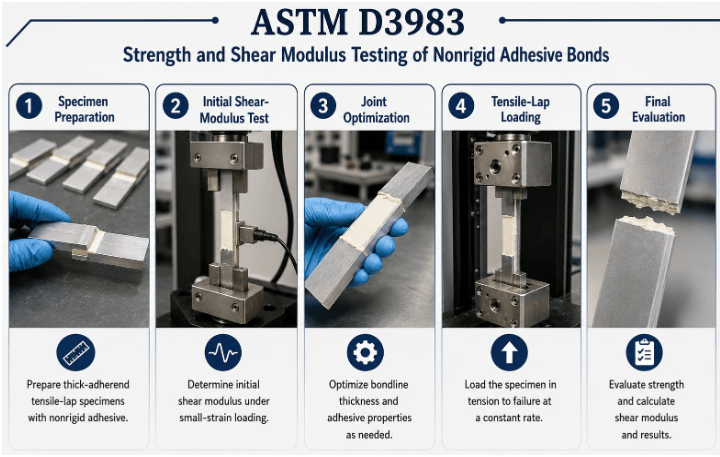
    ASTM D3983 uses load-deformation measurements to determine adhesive shear properties. The shear modulus is estimated as a preliminary step, and the joint geometry is optimized; then test pieces with the optimized geometry are tested. The ASTM D3983 test methods comprise the following test procedure-

    Read more

    Specimen Preparation Technicians prepare the adherends and apply the adhesive under controlled conditions. They use shims or a gluing jig to establish the required adhesive-layer thickness.  
    Initial Shear-Modulus Test  Technicians load the first set of specimens and record the applied load and adherend slip to obtain a preliminary estimate of the adhesive shear modulus. 
    Joint Optimization Engineers use the preliminary shear-modulus value to establish the appropriate joint geometry. Technicians then prepare another set of specimens with the selected geometry. 
    Tensile-Lap Loading Technicians mount each specimen in the tensile testing machine and apply tensile loading through the grips while recording the load and corresponding adherend slip.
    Final Evaluation Technicians analyze the final load-slip response and determine the adhesive shear modulus and maximum nominal shear stress. They record the relevant test conditions and specimen information with the results. 

    ASTM D3983 Testing Process and Data Collection 

    Technicians choose an appropriate adherend type and surface preparation before building thick-adherend lap-shear specimens. They control the overlap length and adhesive thickness, and allow the adhesive to reach its desired strength. Technicians then place each specimen in the tensile testing machine and attach a slip gauge to measure relative movement of the adherends. Technicians apply tensile loading to the specimen in the machine and measure the slip with the LVDTs. The laboratory calculates the load-slip relationship from the collected measurements. Technicians use the initial results to estimate shear modulus and optimize the joint geometry. They perform the testing of the optimized specimens and calculate the final shear modulus, the maximum nominal shear stress, and related adhesion properties.

    This image shows a thick-adherend tensile-lap specimen undergoing ASTM D3983 testing. The process illustrates Specimen Preparation, Initial Shear-Modulus Test, Joint Optimization, Tensile-Lap Loading, and Final Evaluation.
    ASTM D3983 Strength and Shear Modulus Testing of Nonrigid Adhesive Bonds

    Common Challenges and Troubleshooting 

    Technicians closely control several variables to obtain accurate ASTM D3983 results, such as adherend type, surface preparation, adhesive layer thickness, overlap length, alignment, and slip measurement. Incorrect alignment affects the measured deformation and increases rotation of the adherend. Technicians must carefully position the slip-measurement system and, before testing, check the load cell, grips, and displacement-measurement system. They should also keep environmental conditions controlled as may be required by the test program. Standardizing specimen preparation minimizes variation between specimens. Accurate recording of load slip and dimensional measurements helps detect abnormalities and improves the reliability of the calculated shear properties. 

    ASTM D3983 Analysis Results and Interpretation 

    The report provides an overview of the load-deformation response and shear characteristics of the adhesive tested. Technicians use the measured load, bonded area, adhesive layer thickness, and adherend slippage to determine the required shear parameters.

    Read more

    • The lab reports shear modulus in either MPa or psi. This value measures the adhesive’s shear resistance to deformation.
    • The technicians report the maximum nominal shear stress in MPa (or psi). This value represents the highest shear stress applied to the bonded area, based on the average shear stress.
    • The laboratory reports the failure load in either N or lbf. Technicians use this value, along with the bonded area, to calculate nominal shear stress.
    • Technicians measure the adhesive layer thickness and adherend slip in mm or in. They use these measurements to calculate the shear strain and load-deformation characteristics.
    • Technicians use the load-slip relationship to compare the stiffness, deformation, and strength of various adhesive systems.

    Link to  ASTM D3983 

    FAQ

    What Is ASTM D3983?
    ASTM D3983 is a standard test method for measuring the strength and shear modulus of nonrigid adhesives through a tensile test of a thick-adherend tensile-lap specimen.
    ASTM D3983 covers adhesives with shear moduli up to 700 MPa (100,000 psi), provided that the associated adherend and test requirements meet the standard.
    Manufacturers use ASTM D3983 to evaluate and compare the shear modulus, shear strength, and load-deformation characteristics of nonrigid adhesive systems. Engineers use the results for adhesive development, quality control, material selection, and bonded-assembly design.
    Gokula Srinivasan Selvam
    About Author
    Gokula Srinivasan Selvam
    Gokula Srinivasan Selvam is a Material Testing Associate at MaTestLab Inc. and holds a postgraduate degree in Ceramic Engineering from IIT (BHU), Varanasi.
    Testimonials
    Real results
    Engineers trust us with what matters most
    Start Your Testing
    Project Today
    Define your requirements and get access to
    specialized laboratories ready to deliver results
    Partners with us
    Clients
    Vendors
    Process for testing
    • STEP 01

      You share your testing requirements

    • STEP 02

      You share your sample(s)

    • STEP 03

      We deliver your test reports

    Get your testing done

    Let us known your testing requirements and we will be right back with a solution.

      Let us root for each other. Collaborate to grow, expand, and accelerate our businesses.

      Partner with us

        Contact Us

        Discover more from MaTestLab

        Subscribe now to keep reading and get access to the full archive.

        Continue reading