
ASTM D3931 Standard Test Method for Determining Strength of Gap-Filling Adhesive Bonds in Shear by Compression Loading

    What Is ASTM D3931? 

    ASTM D3931 describes a standard test method that defines the comparative shear properties of gap-filling adhesive bonds in wood-to-wood joints. The technique evaluates adhesive bonds under compression loading conditions at a predetermined bondline thickness in dry conditions. Technicians use the method to bond plywood with lumber, lumber with lumber, and other construction materials in a laboratory. Technicians prepare standardized wood assemblies, apply the adhesive, monitor bondline thickness, and condition the bonded assemblies before testing. The test assesses the shear strength of the adhesive bond and supports adhesive development, process quality control, material specifications, and structural design.

    Read more

    Get Certified ASTM D3931 Testing for Reliable Adhesive Bond Strength Performance 

    Gap-filling adhesives provide useful solutions for joining wood pieces when the adhesive needs to fill a gap between the two pieces. The bond must provide sufficient strength to ensure reliable service performance. ASTM D3931 provides a standard test method for determining the shear strength of gap-filling adhesive bonds under compression loading. ASTM D3931 provides a procedure for assessing adhesive bond shear strength under controlled conditions for comparison. Technicians prepare the wood block specimens, apply the adhesive, assemble the wood pieces, control the bondline thickness, condition the bonded assemblies, and apply compression until the wood/adhesive bond fails. Engineers and manufacturers use the results to compare adhesive formulations, support product development, maintain quality control, and evaluate adhesives for wood-to-wood bonding applications.

    What Is the Scope of ASTM D3931? 

    ASTM D3931 gives a standard test method for comparing the shear strength of gap-filling adhesive bonds in compression-loaded wood-to-wood joints. The procedure assesses an adhesive’s ability to adhere at a controlled bondline thickness under specified test conditions. Technicians adopt the method to compare adhesives for bonding plywood to lumber, lumber to lumber, and other wood combinations in the laboratory. The standard uses controlled specimen preparation, adhesive application, bondline thickness, conditioning, and compression loading. Technicians test the maximum load required to break the bond and determine the shear strength of the bond. Engineers use these results to compare adhesive performance and guide adhesive development and quality control.

    Read more

    Why Is ASTM D3931 Important? 

    ASTM D3931 specifies a procedure for determining the shear strength of gap-filled adhesive joints. The shear strength of adhesive bonds in structural components plays a significant role in their performance. Engineers use the test to compare adhesive performance at controlled bondline thicknesses and under compression loading. Manufacturers use the results to develop adhesives and quality-control programs. Engineers also use the measured shear properties to establish material performance specifications and evaluate adhesives for structural applications. 

    ASTM D3931 Equipment and Sample Preparation Guide 

    ASTM D3931 requires a set of wood bonding assemblies with a controlled adhesive bondline, followed by cutting the assemblies to produce testable specimens. Technicians use the compression-loading machine in conjunction with the shearing machine and measuring equipment. Technicians select equipment that meets the required standard dimensions

    Read more

    Sample and Specimen Details Technicians use hard maple blocks with a minimum specific gravity of 0.65, based on oven-dry weight and oven-dry volume, for preparing the adhesive-bond test specimens.  
    Specimen Preparation Analysts surface the maple blocks immediately before gluing and keep the surfaces unsanded and free from dirt. They apply the adhesive and assemble the blocks while controlling the bondline with spacer strips. 
    Specimen DimensionsTechnicians prepare test specimens according to the form and dimensions shown in ASTM D3931. They measure the bond width and length to the nearest 0.010 in. (0.25 mm) before testing.
    Instrumentation Analysts use a compression-testing machine fitted with a shearing tool and self-aligning seat. The machine applies the load continuously at the specified rate and allows technicians to determine the maximum load.

    Testing Procedures and Requirements for ASTM D3931 

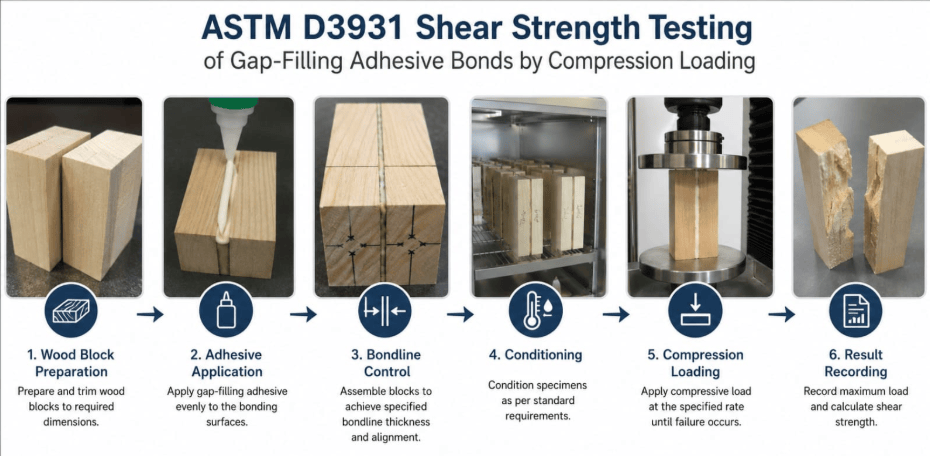
    ASTM D3931 uses controlled adhesive application, bondline thickness, conditioning, and compression loading to determine comparative shear strength. Technicians prepare the bonded assemblies, cut the specimens, and load each specimen until the adhesive bond reaches maximum load.  The ASTM D3931 test methods comprise the following test procedure-

    Read more

    Wood Block Preparation Technicians prepare hard maple blocks and surface the bonding areas immediately before applying the adhesive. They keep the bonding surfaces unsanded and free from dirt.
    Adhesive Application Technicians apply sufficient adhesive to the bonding surfaces and use spacer strips to control the bondline thickness. They assemble the blocks immediately unless the manufacturer and user specify another procedure. 
    Bondline Control & Conditioning Technicians prepare bonds at 0.006 in. (0.15 mm) and 0.060 in. (1.52 mm) thicknesses and condition the bonded assemblies according to the specified requirements. 
    Compression Loading Technicians place each specimen in the testing machine and apply continuous compression through the shearing tool at the specified loading rate. 
    Result Recording Engineers record the maximum load and use the measured load and bond dimensions to determine the adhesive bond strength. 

    ASTM D3931 Testing Process and Data Collection 

    Technicians select the appropriate hard maple blocks for each application and prepare the bonding surfaces before applying the adhesive. They use spacer strips to ensure the proper bondline thickness and apply a 15-lb (7.0-kg) loading force when assembling the blocks. After curing and conditioning the bonded assemblies, technicians cut them into test specimens. They record the width and length of each bond, and place each specimen in the compression-testing machine. The machine applies the load through an appropriate shearing implement until the bond reaches its maximum load. Technicians record the maximum load and bond dimensions and calculate the shear strength of the adhesive bond. 

    This image shows wood-to-wood adhesive specimens undergoing ASTM D3931 testing. The process illustrates Wood Block Preparation, Adhesive Application, Bondline Control, Conditioning, Compression Loading, and Result Recording.
    ASTM D3931 Shear Strength Testing of Gap-Filling Adhesive Bonds by Compression Loading

    Common Challenges and Troubleshooting 

    Technicians control many factors to obtain reliable ASTM D3931 results, including wood selection, conditioning, surface preparation, adhesive application, bondline thickness, curing, and loading. However, air entrapment in bondlines compromises adhesive performance; therefore, technicians should apply the adhesive carefully and achieve adequate squeeze-out to optimize bond performance. Technicians should also remove contaminants from the bonding surfaces during wood preparation and avoid severe bends in the specimens. They must apply the load at the designated rate and ensure proper specimen alignment. In the laboratory, technicians accurately measure the bond dimensions and record the maximum load for each specimen. Laboratories achieve reliable shear-strength results through consistent specimen preparation and testing. 

    ASTM D3931 Analysis Results and Interpretation 

    The report presents an overview of the adhesive bond’s compression shear resistance. Technicians calculate the shear strength using the maximum load and measured bonded area. Engineers compare the results to evaluate adhesive performance at different bondline thicknesses.

    Read more

    • Test reports provide shear-strength values in psi and, where applicable, SI units as mathematical conversions.
    • Technicians record the maximum load applied to each specimen at the point of bond failure.
    • Analysts measure the bond width and bond length, or use the appropriate conversion values, to calculate the bonded area.
    • The calculated shear strength represents the bond’s shear resistance before failure.
    • Engineers compare the mean shear strengths for 0.006-in. and 0.060-in. bondline thicknesses to determine differences in adhesive performance.

    Link to ASTM D3931

    FAQ

    Where can I get the astm d3931 tested?
    You can share your astm d3931 testing requirements with MaTestLab. MaTestLab has a vast network of material testing laboratories, spread across the USA and Canada. We support your all material testing needs ranging from specific astm d3931 test to various testing techniques.
    Please contact us for a detailed quote for your astm d3931 testing needs. Cost incurred to carry out different astm d3931 testing methodology depends on the type of raw material; number of samples, coupons, or specimens; test conditions, turn around time etc. Costs of some ASTM testing methods start from $100 and the final value depends upon the factors listed above. Please contact us for the best and latest prices.
    The required number of samples or specimens should comply with the procedure given in the astm d3931 standard. However, the MaTestLab operations team can assist you for your special requirements once you share your testing details with us.
    MaTestLab has a vast testing laboratory network, hence we bring you the best testing facilities in a cost-effective way. We offer considerable discounts (15-20%) to our returning customers based on test volume and frequency.
    The turnaround time for astm d3931 test methodology depends upon the test procedure mentioned in the standard test document. However, we at MaTestLab understand your research requirements and hence try to get your test completed within the least possible time.
    Malhar Khole
    About Author
    Malhar Khole
    Malhar Khole is a Material Testing Associate at MaTestLab Inc. and holds a postgraduate degree in Material Science and Technology from IIT (BHU), Varanasi.
    Testimonials
    Real results
    Engineers trust us with what matters most
    Start Your Testing
    Project Today
    Define your requirements and get access to
    specialized laboratories ready to deliver results
    Partners with us
    Clients
    Vendors
    Process for testing
    • STEP 01

      You share your testing requirements

    • STEP 02

      You share your sample(s)

    • STEP 03

      We deliver your test reports

    Get your testing done

    Let us known your testing requirements and we will be right back with a solution.

      Let us root for each other. Collaborate to grow, expand, and accelerate our businesses.

      Partner with us

        Contact Us

        Discover more from MaTestLab

        Subscribe now to keep reading and get access to the full archive.

        Continue reading