
ASTM D3833 Standard Test Method for Water Vapor Transmission of Pressure-Sensitive Tapes

    What is ASTM D3833?

    ASTM D3833 describes a test method for measuring the water vapor transmission rate of pressure-sensitive tape. Technicians seal a tape specimen across the test cup opening, using the adhesive to hold the tape against the cup flange, then weigh the assembly in a chamber held at a set temperature and humidity over time. ASTM D3833 (Standard Test Method for Water Vapor Transmission of Pressure-Sensitive Tapes) determines a tape’s relative permeability at its smallest thickness dimension, generally normal to the backing, since the thickness usually forms the main channel for vapor transmission. Manufacturers rely on this test method because a tape’s ability to restrict or allow moisture to pass through affects its performance in packaging, sealing, and protective applications.

    Read more

    Get Certified ASTM D3833 Testing for Reliable Moisture Barrier Performance

    A tape’s performance depends on how effectively it restricts water vapor from passing through after it has been sealed against a moist surface for a period. Thus, an unsubstantiated moisture barrier claim can result in premature seal failure and damage or contamination to the product when the tape arrives in the field. ASTM D3833 provides engineers with a standard test method for water vapor transmission through pressure-sensitive tape used in polymers and plastic applications. Test results provide manufacturers with data for informed decisions during tape formulation, material selection, and quality control of moisture barrier products.
    What is the Scope of the ASTM D3833 Standard?

    ASTM D3833 governs one procedure for measuring the water vapor transmission rate of pressure-sensitive tape. The standard utilizes the adhesive on the tape to seal an opening in a test cup, and the result characterizes the tape backing and adhesive layer as a combined moisture barrier.

    Read more

    The scope of ASTM D3833 includes:

    • Material type: Pressure-sensitive tape, tested over its full cross-section, consisting of backing and adhesive.
    • Purpose: Determination of the relative water vapor permeability of a tape at the smallest dimension, generally normal to the backing.
    • Properties evaluated: Water vapor transmission rate, in addition to the property of the adhesive to hold a seal of the flange of the cup throughout the exposure period.
    • Testing method: A tape specimen seals an opening in a test cup within a chamber held at a specific temperature and humidity, and technicians determine the assembly’s weight change over a specified exposure period.
    • Results: Water vapor transmission rate as weight change per unit of area per unit of time, expressed separately in SI and inch-pound units.
    • Test limitations: A result is only considered if the adhesive of the tape holds its adhesion to the flange of the cup throughout the exposure period, and a failed seal voids the measurement.
    • Use conditions: Technicians hold a chamber at a given temperature and humidity and weigh the assembly at specified intervals until a consistent rate of change presents itself.
    • Applications: Moisture barrier evaluation for tapes in packaging, electronic device sealing, medical dressings, and construction joints.

    What are the Uses of ASTM D3833 Testing?

    ASTM D3833 testing gives manufacturers a standardized procedure for comparing how well different pressure-sensitive tapes resist water vapor. Engineers utilize the resulting transmission rate to select appropriate tapes that can withstand exposure to moist or humid service conditions. This test method:

    • Quantifies the water vapor transmission rate of a pressure-sensitive tape.
    • Supports comparison between different tape formulations and backings.
    • Assesses whether a tape’s adhesive keeps sealing under humid exposure.
    • Assists quality control checks across production batches.
    • Feeds into product development for moisture-barrier tape formulations.
    • Supports material selection for packaging, sealing, and protective applications.

    Which Materials Can Be Tested Under ASTM D3833?

    ASTM D3833 applies to pressure-sensitive tape designed for use as or in addition to a moisture barrier. A technician cuts a circular specimen from the tape and seals it adhesive side down across the test cup opening, and the standard evaluates the tape backing and adhesive as a combined barrier system. Manufacturers often select this test method for tapes used in electronic device sealing, medical dressings, flexible packaging, and construction joint sealing.

    Why is ASTM D3833 Important?

    ASTM D3833 provides the tape industry with a standardized procedure for identifying and comparing a tape’s moisture-barrier performance before it reaches a humid or wet service environment. A tape that allows excessive water vapor to pass through compromises the packaged goods, electronic components, or wound dressings, and a tape whose adhesive fails to maintain a seal presents additional risk. Thus, the results of this test method enable engineers to select a suitable formulation of tape, verify supplier claims, and inform product development for moisture-sensitive applications.

    ASTM D3833 Equipment and Sample Preparation Guide

    ASTM D3833 utilizes a test cup, desiccant to maintain a low-humidity reference environment within the test cup, and a chamber held at a controlled temperature and humidity. Technicians weigh the assembly on a precision balance at specified intervals throughout the exposure period.

    Read more

    Sample and Specimen DetailsTechnicians cut a circular tape specimen, large enough to completely cover the test cup opening, with the release liner removed.
    Specimen PreparationTechnicians seal the specimen, adhesive side down, across the test cup flange, taking care to avoid wrinkles or gaps at the edge.
    Specimen DimensionsA tape specimen, circular in shape, is cut to be large enough to completely cover the test cup opening; a commonly reported specimen diameter is approximately 63.5 mm (2.5 in.).
    InstrumentationThe system consists of a test cup, desiccant charge, controlled temperature and humidity chamber, and precision balance.

    Testing Procedures and Requirements for ASTM D3833

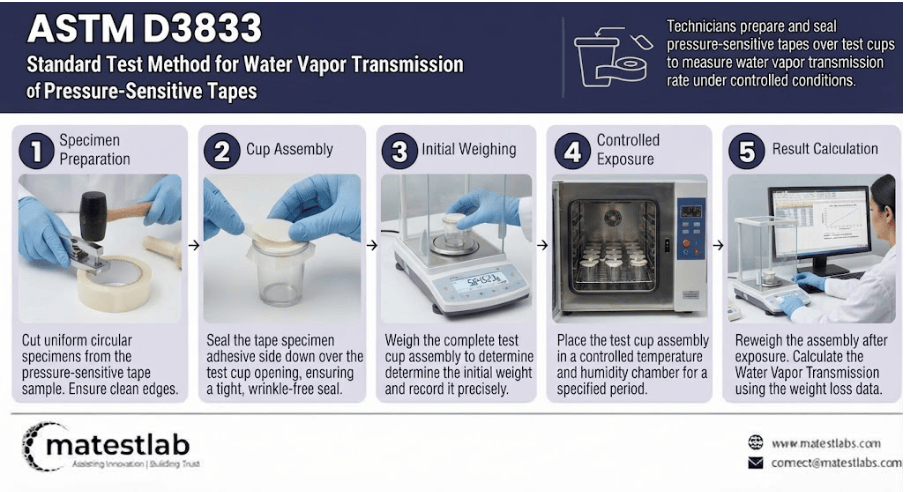
    This test standard dictates sealing a tape specimen across a test cup, exposing the assembly to controlled conditions, and weighing at specified intervals to determine water vapor transmission. The ASTM D3833 test method comprises the following steps-

    Read more

    Specimen PreparationTechnicians cut a circle-shaped tape specimen and remove its release liner prior to sealing.
    Cup AssemblyTechnicians seal the specimen, adhesive side down, across the test cup opening, over the desiccant charge within the test cup.
    Initial WeighingTechnicians record the assembly’s starting weight before exposure begins.
    Controlled ExposureThe assembly sits in a chamber held at a set temperature and humidity for the specified exposure period.
    Periodic WeighingTechnicians reweigh the assembly at intervals indicated by the test procedure to determine the rate of weight change.
    Result CalculationThe analyst determines the water vapor transmission rate from the weight change per unit area per unit time.

    ASTM D3833 Testing Process and Data Collection

    The technician first cuts a circular tape specimen and removes its release liner, then seals the specimen, adhesive side down, across the test cup opening above the desiccant charge. The technician then records the assembly’s initial weight and places it in a chamber held at a fixed temperature and humidity. Next, the technician reweighs the assembly at specified intervals as water vapor passes through the tape and reaches the desiccant, until the rate of weight change stabilizes into a consistent rate. Finally, when a consistent rate of weight change presents itself, the analyst determines the water vapor transmission rate of the tape under study from the recorded weights.

     The image displays the ASTM D3833 sequence from sealing a tape specimen over a test cup through controlled exposure, periodic weighing, and water vapor transmission measurement.
    ASTM D3833 Pressure-Sensitive Tape Testing Sequence for Water Vapor Transmission

    Common Challenges and Troubleshooting in ASTM D3833 Testing

    An inadequate seal between the tape adhesive and the test cup flange allows water vapor to bypass the tape at the edges, making the resulting water vapor transmission rate inaccurate. Temperature or humidity drift within the chamber during the exposure period also alters the vapor pressure gradient needed for transmission, making the resulting water vapor transmission rate inaccurate. Technicians mitigate these issues by carefully sealing the specimen, inspecting the edges before exposure, and controlling chamber conditions throughout the test. Analysts who follow the same sealing and weighing procedure at each interval obtain comparable transmission data across a series of tapes.

    ASTM D3833 Analysis Results and Interpretation

    ASTM D3833 reports the water vapor transmission rate in SI units and inch-pound units, and the standard treats them as separate standards rather than direct conversions of each other.

    Read more

    • Results in SI units appear as grams per square meter per 24 hours, g/(m²·24 h).
    • Results in inch-pound units appear as grams per 100 square inches per 24 hours, g/(100 in²·24 h).
    • A lower rate of water vapor transmission indicates less water vapor transmission through the tape under the given test conditions.
    • A higher rate of water vapor transmission indicates a tape more susceptible to moisture ingress through its smallest dimension.
    • Engineers discard a result if the adhesive stops sealing the cup flange during exposure, since an unintended vapor path through the seal makes the measurement invalid.

    FAQs

    ASTM D3833 measures what property of a tape? 

    ASTM D3833 measures the water vapor transmission rate of pressure-sensitive tape through its smallest dimension, generally normal to the backing.

    ASTM D3833 reports results in which units? 

    ASTM D3833 reports results in SI units, g/(m²·24 h), or inch-pound, g/(100 in²·24 h), and considers them separate standards, rather than equivalent.

    ASTM D3833 requires which specimen preparation? 

    ASTM D3833 requires a circular specimen of tape, approximately 63.5 mm (2.5 in.) in diameter, sealed with its own adhesive across the test cup opening.

    ASTM D3833 considers a result valid under what condition? 

    ASTM D3833 only considers a result valid if the tape’s adhesive keeps sealing the cup flange throughout the full exposure period.

    Link to ASTM D3833

    Updated on September 28, 2026

    Pawan Kumar Mali
    About Author
    Pawan Kumar Mali is a Material Testing Associate at Matestlab Inc. and holds an Integrated Dual Degree (B. Tech + M. Tech) in Metallurgical Engineering from IIT (BHU), Varanasi. His academic background and research experience are centered on Physical Metallurgy, Materials Research, and Data Analytics, strengthened through academic research and industry experience.
    Know More
    Testimonials
    Real results
    Engineers trust us with what matters most
    Why Choose Matestlab?
    Matestlab is a unified testing services partner based in the USA. Matestlab offers raw material and product testing services through accredited, expert laboratories primarily based in the USA. Matestlab supports physical, thermal, chemical, electrical, mechanical, environmental, and characterization testing needs through its global network of 2200+ accredited testing laboratories. Matestlab's in-house materials science experts curate and design comprehensive testing programs matched to the sample material and specific testing need, with regulatory requirements and confidentiality in mind.

    If you are looking for a managed and trusted testing partner to achieve your research goals, feel free to schedule a meeting with us or send us a request at connect@matestlabs.com to learn more about our services. For a quick quote, call us at (302)244-7710. We are happy to serve you.
    Start Your Testing
    Project Today
    Define your requirements and get access to
    specialized laboratories ready to deliver results
    Partners with us
    Clients
    Vendors
    Process for testing
    • STEP 01

      You share your testing requirements

    • STEP 02

      You share your sample(s)

    • STEP 03

      We deliver your test reports

    Get your testing done

    Let us know your testing requirements and we will be right back with a solution.

      Let us root for each other. Collaborate to grow, expand, and accelerate our businesses.

      Partner with us