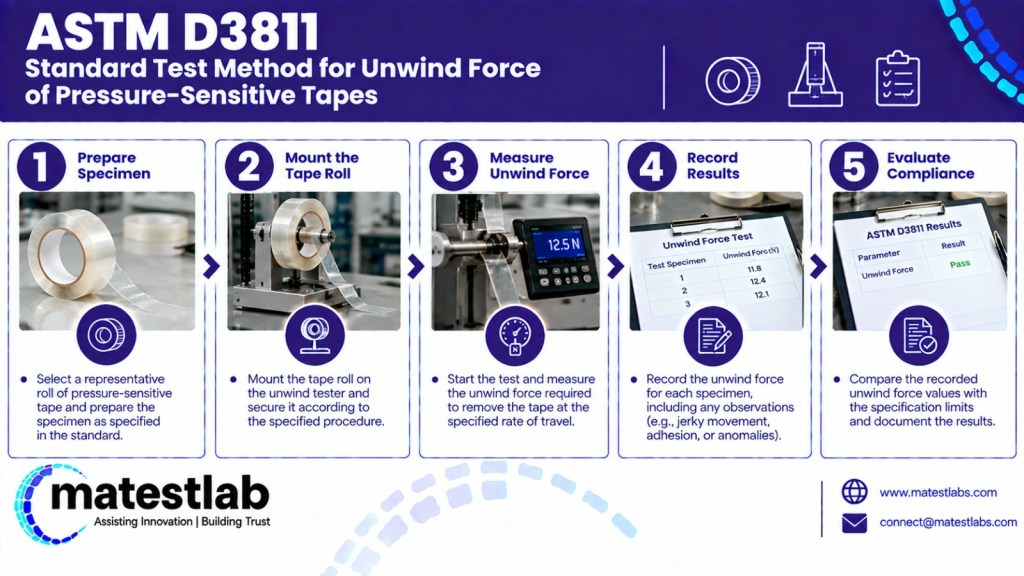
ASTM D3811 specifies one procedure for measuring the force needed to unwind a roll of pressure-sensitive tape. This test method simulates hand and machine unwinding at low rates, and the rate used is not suitable for comparing tapes unwound at high rates. The scope of ASTM D3811 includes:
- Material type: The material type is pressure-sensitive tapes wound on a roll, such as packaging and masking tapes, and specialty adhesive tapes.
- Purpose: The purpose of the testing is to determine the force needed to unwind pressure-sensitive tape at low unwind speeds from a roll.
- Properties evaluated: Unwind force (maximum force measured during unwinding of ~ 150 mm (6 in.) of tape).
- Testing Method: Uncontrolled unwinding of a tape roll at a predetermined very low unwinding speed; unwinding apparatus and force-measuring equipment used.
- Result: Unwind force, which is force per unit width and reported against the max, min, or mean specification value.
- Test Limitations: This test method does not allow comparisons between different tapes unwound at a high rate because unwind force depends on rate, and the response inverts at a specific rate for each construction and manufacturer.
- Environmental conditions: Measured unwind force is dependent on environmental conditions, sample conditioning time, and roll storage history.
- Applications: Quality control for packaging tape, unwind test for masking tape, compatibility test for automatic dispensing equipment, and comparison of pressure-sensitive tape formulation.
What are the Uses of ASTM D3811 Testing?
ASTM D3811 testing enables manufacturers and quality control laboratories to quantify the force necessary for pressure-sensitive tape to be unwrapped from a roll. Product developers and converters then use the results to validate tape dispensing performance and compare formulations. This standard-
- Tests the amount of force required to release pressure-sensitive tapes at low and moderate rates, which are representative of hand and machine operating speeds.
- Compares various formulations of tape for production or quality control.
- Indicates satisfaction when a specification for unwind, maximum, minimum, or mean has been set.
- Assists in forecasting application conduct, for example, smooth unwinding or potential tape snapping.
- Supports ongoing assessment of adhesive-coated tapes and tapes that are coated with protective materials.
- Helps to evaluate the uniformity of the production process from one production run to another.
What Materials Can Be Tested Under ASTM D3811?
ASTM D3811 is applicable to pressure-sensitive tapes wound on a roll or roll form, including many types of tapes, such as packaging tapes, masking tapes, and specialty tapes, as well as materials with adhesive coating and tapes with protective backing. This test method is applicable to low-rate unwinding tapes, typical of hand or machine dispensing, but does not permit comparison of tapes used in high-rate applications. Before proceeding with a test program, the analyst verifies the tape’s unwind rate range and, if specified, the maximum, minimum, and mean unwind forces.
Why is ASTM D3811 Important?
ASTM D3811 evaluates the unwind force of pressure-sensitive tape, which directly affects ease of application, machine handling, and product performance in packaging, automotive, electronics, and construction applications. Excessively low unwind force causes tape to roll off the spool during handling or storage, while excessively high unwind force causes tape to snap, dispense inconsistently, or increase operator fatigue during manual application. The test method highlights the fact that unwind force varies with rate and that a different response occurs at different rates for various tape constructions, allowing laboratories to interpret results accordingly and to prevent inappropriate comparisons of tapes designed to work at different unwind rates.