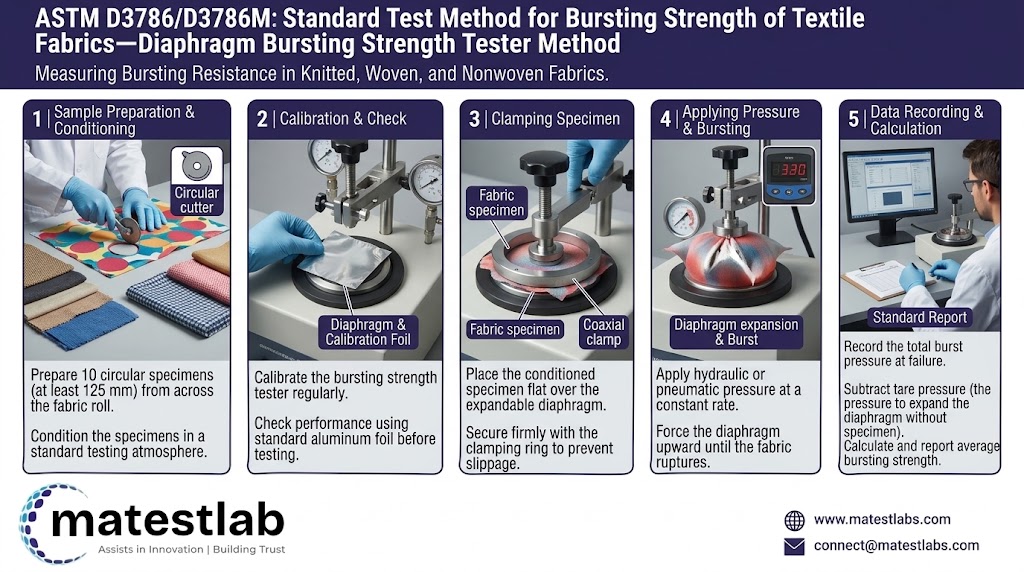
ASTM D3786/D3786M is a standard test method that applies to many knitted, nonwoven, and woven textile fabrics. The method involves the measurement of the hydraulic or pneumatic pressure applied under a diaphragm to cause rupture of the specimen. It can also be used for some stretch-woven and woven industrial fabrics. If outside the operating range of the diaphragm tester, ASTM D3787 or ASTM D6797 may be considered for testing with a ball-burst mechanism. The scope of ASTM D3786/D3786M includes:
- Material: Knitted, nonwoven, and woven textile fabrics.
- Industrial fabrics: Applicable stretch-woven and woven fabrics, including certain inflatable restraint materials.
- Bursting strength: Measurement of resistance to pressure-induced fabric rupture.
- Testing equipment: Use of a hydraulic or pneumatic diaphragm bursting tester.
- Pressure application: Controlled pressure increases beneath the diaphragm until the specimen bursts.
- Test evaluation: Recording the pressure required to cause fabric rupture.
- Quality control: Evaluation of fabric consistency and strength during production.
- Acceptance testing: Assessment of commercial textile shipments against applicable requirements.
- Material comparison: Comparison of fabrics tested under equivalent conditions.
- Equipment limitations: Consideration of alternative ball-burst methods when a fabric exceeds the instrument’s range.
- Units: SI and inch-pound values are treated separately as standard units and should not be combined.
What are the Uses of ASTM D3786/D3786M Testing?
This test subjects textile fabric samples to controlled pressure conditions as prescribed in ASTM D3786/D3786M. The standard provides information on the fabric’s bursting strength for product evaluation, development, quality control, and acceptance testing. Fabric construction, fabric properties, specimen condition, clamping, and test equipment performance can affect measured results. The ASTM D3786/D3786M standard-
- Measures the bursting strength of knitted, nonwoven, and woven fabrics.
- Offers a standard test method for diaphragm bursting.
- Measures the resistance of fabric to a progressively higher hydraulic or pneumatic pressure.
- Helps develop and assess textile products.
- Produces test data for quality control and material verification.
- Assists in comparing fabrics tested under similar laboratory conditions.
- Facilitates acceptance testing of commercial textile shipments.
- Assists in distinguishing differences in fabric strength from lot to lot of production.
- Assesses materials for apparel, upholstery, and other textile uses.
- Facilitates investigation of discrepancies in purchaser and supplier test results.
Which materials can be tested under ASTM D3786/D3786M?
Many knitted, nonwoven, and woven textile fabrics can be tested according to ASTM D3786/D3786M. It can also be used for stretch-woven and woven industrial fabrics, such as some types of inflatable restraints. The specimens should be taken from the fabric under test and prepared and tested as required by the method. Depending on the type of material and testing requirements, materials outside the operating range of the diaphragm tester may need to be tested using another method (e.g., ASTM D3787 or ASTM D6797).
Why is ASTM D3786/D3786M Important?
The significance of ASTM D3786/D3786M is that it is a standardized method of determining the bursting strength of textile fabrics. The method can be used by technicians to determine the resistance of a fabric to rupture caused by pressure under controlled laboratory conditions and to give useful data for quality control, material comparison, and acceptance testing. Uniformly prepared specimens, clamping, and pressure application, as well as uniformity of operation of the test equipment, contribute to the reliability of the test results. But not all the attributes of textile performance in actual service are determined by bursting strength.