
ASTM D3787 Standard Test Method for Bursting Strength of Textiles, Constant-Rate-of-Traverse (CRT) Ball Burst Test

    What is ASTM D3787?

    ASTM D3787 is a standard test method that measures the force required to rupture a textile specimen when a spherical ball moves against the fabric at a controlled rate. It primarily applies to textiles or garments that exhibit a high degree of ultimate elongation. The test clamps the textile specimen between circular plates and drives a ball through the specimen until the fabric ruptures. The test machine records the maximum force required to cause the burst. ASTM identifies D3787 as a textile-industry method used to evaluate a wide variety of materials and for acceptance testing of commercial textile shipments. ASTM D3787 (Standard Test Method for Bursting Strength of Textiles, Constant-Rate-of-Traverse (CRT) Ball Burst Test) uses a constant-rate-of-traverse (CRT) machine. Users should not interchange CRT results with results from constant-rate-of-extension (CRE) equipment because ASTM notes that the two machine types can produce different results. ASTM directs users to D6797 when they use a CRE device.

    Read more

    Get Certified ASTM D3787 Testing for Bursting Strength of Textiles

    The bursting strength of textiles is standardized with the professional ASTM D3787 test. A qualified technician prepares and conditions the textile to be tested, mounts it in the ball-burst fixture, applies the ball at the set traverse rate, and records the force to burst. The findings can be compared in various ways between manufacturers, textile suppliers, garment manufacturers, and buyers and used to assess the performance of various fabrics, as well as commercial fabric shipments. ASTM states that there is no direct correlation between the D3787 results and actual end-use performance, but the method is widely utilized by industry for acceptance testing.

    What is the scope of ASTM D3787?

    ASTM D3787  is a standard test method that provides a controlled procedure for measuring the bursting strength of textiles with a ball-burst mechanism. The method focuses on fabrics or garments that can undergo substantial elongation before rupture. ASTM also distinguishes this CRT method from hydraulic bursting methods and CRE ball-burst methods. The scope of this testing includes:

    Read more

    • Material Type: Textiles and garments with a high degree of ultimate elongation.
    • Property Measured: Bursting strength.
    • Test Method: Constant-rate-of-traverse ball-burst testing.
    • Loading Mechanism: A spherical ball applies force to the clamped textile specimen.
    • Result: Maximum force required to rupture the specimen.
    • Equipment: CRT ball-burst strength tester.
    • Alternative Method: ASTM D3786 covers hydraulic bursting strength, while ASTM D6797 covers CRE ball-burst testing.
    • Units: ASTM recognizes SI and inch-pound units separately; users should not combine the two systems.

    What are the uses of ASTM D3787 testing?

    ASTM D3787 helps textile professionals quantify the force that fabrics can withstand when a concentrated spherical load stretches the material until rupture. The method works particularly well for textile products that exhibit substantial ultimate elongation. The uses of this testing cover:

    • Fabric Evaluation: Determine the bursting strength of textile fabrics.
    • Garment Evaluation: Assess the bursting resistance of selected garment materials.
    • Quality Control: Monitor changes in fabric strength during production.
    • Supplier Qualification: Compare textile materials from different suppliers.
    • Acceptance Testing: Evaluate commercial shipments for bursting-strength requirements.
    • Product Development: Compare fabric constructions during material development.
    • Process Control: Identify changes in textile performance caused by manufacturing variations.

    Which Materials Can Be Tested According to ASTM D3787?

    ASTM D3787 focuses on textiles and garments that exhibit a high degree of ultimate elongation. The method can support evaluation across a wide range of textile products, provided the material and test configuration fall within the method’s intended application.

    • Knitted Fabrics: Evaluate fabrics that can undergo substantial multidirectional deformation.
    • Stretch Textiles: Test materials that exhibit high elongation before rupture.
    • Garment Materials: Evaluate suitable textile sections taken from garments.
    • Woven Textiles: Test suitable woven materials when they meet the method’s applicability requirements.
    • Textile Assemblies: Evaluate applicable textile constructions where the ball-burst method represents the required performance characteristic.

    Why is ASTM D3787 testing important?

    Bursting strength describes how a textile responds when a localized force stretches the fabric in multiple directions. This behavior differs from the uniaxial loading used in conventional tensile testing. ASTM D3787 therefore provides a useful property measurement for textile applications where the material experiences multidirectional deformation. The method also provides a consistent basis for comparing textile specimens under controlled CRT conditions. However, ASTM cautions that D3787 results have not been correlated with actual product performance, so users should interpret the results according to the intended specification or acceptance requirement rather than treating the bursting value as a direct prediction of service life.

    ASTM D3787 Equipment and Sample Preparation Guide

    ASTM D3787 requires a CRT ball-burst testing system that securely clamps the textile and applies a spherical loading element. The test fixture consists of circular clamping plates and a ball/spherical plunger. Specifications for D3787 equipment are included in public descriptions, and the dimensions and settings of all equipment should be checked with the latest version of ASTM against each piece of equipment before performing any tests.

    Read more

    CRT ball-burst testing machineTechnician moves the spherical loading element at a controlled constant rate and measures bursting force.
    Ball-burst fixtureTechnician holds the specimen and provides the controlled loading configuration.
    Conditioning equipmentTechnician brings textile specimens to the required testing condition before measurement.
    Dimensional measurement toolsTechnician verifies specimen and fixture dimensions where required.
    Data-recording systemTechnician records force, test identification, specimen information, and calculated results.
    Specimen Dimensions According to the ASTM D3787 standard, the specimen is at least a 125 mm (5 in.) square or a 125 mm (5 in.) diameter circle.

    ASTM D3787 Testing Procedures and Requirements

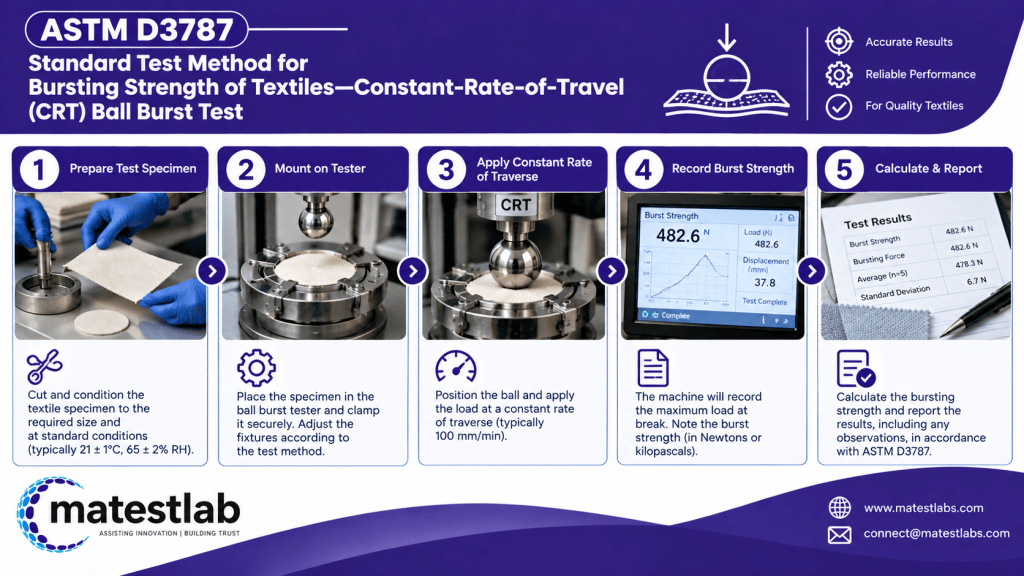
    ASTM D3787 requires the technician to prepare the textile specimen, secure it in the ball-burst fixture, and apply the spherical loading element at a controlled constant rate until the specimen ruptures. The technician then records the maximum bursting force and repeats the test for the required number of specimens. The testing process includes the following steps.

    Read more

    Specimen Identification and ConditioningTechnicians identify representative specimens and establish the required textile testing condition.
    Specimen ClampingTechnicians secure the specimen uniformly between the circular plates and minimize movement during loading.
    CRT Ball-Burst LoadingTechnicians drive the spherical ball against the specimen at the specified constant rate until rupture occurs.
    Burst Force Measurement and ReportingTechnicians record the maximum force at rupture and calculate or report the required bursting-strength result.

    ASTM D3787 Testing Process and Data Collection

    The technician first identifies and prepares representative textile specimens. The technician conditions the specimens according to the applicable textile-conditioning requirements and checks the testing machine, ball-burst fixture, clamping surfaces, and force-measuring system before beginning the test. The technician places the specimen between the circular clamping plates and secures it firmly. The technician positions the spherical ball relative to the specimen and starts the CRT machine. The machine moves the ball against the textile at the specified constant traverse rate and continues loading until the specimen ruptures. The load-measuring system records the force required to produce the burst. The technician records the maximum bursting force for each specimen and identifies any unusual failure, slippage, specimen damage, or test interruption. The analyst then reviews the individual results and calculates the required summary statistics according to the applicable specification or reporting requirement.

     The image shows ASTM D3787 CRT ball-burst test measuring the bursting strength of a textile specimen with a spherical loading ball.
    ASTM D3787 CRT Ball-Burst Testing Process

    Common Challenges and Troubleshooting

    Improper specimen clamping can allow the fabric to slip during loading and produce an inaccurate bursting force. The technician should secure the specimen consistently and inspect the clamping surfaces before each test series. Specimen damage can create premature rupture. The technician should inspect specimens for cuts, holes, creases, contamination, or other defects before testing unless the investigation intentionally targets those defects. Ball or fixture condition can also influence results. The technician should maintain the spherical loading element and clamping components and verify the equipment according to the applicable calibration and maintenance program.

    ASTM D3787 Analysis Results and Interpretation

    ASTM D3787 produces the bursting force required to rupture a textile specimen under the specified CRT ball-burst conditions. The technician records the specimen identification, textile construction or material information where required, conditioning information, test-machine identification, maximum force, and failure observations.

    Read more

    • The analyst compares the individual bursting-force results and calculates the required average or other statistical values specified by the project or material specification. The analyst should evaluate unusually high or low results in relation to specimen condition, clamping, fabric variability, and test behavior rather than automatically removing them from the dataset.
    • The test results are reported in newtons (N) under the SI system or in the applicable inch-pound force unit when that system applies. ASTM requires the SI and inch-pound systems to remain independent because the values are not necessarily exact equivalents.
    • The test report identifies the textile or garment, specimen information, conditioning conditions, equipment and test configuration, individual bursting-force values, calculated summary results, units, and relevant failure observations. The report should also identify the test method as CRT ball-burst testing and distinguish it from hydraulic bursting or CRE ball-burst testing.
    • The measured bursting strength is considered a comparative and acceptance-testing value, not a direct indicator of product performance, and should be compared with other measured values. 

    Link to ASTM D3787

    FAQ

    What happens during the ball-burst test?
    The technician clamps the textile specimen between circular plates and drives a spherical ball against the specimen until the textile ruptures. The system records the maximum force required to produce the burst.
    ASTM D3787 is performed in a ball burst machine using a CRT machine, and ASTM D3786 is performed in a hydraulic or pneumatic diaphragm bursting machine.
    No. ASTM states that D3787 results have not been correlated with actual performance. Users should interpret the results according to the applicable material specification, acceptance requirement, or comparative testing program.

    Updated on October 8, 2026

    Divakar Shukla
    About Author
    Divakar Shukla is an Electrical and Electronics Engineer specializing in the convergence of embedded systems architecture, industrial automation, and applied artificial intelligence.
    Know More
    Testimonials
    Real results
    Engineers trust us with what matters most
    Why Choose Matestlab?
    Matestlab is a unified testing services partner based in the USA. Matestlab offers raw material and product testing services through accredited, expert laboratories primarily based in the USA. Matestlab supports physical, thermal, chemical, electrical, mechanical, environmental, and characterization testing needs through its global network of 2200+ accredited testing laboratories. Matestlab's in-house materials science experts curate and design comprehensive testing programs matched to the sample material and specific testing need, with regulatory requirements and confidentiality in mind.

    If you are looking for a managed and trusted testing partner to achieve your research goals, feel free to schedule a meeting with us or send us a request at connect@matestlabs.com to learn more about our services. For a quick quote, call us at (302)244-7710. We are happy to serve you.
    Start Your Testing
    Project Today
    Define your requirements and get access to
    specialized laboratories ready to deliver results
    Partners with us
    Clients
    Vendors
    Process for testing
    • STEP 01

      You share your testing requirements

    • STEP 02

      You share your sample(s)

    • STEP 03

      We deliver your test reports

    Get your testing done

    Let us know your testing requirements and we will be right back with a solution.

      Let us root for each other. Collaborate to grow, expand, and accelerate our businesses.

      Partner with us