ASTM D3658 Standard Test Method for Determining the Torque Strength of Ultraviolet (UV) Light-Cured Glass/Metal Adhesive Joints
What is ASTM D3658?
ASTM D3658 describes a standard test method for comparing the torque strength of glass/metal adhesive joints cured with ultraviolet (UV) radiation. The method uses standard specimens and specified conditions for specimen preparation, UV exposure, and torque loading. The technique uses UV-bonded hexagonal metal blocks attached to glass plates. Technicians apply a torque to the bonded assembly until the bond breaks. The resulting torque-to-failure data enables laboratories to compare the performance of different bonded joint systems. ASTM D3658 (Standard Test Method for Determining the Torque Strength of Ultraviolet (UV) Light-Cured Glass/Metal Adhesive Joints) provides standardized test conditions for comparing adhesive-joint torque strength.
Get Certified ASTM D3658 Testing for Reliable UV-Cured Adhesive Performance
ASTM D3658 testing provides information on the resistance of UV-curing adhesives to torsional shear forces. Laboratories use the method to study the effect of environmental conditions on torsional shear strength. The method provides a controlled procedure for preparing, curing, loading, and evaluating adhesive joints. This helps manufacturers and laboratories in comparing the adhesive properties under uniform test conditions.
What is the Scope of ASTM D3658?
ASTM D3658 covers the simple comparison of strengths of glass/metal joints when the adhesive is cured with UV radiation, using standard specimens tested under specified preparation, radiation, and load conditions. The ASTM D3658 standard-
Compares the strength of joints made with UV-cured glass/metal.
Uses specified preparation, radiation, loading conditions, and standard specimens.
Applies torque to UV-bonded hexagonal metal blocks attached to glass plates.
Gives relative torque strength-to-failure data.
Assesses comparative torque strength-to-failure data for radiation-cured and non-radiation-cured systems.
What are the Uses of ASTM D3658 Testing?
Laboratories use ASTM D3658 to simulate torque strength of adhesive joints under controlled conditions. The technique compares adhesive systems and investigates changes in torsional shear strength due to environmental exposure. This standard-
Determines the torsional shear strength of UV-cured adhesive joints.
Supports comparison of various adhesive formulations or bonded joint systems.
Assesses the impact that environmental factors have on joint strength.
Helps develop and test adhesive quality.
What Materials Can Be Tested Under ASTM D3658?
ASTM D3658 specifically assesses glass or metal adhesive joints in which the adhesive cures through UV radiation. The standard test specimen comprises a UV-bonded hexagonal metal block attached to a glass plate. The method generates comparative torque strength-to-failure data for other bonded joint systems, whether or not those systems use radiation curing.
Why is ASTM D3658 Important?
ASTM D3658 provides a controlled approach to assess the response of adhesive joints to torsional loads. UV-curing adhesives experience twisting forces in applications where bonded components maintain their connection with rotational loads. The method is reasonably effective for assessing the ability of UV-curing adhesives to resist torsional shearing. Laboratories use it to determine the effect of environmental conditions on torsional shear strength.
ASTM D3658 Equipment and Sample Preparation Guide
ASTM D3658 uses glass plates and hexagonal metal blocks to form the bonded specimens. Technicians prepare the adhesive joint, expose it to the specified UV radiation, and apply torque to the metal block. They also adjust the UV curing and torque loading conditions during the test.
Technicians use a glass plate with a UV-bonded hexagonal metal block. The metal block forms the loading point for the torque test. Metal materials include brass, copper, aluminum, steel, stainless steel, or titanium.
Specimen Preparation
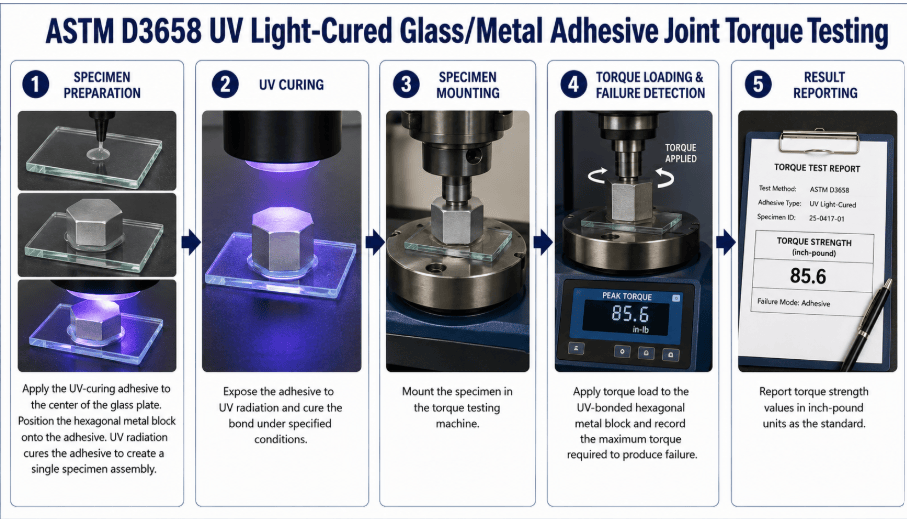
Technicians bond the hexagonal metal block to the center of the glass plate using the UV-curing adhesive. UV radiation cures the adhesive, creating a single specimen assembly.
Specimen Dimensions
The glass plate specimen measures 3 in. x 3 in. x 1/2 in. The metal hexagonal block measures 1 in. across and 1/2 in. thick.
Instrumentation
The test uses a torque testing machine capable of applying torsional load to the specimen, UV curing equipment, and fixtures to hold the specimen during testing.
Testing Procedures and Requirements for ASTM D3658
Technicians prepare and cure standard adhesive specimens per ASTM D3658 before applying torque. The test imposes torque on the UV-bonded metal block until the joints fail. A laboratory description of the method reports a torque application rate of 0.5 rpm and records both the load at failure and the nature and extent of the failure.
Technicians apply the UV-curing adhesive to the center of the glass plate. They then position the hexagonal metal block onto the adhesive. UV radiation cures the adhesive, creating a single specimen assembly.
UV Curing
Technicians expose the adhesive to UV radiation and cure the bond under specified conditions.
Specimen Mounting
Technicians mount the specimen in the torque testing machine.
Torque Loading & Failure Detection
Technicians apply torque load to the UV-bonded hexagonal metal block and record the maximum torque required to produce failure.
Result Reporting
Laboratories report torque strength values in inch-pound units.
ASTM D3658 Testing Process and Data Collection
Technicians first prepare the glass and metal components and form the adhesive joint. Then they subject the joint to a UV dose under the specified curing conditions. According to ASTM D3658, labs adhere to specific preparation, radiation, and loading conditions to achieve the required results. After curing, technicians place the specimen in a holding fixture and secure it to prevent unwanted movement during loading. They then apply torque to the metal block until the joint breaks. Technicians measure the load at failure and note the failure condition and failure severity. These observations provide additional insight into the adhesive joint’s behavior during testing.
Consistent specimen preparation, controlled exposure to UV light, correct specimen alignment, and reliable torque measurement are essential for accurate results. Variations in the adhesive layer, surface preparation, curing conditions, or specimen positioning can affect measured torque strength. The glass and metal parts should be prepared in the same way before each test, and the UV radiation equipment should be checked before the test. They are responsible for ensuring the specimen is held in proper alignment and not sliding side to side when they are applying the torque. The failure load and the nature and extent of failure should be recorded by the technician. These observations aid laboratories in determining the differences in adhesive joint performance and make improved comparisons between test pieces.
ASTM D3658 Analysis Results and Interpretation
The report summarizes the torque performance of the tested UV-cured glass/metal adhesive joints. It records the torque required to produce joint failure together with information about the observed failure.
Rohit Dhembare is an Operations Associate at Matestlab Inc., holds a postgraduate degree in Organic Chemistry and is trained in Materials Science testing techniques. Know More
Testimonials
Real results
Engineers trust us with what matters most
“We had a great experience working with this company for our ASTM E84 testing. They were the first company to respond to our inquiry within just a few minutes of submitting it. From start to finish, the communication was excellent, and the entire process was swift, straightforward, and hassle-free.”
Ivars FancyWalls
United States
“Very good communication, testing associates were very patient with delays on our end. Reasonable turnaround time for results and nicely detailed report. Analysts were also quick to answer any follow-up questions. Happy with results.”
Skye Henderson
United States
“Matestlab connected us with an accredited lab within days, cutting weeks off our product validation timeline.”
Rebecca Kozodoy-Pins
United States
Why Choose Matestlab?
Matestlab is a unified testing services partner based in the USA. Matestlab offers raw material and product testing services through accredited, expert laboratories primarily based in the USA. Matestlab supports physical, thermal, chemical, electrical, mechanical, environmental, and characterization testing needs through its global network of 2200+ accredited testing laboratories. Matestlab's in-house materials science experts curate and design comprehensive testing programs matched to the sample material and specific testing need, with regulatory requirements and confidentiality in mind.
If you are looking for a managed and trusted testing partner to achieve your research goals, feel free to schedule a meeting with us or send us a request at connect@matestlabs.com to learn more about our services. For a quick quote, call us at (302)244-7710. We are happy to serve you.
Start Your Testing Project Today
Define your requirements and get access to specialized laboratories ready to deliver results