
ASTM D3123 Standard Test Method for Spiral Flow of Low-Pressure Thermosetting Molding Compounds

    What is ASTM D3123?

    ASTM D3123 is a standard test method for determining the spiral flow of low-pressure thermosetting molding compounds. This standard measures the flow characteristics of the molding compound as it enters a heated mold and flows through the mold cavity in a spiral pattern under controlled molding conditions. The resulting spiral-flow value indicates the material’s flow characteristics during processing. The ASTM D3123 (Standard Test Method for Spiral Flow of Low-Pressure Thermosetting Molding Compounds) can be used to compare the flow properties of thermosetting molding compounds under specific conditions. The compound is processed in a molding press, and the distance the compound travels through the spiral cavity is measured by technicians. The measured flow length gives comparative information on the molding properties of the compound.

    Read more

    Get Certified ASTM D3123 Testing for Reliable Thermosetting Molding Compounds

    The flow behavior of a thermosetting molding compound affects how effectively the material fills a mold during processing. ASTM D3123 is used for measuring this behavior through spiral flow. Test results can help laboratories evaluate processing characteristics, monitor the consistency of molding compounds, compare molding compounds, and aid in quality-control programs. Manufacturers use this spiral-flow data for material selection where flow control behavior matters. 
    What is the scope of ASTM D3123?

    ASTM D3123 covers the determination of the spiral flow of low-pressure thermosetting molding compounds. The method measures the flow distance obtained by the molding compound under specific molding conditions. This standard-

    Read more

    • Determines spiral flow of thermosetting molding compounds and the flow characteristics of molding compounds during processing.
    • Uses a heated spiral-flow mold and applies controlled molding pressure and temperature.
    • Measures the distance traveled by the molding compound and provides comparative flow data for different compounds.
    • Supports material development and quality control and applies to low-pressure thermosetting molding compounds.

    What are the uses of ASTM D3123 testing?

    ASTM D3123 testing helps manufacturers and laboratories evaluate the flow characteristics of thermosetting molding compounds. The measured spiral-flow value gives comparative data on material flow at the molding conditions used. This testing-

    • Determines the flow characteristics of molding compounds and compares different thermosetting formulations.
    • Supports formulation development; monitors batch-to-batch consistency, quality-control programs, and processing characteristics.
    • Given comparative data for material selection and supports molding-process development.

    Which Materials Can Be Tested Under ASTM D3123?

    ASTM D3123 is used for low-pressure thermosetting molding compounds. Laboratories can use this method to compare the flow behavior of appropriate molding compounds under controlled molding conditions.

    Why is ASTM D3123 important?

    ASTM D3123 provides a standardized way to compare the flow characteristics of low-pressure thermosetting molding compounds. The flow behavior can affect the fullness of the compound in the mold and the ability to fill the various portions of the mold cavity.

    ASTM D3123 Equipment and Sample Preparation Guide

    ASTM D3123 requires a molding system and spiral-flow mold that can maintain the specified processing conditions. Technicians prepare a representative molding compound and fill the required quantity into the heated mold.

    Read more

    Sample and Specimen DetailsTechnicians use representative samples of low-pressure thermosetting molding compound for spiral-flow testing.
    Specimen PreparationTechnicians prepare and condition the molding compound as required, load the specified material into the heated spiral-flow mold, and apply the prescribed molding conditions.
    Specimen DimensionsThe molded spiral serves as the flow path, and the laboratory measures the flow length.
    InstrumentationHeated molding press, spiral-flow mold, pressure-control system, temperature-control system, timer, measuring scale or suitable flow-length measuring device, and sample weighing equipment.

    Testing Procedures and Requirements for ASTM D3123

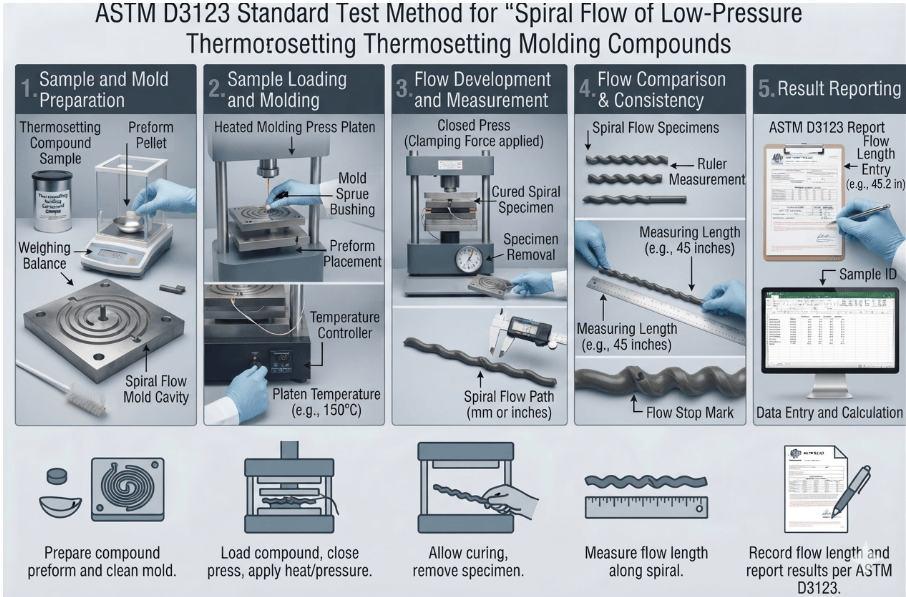
    ASTM D3123 determines spiral flow by molding the thermosetting compound under controlled conditions and measuring the distance that the material travels through the spiral cavity. The testing procedures and requirements for ASTM D3123 are given as-

    Read more

    Sample and Mold PreparationTechnicians select and prepare a representative thermosetting molding-compound sample and set up and preheat the spiral-flow mold to required molding conditions.
    Sample Loading and MoldingTechnicians place the required molding compound into the mold and apply the specified molding pressure, temperature, and molding time.
    Flow Development and Measurement Then, analysts apply the specified molding pressure, temperature, and molding time. They remove the molded spiral and measure the distance the material reached.
    Result ReportingTechnicians document the spiral-flow value together with the applicable material and molding conditions.

    ASTM D3123 Testing Process and Data Collection

    Technicians first choose a representative sample of the thermosetting molding compound and make the spiral-flow mold. Technicians then place the required compound into the heated mold and apply the appropriate molding conditions. The material is allowed to reach its final flow position as the compound flows through the spiral cavity in the laboratory. The analyst then removes the molded spiral and measures the flow distance. The analyst records the spiral-flow value, material identification, molding conditions, and observations. Reliable comparative results require consistent temperature, pressure, time, sample preparation, and measurement procedures.

    This image shows a heated molding press used for heating as per ASTM D3123.
    ASTM D3123 Heated Molding Press

    Common Challenges and Troubleshooting

    Several factors can influence spiral-flow results. Technicians should keep molding conditions and sample preparation consistent to reduce variation. Common challenges include incorrect molding temperature, inconsistent molding pressure, incorrect molding time, improper sample quantity, inadequate mold heating, and mold contamination. Technicians should test the mold temperature, pressure, timer, and measurement equipment before testing. They should also thoroughly clean the spiral-flow mold between tests and handle the samples consistently.

    ASTM D3123 Analysis Results and Interpretation

    • The test measures the flow characteristics of low-pressure thermosetting molding compounds during molding. 
    • Laboratories determine the spiral-flow result by measuring the distance traveled by the compound through the spiral cavity.
    • Laboratories report results for flow length in inches (in.) and sometimes convert them into millimeters (mm). 
    • A greater spiral-flow value indicates that the material travels farther through the spiral cavity under the specified conditions.
    • Laboratories should report the molding conditions: temperature, pressure, time, sample details, and measured flow length, as these can affect the result.

    FAQs 

    What is ASTM D3123?

    Read more

    ASTM D3123 is a standard test method for determining the spiral flow of low-pressure thermosetting molding compounds.

    What material does ASTM D3123 test?

    The method applies to low-pressure thermosetting molding compounds.

    Which units are used for ASTM D3123 results? 

    Laboratories commonly report spiral-flow distance in inches (in.) under the standard inch-pound system.

    Why is spiral flow important? 

    Spiral flow provides comparative information about the processing and mold-filling behavior of thermosetting molding compounds. The manufacturer can use the results for comparison of formulations, quality control, and selection of materials.

    Link to ASTM D3123

    FAQ

    Where can I get the astm d3123 tested?
    You can share your astm d3123 testing requirements with MaTestLab. MaTestLab has a vast network of material testing laboratories, spread across the USA and Canada. We support your all material testing needs ranging from specific astm d3123 test to various testing techniques.
    Please contact us for a detailed quote for your astm d3123 testing needs. Cost incurred to carry out different astm d3123 testing methodology depends on the type of raw material; number of samples, coupons, or specimens; test conditions, turn around time etc. Costs of some ASTM testing methods start from $100 and the final value depends upon the factors listed above. Please contact us for the best and latest prices.
    The required number of samples or specimens should comply with the procedure given in the astm d3123 standard. However, the MaTestLab operations team can assist you for your special requirements once you share your testing details with us.
    MaTestLab has a vast testing laboratory network, hence we bring you the best testing facilities in a cost-effective way. We offer considerable discounts (15-20%) to our returning customers based on test volume and frequency.
    The turnaround time for astm d3123 test methodology depends upon the test procedure mentioned in the standard test document. However, we at MaTestLab understand your research requirements and hence try to get your test completed within the least possible time.
    Rohit Dhembare
    About Author
    Rohit Dhembare
    Rohit Dhembare is an Operations Associate at MaTestLab Inc. and holds a postgraduate degree in Organic Chemistry.
    Testimonials
    Real results
    Engineers trust us with what matters most
    Start Your Testing
    Project Today
    Define your requirements and get access to
    specialized laboratories ready to deliver results
    Partners with us
    Clients
    Vendors
    Process for testing
    • STEP 01

      You share your testing requirements

    • STEP 02

      You share your sample(s)

    • STEP 03

      We deliver your test reports

    Get your testing done

    Let us known your testing requirements and we will be right back with a solution.

      Let us root for each other. Collaborate to grow, expand, and accelerate our businesses.

      Partner with us

        Contact Us

        Discover more from MaTestLab

        Subscribe now to keep reading and get access to the full archive.

        Continue reading