
ASTM D3016 is a standard practice that defines the terms, symbols, and relationships used in liquid exclusion chromatography (LEC). The practice facilitates consistent terminology across liquid exclusion chromatography and other chromatographic techniques. Liquid exclusion chromatography includes techniques commonly known as gel filtration chromatography (GFC) and gel permeation chromatography (GPC). ASTM D3016 defines terms for the chromatographic system, chromatographic column, eluents, detectors, chromatogram, molecular size, and related chromatographic relationships. ASTM D3016 (Standard Practice for Use of Liquid Exclusion Chromatography Terms and Relationships) defines the terms, symbols, and relationships used in liquid exclusion chromatography (LEC). Technicians should use proper analysis methods and follow ASTM D3016 terminology when documenting work.
ASTM D3016 Standard Practice for Use of Liquid Exclusion Chromatography Terms and Relationships
What is ASTM D3016?
What is the scope of the ASTM D3016 practice?
ASTM D3016 covers the definitions of terms and symbols most often used in liquid exclusion chromatography. The practice also creates relationships to describe chromatographic measurements. ASTM notes that it can incorporate additional terms and relationships as the technique develops. The ASTM D3016 standard-
- Defines terminology used in liquid exclusion chromatography.
- Establishes symbols used to describe chromatographic measurements and defines relationships used in LEC calculations and interpretation.
- Covers terminology associated with chromatographic columns and equipment.
- Provides terminology related to eluents and sample introduction.
- Provides terminology relevant to molecular-weight and molecular-size characterization.
What are the uses of ASTM D3016 practice?
ASTM D3016 is primarily a terminology and calculation reference practice, not a laboratory test method that delivers a single physical property value. Laboratories and analysts use its terms and relationships to discuss, document, and interpret liquid exclusion chromatography. This standard-
- Establishes consistent LEC terminology and supports preparation of laboratory reports and technical documents.
- Helps analysts describe chromatographic equipment, procedures, and chromatogram interpretation.
- Helps laboratories communicate molecular-weight and molecular-size information.
- Supports polymer characterization using GPC and related LEC techniques.
Which materials can be tested under ASTM D3016?
ASTM D3016 is not a material-specific test method, so it does not specify a material or specimen type for direct use. The terminology is used for liquid exclusion chromatography, including polymer analysis and related chromatography.
Why is ASTM D3016 Important?
ASTM D3016 provides a common technical language for liquid exclusion chromatography. Analysts can use consistent terms and symbols to describe columns, eluents, chromatograms, molecular-weight distributions, and chromatographic relationships.
ASTM D3016 Equipment and Sample Preparation Guide
ASTM D3016 is a guide that defines terminology and relationships, not a specific analytical test. Analysts select LEC equipment and sample preparation procedures based on the analytical application.
| Sample and Specimen Details | Laboratories use liquid exclusion chromatography samples, such as polymer solutions, for molecular-weight or molecular-size characterization. |
| Sample Preparation | Analysts prepare and dissolve samples as specified in the selected LEC procedure, solvent system, concentration, and instrument. |
| Instrumentation | Liquid exclusion chromatography/GPC system, chromatographic column, solvent or eluent delivery system, sample injector, detector, data-acquisition system, and suitable sample-preparation equipment. |
Testing Procedures and Requirements for ASTM D3016
ASTM D3016 is a standard for terminology and relationships for performing liquid exclusion chromatography in the laboratory. Testing procedures and requirements for ASTM D3016 are given below-
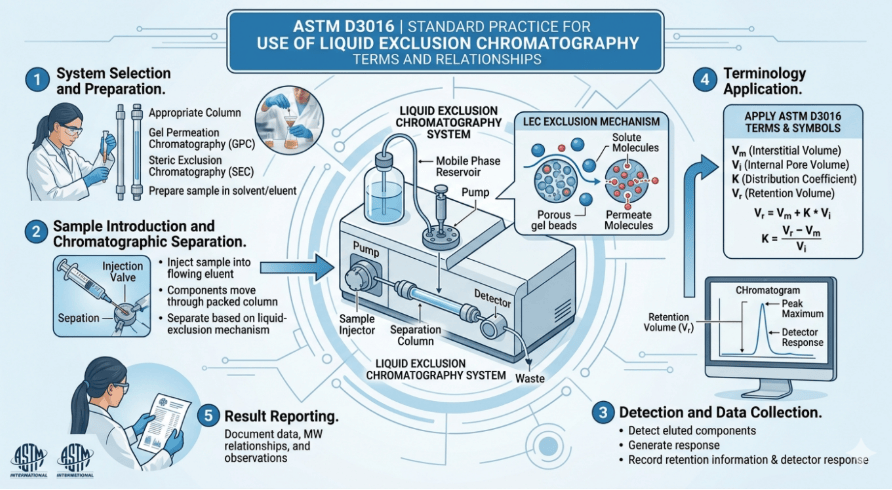
| System Selection and Preparation | Technicians select an appropriate liquid exclusion chromatography system and column and prepare the sample in an appropriate solvent/eluent according to the applicable procedure. |
| Sample Introduction and Chromatographic Separation | Then, they inject the prepared sample into the flowing eluent via the injection system, and sample components move through the packed column and separate based on the liquid-exclusion mechanism. |
| Detection and Data Collection | Analysts detect the eluted components, generate the chromatographic response, and record retention/elution information and detector response. |
| Terminology Application | Analysts use ASTM D3016 terms, symbols, and relationships when describing the chromatographic system and results. |
| Result Reporting | Laboratories document the relevant chromatographic data, molecular-weight data, relationships, and analytical observations. |
ASTM D3016 Testing Process and Data Collection
Technicians first choose an appropriate liquid exclusion chromatography system, column, eluent, and detector, and select a sample preparation procedure. Then they mix up the sample and put it into the chromatographic system. The column separates sample components by liquid-exclusion mechanisms and records responses as components elute from the column, and the data system generates the chromatogram. Laboratories can collect information such as retention volume and time, chromatographic peak response, and peak width and peak characteristics.
Common Challenges and Troubleshooting
For correct interpretation of liquid exclusion chromatography, use uniform terms, proper apparatus configuration, and proper sample preparation. Analysts may be confused because different analysts use different definitions, symbols, and calculation methods. Typical problems include poor chromatography terminology, incorrect use of LEC symbols, improper selection, insufficient sample dissolution, instrument calibration issues, and detector response variation. ASTM D3016 terminology and appropriate analysis procedures should be followed in documenting work in laboratories.
ASTM D3016 Analysis Results and Interpretation
- Laboratories report chromatographic measurements based on the selected LEC procedure and instrument configuration.
- Laboratories report results for elute volume in mL, molecular weight in g/mol, and elution time in s.
- Laboratories report detector responses according to the detector and analytical system used.
- Chromatographers utilize the standardized terminology and relationships from the ASTM D3016 to describe and interpret chromatographic data.
Get Certified ASTM D3016 for Reliable Liquid Exclusion Chromatography Analysis
Consistent terminology helps manufacturers to communicate chromatographic results accurately. ASTM D3016 provides definitions and symbols widely used to describe liquid exclusion chromatography procedures and results in technical terms. This practice supports interpretation and reporting in polymer analysis, molecular-weight characterization, and liquid exclusion chromatography applications.
Updated on August 26, 2026


If you are looking for a managed and trusted testing partner to achieve your research goals, feel free to schedule a meeting with us or send us a request at connect@matestlabs.com to learn more about our services. For a quick quote, call us at (302)244-7710. We are happy to serve you.
Project Today
specialized laboratories ready to deliver results