ASTM D2976 Standard Test Method for pH of Peat Materials

    What is ASTM D2976? 

    ASTM D2976 outlines a standard test method for measuring the pH of peat materials used as a growing medium. The method determines the degree of acidity or alkalinity of peat suspended in test water and a 0.01 M calcium chloride solution. Laboratories measure pH in both liquids because salt in peat may affect water pH, and the calcium chloride solution gives an alternative indication of peat acidity. This method applies only to peat used as a growing medium. ASTM D2976 (Standard Test Method for pH of Peat Materials) is a standard test method for measuring the pH of peat materials used as a growing medium. Technicians should collect representative specimens, check the pH meter before use, and maintain proper solution concentration and conditions for mixing and standing to obtain reproducible results.

    Read more

    Get Certified ASTM D2976 Testing for Reliable Peat Material Characterization  

    Peat pH provides important information about the chemical environment surrounding plants. Laboratories can use ASTM D2976 to determine peat acidity or alkalinity and evaluate its suitability as a growing medium. The pH results allow manufacturers to characterize peat materials and determine their suitability for plant-growth uses. ASTM recognizes peat pH as a valuable indicator of mineral solubility, ion mobility, and the peat-plant environment

    What is the scope of the ASTM D2976 test standard? 

    ASTM D2976 is the standard for measuring pH in peat growing media. Laboratories take representative peat specimens and suspend them in test water and 0.01 M calcium chloride solution to measure the pH of both suspensions. The ASTM D2976 standard-

    Read more

    • Measures the pH of peat materials, degree of acidity or alkalinity, measures pH in test water, and applies to peat materials used as growing media.
    • Measures pH in a 0.01 M calcium chloride solution. 
    • Uses both liquids to fully characterize peat pH.
    • Supports evaluation of the peat-plant environment.

    What are the uses of ASTM D2976 testing? 

    ASTM D2976 testing helps laboratories characterize the chemical state of peat used for plant growth. The measured pH can help manufacturers assess peat interactions with minerals, ions, and plant environments. This testing-

    • Determines the acidity or alkalinity of peat for growing media use.
    • Supports evaluation of mineral solubility and ion mobility within peat.
    • Provides pH measurements in both water and calcium chloride solutions.
    • Helps manufacturers characterize peat products.

    Which materials can be tested under ASTM D2976? 

    ASTM D2976 is for peat used as growing media. Laboratories obtain representative samples from the bulk peat and prepare two similar test specimens for measurement.

    Why is ASTM D2976 Important?

    ASTM D2976 provides a consistent procedure for determining peat acidity and alkalinity. Testing in both solutions (water and calcium chloride) gives laboratories two complementary pH measurements and helps determine the chemical characteristics of peat more accurately.

    ASTM D2976 Equipment and Sample Preparation Guide

    ASTM D2976 requires a calibrated pH measurement system and suitable equipment for preparing and conditioning the peat suspensions. This standard provides a pH meter with an electrode system, a specimen mixing container, a thermometric device, and an optional balance for preparing solutions.

    Read more

    Sample and Specimen DetailsLaboratories obtain a representative peat sample from the bulk material and prepare two similar test specimens.
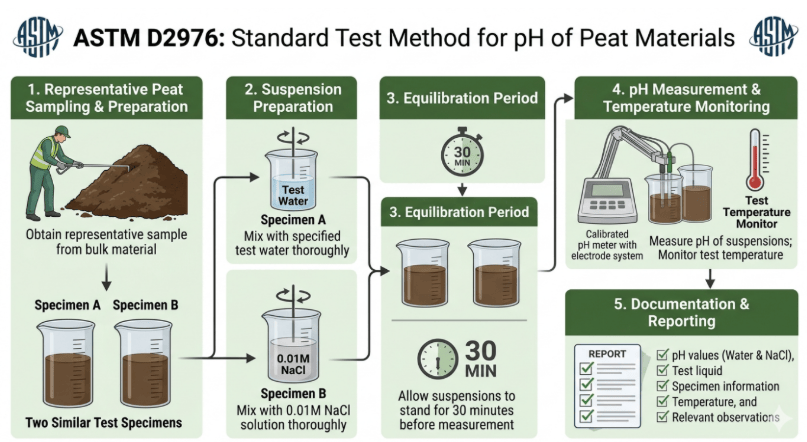
    Specimen PreparationTechnicians mix one specimen with test water and the other with 0.01 M chloride solution. They thoroughly stir the suspensions and allow them to stand for 30 min before pH measurement.
    Specimen DimensionsTechnicians prepare 3.0 grams of air-dried peat test specimens according to ASTM D2976.
    Instrumentation pH meter with electrode system, glass beaker or other inert mixing vessel, thermometric device, and balance when required for solution preparation.

    Testing Procedures and Requirements for ASTM D2976

    ASTM D2976 uses two similar peat specimens to obtain pH measurements in different liquid environments. Technicians prepare the test suspensions, allow them to equilibrate, and then measure their pH with a suitable pH meter. The testing procedures and requirements for ASTM D2976 are given as-

    Read more

    Sample Selection and Preparation Technicians obtain a representative peat sample from the bulk material and prepare two similar test specimens that represent the peat sample.
    Water and Calcium Chloride SuspensionThen, they mix one specimen with the specified test water and the other with a 0.01 M sodium chloride solution, and mix them thoroughly. 
    Standing Period and pH MeasurementThen, technicians allow the suspensions to stand for 30 min before measurement and use a calibrated pH meter with an electrode system to measure pH. 
    Temperature MeasurementLaboratories monitor the test temperature using the specified thermometric device.
    Result RecordingLaboratories document the pH values, test liquid, specimen information, temperature, and relevant observations.

    ASTM D2976 Testing Process and Data Collection

    Technicians first obtain representative peat samples, prepare two similar test specimens, suspend one sample in test water and the other in a 0.01 M sodium chloride solution, and then thoroughly mix both suspensions and allow them to stand for 30 minutes.  Next, technicians measure the pH of each suspension with a pH meter and document the pH measurement, test solution, specimen identification, temperature, and relevant observations.

    This image depicts a pH meter used to check the pH of peat as per ASTM D2946.
    ASTM D2976 pH of Peat Materials

    Common Challenges and Troubleshooting

    Reliable, reproducible ASTM D2976 results require representative sampling, proper preparation, suitable equipment, and controlled testing conditions. The ASTM standard notes that reliable results depend on personnel competence and the suitability of equipment and facilities. Common challenges include nonrepresentative peat sampling, incorrect calcium chloride concentration, poor mixing, incorrect standing time, electrode contamination, improper pH meter equilibration, and incorrect temperature measurement. Technicians should collect representative specimens, check the pH meter before use, and maintain proper solution concentration and conditions for mixing and standing.

    ASTM D2976 Analysis Results and Interpretation

    • ASTM D2976 results are reported as pH values for peat suspensions in test water and 0.01 M calcium chloride solution. 
    • The test provides two pH results because both liquid environments help characterize the peat’s pH behavior.
    • The pH meter should provide readability and accuracy of 0.1 pH unit or better.
    • The calcium chloride measurement typically results in a lower pH than the water measurement because the solution may encourage increased hydrogen-ion release through cation exchange.

    Link to ASTM D2976

    Read more

    FAQ

    Where can I get the astm d2976 tested?
    You can share your astm d2976 testing requirements with MaTestLab. MaTestLab has a vast network of material testing laboratories, spread across the USA and Canada. We support your all material testing needs ranging from specific astm d2976 test to various testing techniques.
    Please contact us for a detailed quote for your astm d2976 testing needs. Cost incurred to carry out different astm d2976 testing methodology depends on the type of raw material; number of samples, coupons, or specimens; test conditions, turn around time etc. Costs of some ASTM testing methods start from $100 and the final value depends upon the factors listed above. Please contact us for the best and latest prices.
    The required number of samples or specimens should comply with the procedure given in the astm d2976 standard. However, the MaTestLab operations team can assist you for your special requirements once you share your testing details with us.
    MaTestLab has a vast testing laboratory network, hence we bring you the best testing facilities in a cost-effective way. We offer considerable discounts (15-20%) to our returning customers based on test volume and frequency.
    The turnaround time for astm d2976 test methodology depends upon the test procedure mentioned in the standard test document. However, we at MaTestLab understand your research requirements and hence try to get your test completed within the least possible time.
    Malhar Khole
    About Author
    Malhar Khole
    Malhar Khole is a Material Testing Associate at MaTestLab Inc. and holds a postgraduate degree in Material Science and Technology from IIT (BHU), Varanasi.
    Testimonials
    Real results
    Engineers trust us with what matters most
    Start Your Testing
    Project Today
    Define your requirements and get access to
    specialized laboratories ready to deliver results
    Partners with us
    Clients
    Vendors
    Process for testing
    • STEP 01

      You share your testing requirements

    • STEP 02

      You share your sample(s)

    • STEP 03

      We deliver your test reports

    Get your testing done

    Let us known your testing requirements and we will be right back with a solution.

      Let us root for each other. Collaborate to grow, expand, and accelerate our businesses.

      Partner with us

        Contact Us

        Discover more from MaTestLab

        Subscribe now to keep reading and get access to the full archive.

        Continue reading