ASTM D2923 Standard Test Method for Rigidity of Polyolefin Film and Sheeting
What is ASTM D2923?
ASTM D2923 is a standard test method for measuring the rigidity of polyolefin film and sheeting. The method describes two procedures for evaluating flexural resistance in polyolefin webs. Procedure A uses high-voltage static elimination and TFE-fluorocarbon-coated plates, while Procedure B uses a fine powder on uncoated plates to reduce the effects of static electricity and friction. Rigidity depends on film or sheet thickness and the inherent material stiffness. Overall, rigidity affects how the material responds during converting and packaging. The ASTM method states that rigidity may affect a web’s machinability if a cut piece of web remains temporarily flat without support on all sides. ASTM D2923 (Standard Test Method for Rigidity of Polyolefin Film and Sheeting) specifies a standard test method for measuring the rigidity of polyolefin film and sheeting.
Get Certified ASTM D2923 Testing for Reliable Polyolefin Film and Sheeting
Polyolefin films and sheets need suitable rigidity to maintain their shape and perform consistently during handling and converting. ASTM D2923 specifies a standardized procedure for determining this property under controlled laboratory conditions. Manufacturers use the results to assess film-handling properties, compare polyolefin materials, and support quality control of film and sheeting products.
What is the scope of the ASTM D2923 test standard?
ASTM D2923 covers measuring rigidity in polyolefin film and sheeting. It provides two procedures that reduce the influence of static electricity and friction during testing. The ASTM D2923 standard-
Measures the rigidity of polyolefin film and sheeting.
Provides Procedure A using high-voltage static eliminators and PTFE-fluorocarbon-coated plates.
Provides Procedure B using a fine powder on uncoated plates.
Reduces the effects of static electricity and friction during measurement.
Understands that the two procedures can yield different outcomes.
What are the uses of ASTM D2923 testing?
Laboratories use the ASTM D2923 test method to determine how readily polyolefin film or sheeting resists flexure. Manufacturers can use the measured rigidity to assess handling and converting performance and to compare materials or production lots. This testing-
Measures film rigidity of polyolefins and flexure resistance and supports film and sheeting quality control.
Helps compare different polyolefin materials and evaluate machinability.
Helps assess whether a cut web can remain temporarily flat.
Facilitates materials selection for conversion and packaging applications.
Which materials can be tested under ASTM D2923?
ASTM D2923 applies to polyolefin film and sheeting. Laboratories can use the method to evaluate the rigidity of these flexible polymeric materials when they need to characterize flexural resistance.
Why is ASTM D2923 important?
ASTM D2923 is a standard method for measuring a property that directly impacts the handling and machinability of polyolefin webs. Film rigidity varies with thickness and inherent material stiffness, so laboratories use specific methods to evaluate their combined effects. Procedure A and Procedure B use different approaches to minimize these effects.
ASTM D2923 Equipment and Sample Preparation Guide
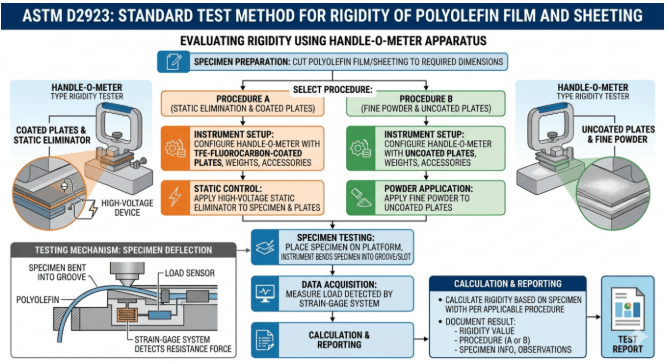
Laboratories use a Handle-O-Meter or equivalent apparatus to measure rigidity following ASTM D2923. Laboratories use TFE-fluorocarbon-coated plates and a high-voltage static eliminator for procedure A and a Handle-O-Meter with fine powder on uncoated plates for procedure B.
Technicians prepare polyolefin film or sheeting specimens for rigidity measurement.
Specimen Preparation
Technicians clean the prepared specimens and select the appropriate procedure (A or B) for testing. Procedure A involves static elimination and coated plates; Procedure B involves fine powder and uncoated plates.
Specimen Dimensions
Then, laboratories identify a cutting board or template suitable for preparing 203 × 203 mm (8.0 × 8.0 in.) specimens.
Instrumentation
Handle-O-Meter or equivalent rigidity tester, calibrating and augmenting weights, cutting board or specimen template, high-voltage static eliminator and generator for Procedure A, TFE-fluorocarbon-coated plates for Procedure A, and fine powder for Procedure B.
Testing Procedures and Requirements for ASTM D2923
ASTM D2923 determines the flexing resistance of films and sheets by a beam and strain-gage method. The apparatus pushes the specimen into a groove or slot in a horizontal platform, and the instrument measures the load. Other reference documents include D618 and D1898. The testing procedures and requirements for ASTM D2923 are given as-
Technicians prepare the polyolefin film or sheeting specimen to specific dimensions and select Procedure A (static elimination and coated plates) or Procedure B (fine powder and uncoated plates).
Apparatus Setup
The technician sets up the Handle-O-Meter or similar apparatus with the required plates, weights, and accessories.
Static and Friction Control
Laboratories use high-voltage static eliminators and PTFE-fluorocarbon-coated plates for Procedure A or fine powder on uncoated plates for Procedure B.
Rigidity and Load Measurement
The technician then places the specimen on the platform and lets the instrument bend it into the groove/slot. Then, they measure the load detected by the strain gauge system.
Result Calculation and Reporting
Laboratories calculate the measured rigidity based on the specimen width, per the applicable procedure, and document the rigidity result, procedure used, specimen information, and test observations.
ASTM D2923 Testing Process and Data Collection
Technicians first select representative polyolefin film or sheeting specimens and choose procedure A or B based on the desired testing conditions. Then, they place the specimens on a rigidity tester and apply specific methods to control static electricity and friction. The apparatus bends the specimen to the specified groove or slot to measure the load. Laboratories document sample rigidity with specimen identification, the chosen method, and relevant observations. When the material has directional properties, laboratories may evaluate specimens in the appropriate orientations to characterize the material consistently.
ASTM D2923 Handle-O-Meter Apparatus
Common Challenges and Troubleshooting
Consistent specimen preparation is required for accurate, reliable testing, and static electricity and friction must be properly controlled. ASTM D2923 includes two procedures, as they can affect the measurement. Some of the common problems are: the dimensions of the specimen are not correct; the apparatus is not set up correctly; the specimen rubs against the test surfaces; static electricity occurs; Procedure A or Procedure B is not correctly used; the orientation of the specimen is not the same; the instrument is not truly calibrated; and the film thickness is not consistent. Technicians should ensure the specimen is clean, test the apparatus before testing the specimen, control static and friction, and use the same testing procedure when comparing different materials.
ASTM D2923 Analysis Results and Interpretation
Laboratories report ASTM D2923 results as rigidity, based on the measured resistance to flexure of the polyolefin film or sheeting.
Laboratories present rigidity results in g/cm (grams of specimen width).
Laboratories measure rigidity with specimen identification, choose a method, and make relevant observations.
When the material has directional properties, laboratories may evaluate specimens in the appropriate orientations to characterize the material consistently.
Rohit Dhembare is an Operations Associate at Matestlab Inc., holds a postgraduate degree in Organic Chemistry and is trained in Materials Science testing techniques. Know More
Testimonials
Real results
Engineers trust us with what matters most
“We had a great experience working with this company for our ASTM E84 testing. They were the first company to respond to our inquiry within just a few minutes of submitting it. From start to finish, the communication was excellent, and the entire process was swift, straightforward, and hassle-free.”
Ivars FancyWalls
United States
“Very good communication, testing associates were very patient with delays on our end. Reasonable turnaround time for results and nicely detailed report. Analysts were also quick to answer any follow-up questions. Happy with results.”
Skye Henderson
United States
“Matestlab connected us with an accredited lab within days, cutting weeks off our product validation timeline.”
Rebecca Kozodoy-Pins
United States
Start Your Testing Project Today
Define your requirements and get access to specialized laboratories ready to deliver results