ASTM D2918 Standard Test Method for Durability Assessment of Adhesive Joints Stressed in Peel

    What Is ASTM D2918?

    ASTM D2918 describes a test to determine the peel-stress durability of adhesive joints. Technicians prepare the bonded specimens and test the adhesive joints under the prescribed peel-loading conditions. During ASTM D2918 testing (Standard Test Method for Durability Assessment of Adhesive Joints Stressed in Peel), the laboratory records and monitors the joint response. These results allow comparison of adhesive systems and assessment of bonded joints’ resistance to peel stresses. The test provides useful information about an adhesive joint’s ability to withstand peel loading and maintain bonding performance. Manufacturers, engineers, and quality-control laboratories can use the results to compare adhesive systems, evaluate bonding conditions, identify potential weaknesses, and support the selection of adhesives for applications where peel stress can affect joint durability. 

    Read more

    Get Certified ASTM D2918 Adhesive Joint Durability Testing

    ASTM D2918 testing is useful because it allows fabricators, adhesive suppliers, engineers, and quality-control laboratories to evaluate the strength of bonded joints under peel loading. Technicians prepare bonded specimens using the specified adhesive, adherend materials, surface preparation, and bonding conditions. During the test process, the analyst inspects the samples and notes the test conditions, the loading, and the joint responses. Engineers analyze the recorded measurements and observations to compare adhesive-joint performance under the specified peel conditions. 
    What is the scope of ASTM D2918?

    ASTM D2918 determines the durability of an adhesive joint when the joint is subjected to peel stress under certain test conditions. The technique is a controlled test that allows the response of bonded joints to peeling loads to be assessed during the test duration. The standard covers:

    Read more

    • Adhesive Joints: Technicians evaluate bonded joints prepared with the applicable adhesive system and adherends. 
    • Peel Stress: The test subjects the adhesive joint to the specified peel-loading conditions. 
    • Durability: Laboratories monitor the joint response during the specified exposure or loading period. 
    • Failure Evaluation: Technicians observe and record adhesive-joint failure or other changes in joint performance. 
    • Material Comparison: Engineers can compare adhesive systems, adherends, and bonding conditions using the test results. 

    What are the uses of ASTM D2918 testing?

    ASTM D2918 gives information on the performance of an adhesive joint with peel stress. Manufacturers and engineers can use the results to assess bond durability, compare different adhesive systems, and support product development and quality control. The test is useful to:

    • Evaluate the durability of adhesive joints under peel stress. 
    • Helps compare different adhesive systems. 
    • Supports evaluation of bonding conditions and adhesive formulations. 
    • Helps identify changes in adhesive-joint performance during testing. 
    • Supports quality control of bonded products. 
    • Provides data for adhesive selection and product development. 
    • Helps engineers evaluate adhesive joints for applications involving peel stresses. 

    Which Materials Can Be Tested According to ASTM D2918?

    ASTM D2918 addresses applicable adhesive joints that can be prepared and tested with the specified peel conditions. Before testing, laboratories should verify the adhesive type, adherend materials, specimen configuration, and testing requirements. This standard applies to

    • Adhesive Systems: Evaluates applicable adhesives used to form bonded joints. 
    • Bonded Materials: Tests adhesive joints prepared from suitable adherend materials. 
    • Adhesive Formulations: Allows engineers to compare applicable adhesive formulations. 
    • Bonding Conditions: Helps evaluate differences associated with surface preparation, curing, and bonding conditions. 

    Why Is ASTM D2918 Testing Important?

    Peel stresses can occur in adhesive joints during handling, assembly, and service. These stresses may affect joint strength and durability and can cause damage or failure over time. ASTM D2918 is a controlled test that measures adhesive-joint performance under peel loading. The results help manufacturers detect differences in adhesive performance and bonding quality. The data can aid engineers in adhesive selection, product development, quality control, and evaluation of bonded assemblies.

    ASTM D2918 Equipment and Sample Preparation Guide

    Technicians have appropriate adhesive-joint samples and equipment to apply and hold the specified peel-loading conditions. Technicians prepare representative bonded specimens and control the adhesive application, surface preparation, curing conditions, and specimen dimensions according to the applicable requirements. 

    Read more

    Sample IdentificationTechnicians identify the adhesive, adherend materials, specimen configuration, batch, and relevant bonding information before testing.
    Specimen PreparationTechnicians prepare bonded specimens with consistent dimensions and controlled adhesive application and curing conditions.
    Joint InspectionTechnicians inspect the bonded joints for visible defects, gaps, contamination, or other conditions that could affect the test.
    InstrumentationLaboratories use suitable peel-loading and force-measurement equipment that can apply the specified test conditions.

    ASTM D2918 Testing Procedures and Requirements

    Technicians first prepare and inspect the adhesive-joint specimens. They mount the specimens in the appropriate testing apparatus and apply the specified peel-loading conditions. The laboratory monitors the joint response throughout the test and records the required measurements and observations. The ASTM D2918 testing procedure includes the following steps: 

    Read more

    Specimen PreparationTechnicians prepare and inspect representative adhesive-joint specimens with controlled bonding conditions.
    Specimen Mounting and LoadingTechnicians mount the bonded specimen in the testing apparatus and apply the specified peel stress.
    Durability Monitoring and Data RecordingThe laboratory monitors the adhesive joint during testing and records loading conditions, exposure time, and relevant observations.
    Failure Evaluation and Result DeterminationEngineers evaluate the joint response and failure characteristics to determine the applicable durability results.

    ASTM D2918 Testing Process and Data Collection

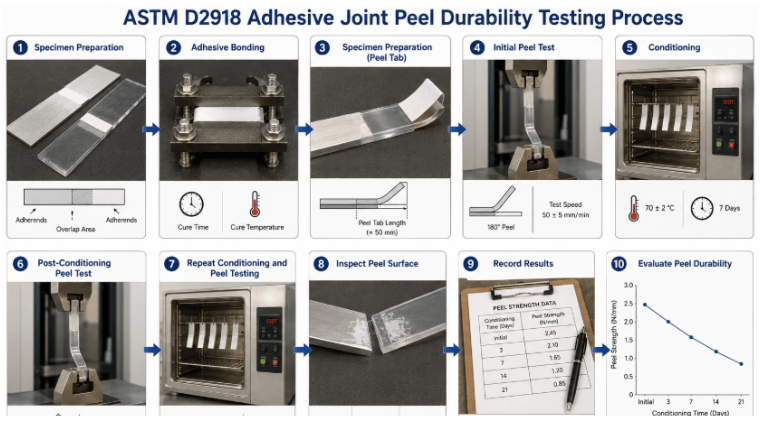
    The first step is for technicians to identify the adhesive and adherend materials and prepare representative bonded specimens. They inspect the joints and verify the specimen dimensions and bonding conditions before testing. The technician then installs the panel in the peel-testing machine. During the test, the laboratory applies the specified peel stress and observes the adhesive joint. Technicians record the loading conditions, test duration, joint response, and any visible damage or failure. Engineers compare the gathered observations and measurements to determine the durability of adhesive joints.

    ASTM D2918 testing process showing adhesive-joint specimen preparation, mounting in the peel-testing apparatus, application of peel stress, monitoring of joint durability, and recording of test results.
    ASTM D2918 Adhesive Joint Peel Durability Testing Process

    Common Challenges and Troubleshooting

    Adhesive application, surface preparation, curing conditions, specimen dimensions, joint defects, loading conditions, and equipment performance can affect ASTM D2918 results. Technicians should follow standard bonding procedures and inspect specimens before testing. Laboratories should check the testing equipment and force measuring system before use. Technicians should also verify specimen alignment and loading conditions. When results deviate significantly from expectations, the laboratory should consider adhesive preparation, surface condition, curing, specimen geometry, loading, and equipment performance.

    Analysis Results and Interpretation

    The report summarizes the performance and durability response of the adhesive joints tested under the specified peel-stress conditions. It presents the relevant measurements or observations, along with the loading conditions, test duration, specimen information, and joint response.

    Read more

    • ASTM D2918 produces results related to the durability response of adhesive joints under the specified peel-stress conditions rather than a single universal value for adhesive-joint durability.
    •  The report should include the test duration (in s, min, or h, as appropriate).
    • Laboratories report the applicable peel-loading measurements, test duration, specimen information, and observed joint or failure characteristics using the units and reporting requirements applicable to the test procedure.
    • Consistent specimen preparation, controlled bonding conditions, accurate loading, suitable equipment, and proper observation of joint response help laboratories produce reliable and comparable results.

    What Factors Should You Consider for ASTM D2918 Testing?

    Confidentiality: Matestlab maintains confidentiality throughout the testing process and shares test results only with authorized stakeholders. 

    Expertise: Skilled technicians should be familiar with adhesive preparation, surface treatment, specimen assembly, peel testing, and failure evaluation. 

    Speed: The laboratory should allow adequate time for specimen preparation, adhesive curing, testing, monitoring, data analysis, and reporting. 

    Cost: ASTM D2918 testing costs vary based on the number of specimens, adhesive systems, test duration, equipment requirements, and testing conditions. 

    Link to ASTM D2918 

    FAQ

    Where can I get the astm d2918 tested?
    You can share your astm d2918 testing requirements with MaTestLab. MaTestLab has a vast network of material testing laboratories, spread across the USA and Canada. We support your all material testing needs ranging from specific astm d2918 test to various testing techniques.
    Please contact us for a detailed quote for your astm d2918 testing needs. Cost incurred to carry out different astm d2918 testing methodology depends on the type of raw material; number of samples, coupons, or specimens; test conditions, turn around time etc. Costs of some ASTM testing methods start from $100 and the final value depends upon the factors listed above. Please contact us for the best and latest prices.
    The required number of samples or specimens should comply with the procedure given in the astm d2918 standard. However, the MaTestLab operations team can assist you for your special requirements once you share your testing details with us.
    MaTestLab has a vast testing laboratory network, hence we bring you the best testing facilities in a cost-effective way. We offer considerable discounts (15-20%) to our returning customers based on test volume and frequency.
    The turnaround time for astm d2918 test methodology depends upon the test procedure mentioned in the standard test document. However, we at MaTestLab understand your research requirements and hence try to get your test completed within the least possible time.
    Dr Ruchika Yogesh
    About Author
    Dr Ruchika Yogesh
    Dr. Ruchika Yogesh is an entrepreneur, science and AI/ML enthusiast, medicinal chemistry subject matter expert (SME), scientific/medical copyeditor, and an independent researcher.
    Testimonials
    Real results
    Engineers trust us with what matters most
    Start Your Testing
    Project Today
    Define your requirements and get access to
    specialized laboratories ready to deliver results
    Partners with us
    Clients
    Vendors
    Process for testing
    • STEP 01

      You share your testing requirements

    • STEP 02

      You share your sample(s)

    • STEP 03

      We deliver your test reports

    Get your testing done

    Let us known your testing requirements and we will be right back with a solution.

      Let us root for each other. Collaborate to grow, expand, and accelerate our businesses.

      Partner with us

        Contact Us

        Discover more from MaTestLab

        Subscribe now to keep reading and get access to the full archive.

        Continue reading