
ASTM D2911 Standard Specification for Dimensions and Tolerances for Plastic Bottles

    What Is ASTM D2911?

    ASTM D2911 defines a standard specification for the size and tolerances of plastic bottles. It sets the dimensional requirements to enable manufacturers to produce bottles with consistent, controlled geometry. Technicians take the following bottle dimensions and compare them to the tolerances. Both manufacturers and quality control laboratories use ASTM D2911 test (Standard Specification for Dimensions and Tolerances for Plastic Bottles) results to track manufacturing consistency and dimensional differences that may affect bottle performance or compatibility.

    Read more

    Get Certified ASTM D2911 Plastic Bottle Dimensions and Tolerances Testing

    Manufacturers and packagers, suppliers, and quality-control laboratories can use ASTM D2911 testing to assess plastic bottle dimensional uniformity. Technicians select representative bottles, measure the required dimensions, and record the results under controlled conditions. Engineers compare the measured dimensions with the applicable specification requirements. The results enable manufacturers to track production batches, detect dimensional changes, and ensure uniformity in plastic bottle production.
    What is the scope of ASTM D2911?

    ASTM D2911 covers dimensions and tolerances for applicable plastic bottles. The specification provides a basis for measuring bottle dimensions and evaluating whether they remain within the specified limits. ASTM D2911 covers 

    Read more

    • Bottle Dimensions: Technicians measure applicable plastic bottle dimensions according to the specification. 
    • Dimensional Tolerances: Laboratories compare measured dimensions with the specified tolerances. 
    • Bottle Consistency: Manufacturers use measurements to monitor dimensional variation between bottles and production batches. 
    • Quality Control: Quality-control teams use dimensional measurements to identify manufacturing variation. 
    • Packaging Compatibility: Engineers can use dimensional data to assess bottle compatibility with closures, filling equipment, and packaging systems. 

    What are the uses of ASTM D2911 testing?

    ASTM D2911 provides dimensional information that helps manufacturers control the consistency and accuracy of plastic bottles. The results support quality control, production monitoring, and packaging evaluation. The specification-

    • Verifies specified plastic bottle dimensions. 
    • Evaluates dimensional tolerances during production. 
    • Helps identify variation between production batches. 
    • Supports quality-control inspections. 
    • Helps manufacturers maintain consistent bottle geometry. 
    • Supports compatibility checks with closures and packaging equipment. 
    • Assists in product development and manufacturing-process control. 

    Which materials can be tested according to ASTM D2911?

    ASTM D2911 focuses on applicable plastic bottles and the dimensional requirements and tolerances relevant to them. Laboratories should confirm the bottle type, dimensions, and applicable specification requirements before testing. ASTM D2911 tests-

    • Plastic Bottles: Evaluates applicable plastic bottles for dimensional consistency. 
    • Different Bottle Designs: Allows laboratories to evaluate the specified dimensions of applicable bottle designs. 
    • Production Samples: Supports dimensional inspection of representative bottles from production batches. 
    • Packaging Bottles: Provides dimensional information for bottles used in packaging applications. 

    Why is ASTM D2911 Testing Important?

    Plastic bottles require uniformity of size for consistent manufacturing and packaging performance. ASTM D2911 is a standard-based approach to assessing bottle size and tolerances. The results help manufacturers detect dimensional variation and ensure consistent production. The measurements also help engineers and quality-control personnel with bottle design, manufacturing control, and compatibility with other bottle packaging components.

    ASTM D2911 Equipment and Sample Preparation Guide

    Technicians need accurate dimensional-measurement equipment to evaluate plastic bottles against the applicable requirements. They select representative bottles, inspect them for visible defects, and measure the required dimensions using suitable calibrated instruments.

    Read more

    Sample IdentificationTechnicians identify the bottle type, design, production batch, material, and other relevant information before testing.
    Sample PreparationTechnicians select representative bottles and inspect them for visible damage, deformation, or defects that could affect dimensional measurements.
    Dimensional MeasurementTechnicians measure the applicable bottle dimensions using suitable calibrated measuring equipment.
    InstrumentationLaboratories use dimensional-measurement tools such as calibrated calipers, micrometers, height gauges, or other suitable equipment based on the required measurement.

    ASTM D2911 Testing Procedures and Requirements

    Technicians identify the bottle and determine the applicable dimensions and tolerances before measurement. They check representative samples and place each bottle in the correct position for measurement. The laboratory then takes the necessary measurements and records them for comparison with the tolerances. This document includes other specifications such as ASTM D618 and ASTM D1898. The ASTM D2911 testing procedure is described below.

    Read more

    Sample PreparationTechnicians select representative plastic bottles and inspect them for visible defects or deformation.
    Measurement SetupTechnicians position the bottle correctly and prepare the calibrated dimensional-measurement equipment.
    Dimensional Measurement & Data RecordingTechnicians measure the specified bottle dimensions and record each value with the relevant units.
    Tolerance EvaluationEngineers compare the measured dimensions with the applicable specification tolerances and document the results.

    ASTM D2911 Testing Process and Data Collection

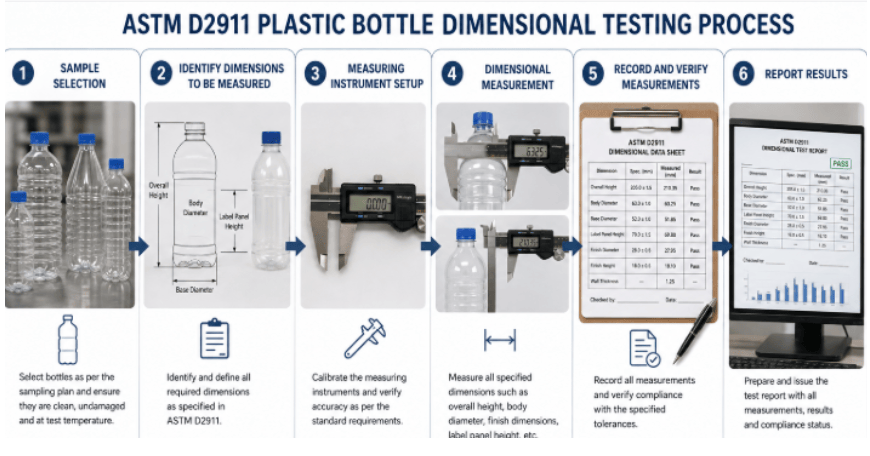
    Technicians identify the plastic bottle and select representative samples. They inspect each bottle for visible deformation or damage before measurement. The technician then positions the bottle correctly and verifies the measuring equipment. Analysts measure the specified bottle dimensions and record each measurement in the appropriate unit. Engineers then compare the recorded measurements to the appropriate dimensional tolerances, and note any measurements outside the specified tolerances.

    ASTM D2911 testing process showing plastic bottle sample preparation, positioning on dimensional measurement equipment, measurement of specified bottle dimensions, comparison with tolerances, and recording of test results.
    ASTM D2911 Plastic Bottle Dimensional Testing Process

    Common Challenges and Troubleshooting

    Bottle deformation, inconsistent sample selection, incorrect measurement positioning, instrument errors, and operator technique can affect ASTM D2911 results. Technicians should use representative samples and inspect each bottle before taking measurements.

    Laboratories should check the calibration of dimensional-measurement equipment and ensure they use the same measurement procedures. Technicians should inspect the bottle condition, measurement location, instrument accuracy, and sample position if measurements deviate from expectations.

    Analysis Results and Interpretation

    The report presents the summary of dimensions of the test plastic bottles. It includes the measured dimensions, units, specified tolerances, sample identification, and test observations.

    Read more

    • ASTM D2911 produces dimension-specific measurements rather than a single overall test value.
    • Laboratories report applicable bottle dimensions in mm or the specified unit. 
    • The report compares each measured dimension with the applicable tolerance in mm. 
    • Laboratories record sample identification, bottle type, production batch, and measurement conditions when applicable. 
    • The report identifies any dimensional measurement that falls outside the specified tolerance. 
    • Consistent sample selection, accurate measurement, proper bottle positioning, and calibrated equipment help laboratories produce reliable and comparable results. 

    Link to ASTM D2911

    Updated on August 27, 2026

    Rohit Dhembare
    About Author
    Rohit Dhembare is an Operations Associate at Matestlab Inc., holds a postgraduate degree in Organic Chemistry and is trained in Materials Science testing techniques.
    Know More
    Testimonials
    Real results
    Engineers trust us with what matters most
    Start Your Testing
    Project Today
    Define your requirements and get access to
    specialized laboratories ready to deliver results
    Partners with us
    Clients
    Vendors
    Process for testing
    • STEP 01

      You share your testing requirements

    • STEP 02

      You share your sample(s)

    • STEP 03

      We deliver your test reports

    Get your testing done

    Let us know your testing requirements and we will be right back with a solution.

      Let us root for each other. Collaborate to grow, expand, and accelerate our businesses.

      Partner with us

        Discover more from Matestlab

        Subscribe now to keep reading and get access to the full archive.

        Continue reading