ASTM D2839 Standard Practice for Use of a Melt Index Strand for Determining Density of Polyethylene
What Is ASTM D2839?
ASTM D2839 describes a standard practice for determining polyethylene density using a melt index strand. During melt index testing, technicians recover the strand, which is then used for the density test. ASTM D2839 (Standard Practice for Use of a Melt Index Strand for Determining Density of Polyethylene) offers a simple method for measuring polyethylene density without needing a separate molded specimen. The density result helps manufacturers and laboratories characterize polyethylene materials, compare grades, monitor production consistency, and assess changes due to processing and/or formulation.
Get Certified ASTM D2839 Polyethylene Density Testing
The ASTM D2839 test is designed to calculate polyethylene density from a strand of polyethylene melt for manufacturers, polymer processors, and others who use the polymer. The strand is melted under controlled melt index conditions to obtain a representative sample, which is weighed and measured to determine the strand density. Engineers can then compare the various grades of polyethylene, production batches, formulations, and processing conditions. Consistent results depend on proper specimen preparation and measurement.
What is the scope of ASTM D2839?
ASTM D2839 is the use of a melt index strand for determining the density of polyethylene. The practice provides a method for obtaining density information from material produced during melt index testing. ASTM D2839 covers the following materials:
Polyethylene: Laboratories determine the density of applicable polyethylene materials.
Melt Index Strand: Technicians use the strand produced during melt index testing as the density specimen.
Density Determination: Laboratories measure the relevant specimen characteristics to determine density.
Material Comparison: Engineers compare polyethylene grades and production batches using density results.
Quality Control: Manufacturers use density measurements to monitor material consistency.
Processing Evaluation: Engineers can evaluate differences associated with material processing and formulation.
What are the uses of ASTM D2839 testing?
ASTM D2839 testing provides useful density information for polyethylene characterization and quality evaluation. Manufacturers and engineers can use the results to compare materials and identify variations between production conditions. ASTM D2839 test standard-
Determines polyethylene density using a melt index strand.
Supports polyethylene material characterization.
Helps compare different polyethylene grades.
Supports quality control between production batches.
Helps identify material variations.
Supports research and development activities.
Provides density information for material selection.
Helps evaluate processing and formulation differences.
Which materials can be tested according to ASTM D2839?
ASTM D2839 applies to polyethylene for which a suitable melt index strand can be obtained. Laboratories should confirm what the material is and the specimen requirements before testing.
Polyethylene Materials: Determines density from a melt index strand.
Polyethylene Grades: Allows engineers to compare density characteristics among applicable grades.
Processed Polyethylene: Supports evaluation of material obtained through controlled melt index testing.
Different Formulations: Helps compare density differences associated with polyethylene formulations.
Production Batches: Supports consistency checks between batches of polyethylene material.
Why is ASTM D2839 testing important?
Density provides important information about polyethylene structure and material characteristics. Property variations depend on differences in density, for example, stiffness, strength, flexibility, and processing behavior. ASTM D2839 offers a practical method for measuring polyethylene density from a strand of the melt index. The strand from the melt index test can aid in sample preparation and in material comparison and quality control.
What equipment is used for ASTM D2839 testing?
The following equipment supports ASTM D2839 density determination:
Melt Indexer: Produces the polyethylene strand used for density determination.
Analytical Balance: Measures the mass of the prepared strand specimen.
Micrometer or Dimensional Measuring Device: Measures the relevant specimen dimensions.
Specimen Cutting Tool: Allows technicians to prepare a suitable section of the melt index strand.
Calibrated Measuring Equipment: Supports accurate dimensional and mass measurements.
How is density determined in ASTM D2839?
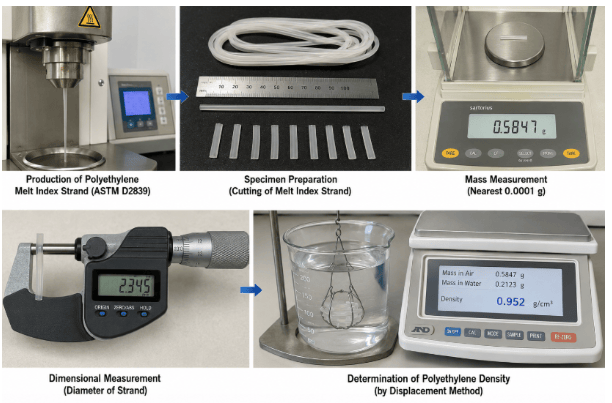
To determine density, the mass of the specimen is measured and compared to the volume calculated using the dimensions of the specimen.
Density = Mass ÷ Volume
The laboratory reports the density in an appropriate unit (e.g., g/cm³) as required by the reporting procedures.
ASTM D2839 Equipment and Sample Preparation Guide
To obtain reliable density results, technicians must have appropriate melt index equipment and accurate measuring devices. They produce and carefully measure a representative strand of melt and determine the specimen density.
Sample Details
Technicians identify the polyethylene material, grade, production lot, and relevant processing information before testing.
Melt Index Strand
Technicians obtain a representative strand during the applicable melt index testing procedure.
Specimen Preparation
Technicians prepare a suitable section of the melt index strand and avoid contamination, deformation, or other conditions that could affect measurements.
Mass Measurement
Technicians use a calibrated balance to determine the specimen mass accurately.
Dimensional Measurement
Technicians measure the relevant specimen dimensions using a suitable calibrated measuring device.
Density Determination
The laboratory uses the measured mass and volume information to determine polyethylene density.
ASTM D2839 Testing Procedures and Requirements
Technicians first identify the polyethylene material and obtain a suitable melt index strand. They prepare a representative specimen and measure its mass and relevant dimensions. The laboratory then determines the specimen volume and calculates the density from the measured values.
This practice covers other tests such as ASTM D1505 and D1238. The ASTM D2839 testing procedure is as follows.
Melt Index Strand Preparation
Technicians produce the polyethylene strand using the applicable melt index testing procedure.
Specimen Selection
Technicians select a representative section of the strand and inspect it for conditions that could affect measurement.
Mass Measurement
Technicians measure the specimen mass using a calibrated balance.
Dimensional Measurement
Technicians measure the relevant specimen dimensions to determine its volume.
Density Calculation
Engineers use the measured mass and volume to determine the polyethylene density.
Result Recording
Technicians record the density result together with specimen identification and relevant test information.
ASTM D2839 Testing Process and Data Collection
Technicians begin by identifying the polyethylene sample and preparing the melt index test. The melt indexer produces the strand under the specified testing conditions. The technician then selects a representative strand section and measures its mass and relevant dimensions. The laboratory uses these measurements to determine the specimen volume and calculate density. Technicians record the density result along with material identification, specimen information, measurement data, and relevant observations. Accurate measurements help engineers compare polyethylene materials and production batches.
ASTM D2839 Polyethylene Density Determination Using a Melt Index Strand
Common Challenges and Troubleshooting
There are a number of factors that may impact ASTM D2839 density results. These include changes in melt index, strand deformation, incorrect dimensional readings, balance performance, contamination, and inconsistent specimen preparation. Take representative samples and use calibrated measurement instruments. Technicians should also not bend the strand before taking the measurement. The laboratory should investigate the following if the results are significantly different between specimens: specimen preparation, strand quality, dimensional measurement, balance performance, and other factors that may affect the tests.
Analysis Results and Interpretation
The report summarizes the density characteristics of the tested polyethylene material using the applicable melt index strand specimen. It presents the measured density along with the relevant mass, dimensional, volume, and specimen identification information.
ASTM D2839 produces a density result rather than a collection of different property-specific test values.
Laboratories typically report polyethylene density in an applicable unit such as g/cm³, along with the measured specimen mass, dimensions, calculated volume, and relevant material information.
Consistent melt index strand preparation, accurate mass and dimensional measurements, suitable equipment, and controlled test conditions help laboratories produce reliable density results.
Engineers can use these results to compare polyethylene grades, formulations, production batches, and processing conditions. They should interpret density values alongside relevant material and testing information.
Malhar Khole is a Material Testing Associate at Matestlab Inc. and holds a postgraduate degree in Material Science and Technology from IIT (BHU), Varanasi. Know More
Testimonials
Real results
Engineers trust us with what matters most
“We had a great experience working with this company for our ASTM E84 testing. They were the first company to respond to our inquiry within just a few minutes of submitting it. From start to finish, the communication was excellent, and the entire process was swift, straightforward, and hassle-free.”
Ivars FancyWalls
United States
“Very good communication, testing associates were very patient with delays on our end. Reasonable turnaround time for results and nicely detailed report. Analysts were also quick to answer any follow-up questions. Happy with results.”
Skye Henderson
United States
“Matestlab connected us with an accredited lab within days, cutting weeks off our product validation timeline.”
Rebecca Kozodoy-Pins
United States
Start Your Testing Project Today
Define your requirements and get access to specialized laboratories ready to deliver results