
ASTM D2673 Standard Specification for Oriented Polypropylene Film

    What Is ASTM D2673?

    ASTM D2673 defines a standard specification for oriented polypropylene film. The specification includes film characteristics and provides a basis for assessing the quality and uniformity of oriented polypropylene films for use. Manufacturers produce oriented polypropylene film by stretching polypropylene to develop the desired molecular orientation and resulting properties. Laboratories test applicable characteristics with the specified or referenced test procedures and compare the measured results with the relevant requirements. ASTM D2673 (Standard Specification for Oriented Polypropylene Film) enables manufacturers, suppliers, purchasers, and quality control laboratories to monitor production consistency and evaluate whether the film is suitable for the intended purpose.

    Read more

    Get Certified ASTM D2673 Oriented Polypropylene Film Testing

    ASTM D2673 evaluation provides manufacturers and purchasers with a way to evaluate oriented polypropylene film for compliance with applicable specification requirements. Laboratories take representative film samples, measure the film properties with suitable calibrated instruments, and record the measurements. The laboratory notes the specimen ID, thickness, direction of testing, test conditions, measured properties, test units, and observations. The manufacturer can use the results to compare production lots, explore variations, assist in quality control, and qualify oriented polypropylene film for specific applications.

    What is the scope of ASTM D2673?

    ASTM D2673 covers oriented polypropylene (OPP) film from 10 to 75 μm (0.4 to 3.0 mils). The film may contain colorants, stabilizers, or other additives and may receive coatings to improve performance characteristics. The specification also covers films that manufacturers heat-set to reduce unrestrained linear shrinkage and shrink tension. 

    Read more

    • Oriented Polypropylene Film: Laboratories evaluate polypropylene films that have undergone orientation during manufacturing. 
    • Film Properties: Technicians measure applicable physical and performance characteristics required by the specification. 
    • Dimensional Characteristics: Laboratories can evaluate applicable film dimensions and related characteristics. 
    • Mechanical Performance: Testing can provide information about the film’s mechanical behavior in the applicable test direction. 
    • Material Consistency: Manufacturers can compare test results between production lots to identify variations. 
    • Quality Control: Testing supports production monitoring and verification of film quality. 

    What are the uses of the ASTM D2673 specification?

    The ASTM D2673 evaluation provides information that can help manufacturers and users assess oriented polypropylene film.

    • Evaluates oriented polypropylene film against applicable requirements. 
    • Supports quality control and production-lot comparison. 
    • Helps manufacturers identify variations in film properties. 
    • Supports material qualification and supplier verification. 
    • Helps engineers select appropriate polypropylene film. 
    • Supports product development and process evaluation. 
    • Provides comparative data for different film lots and production conditions. 
    • Helps assess film suitability for applications where consistent physical and mechanical properties are important. 

    Which Materials Can Be Tested According to ASTM D2673?

    ASTM D2673 specifically addresses oriented polypropylene films with the characteristics defined by the specification. The base polymer must be a specified Group 1 or Group 2 polypropylene, or a blend with another polymer in which polypropylene remains the main component. 

    • Oriented Polypropylene Film: Laboratories evaluate oriented polypropylene film against the applicable specification requirements to verify its relevant physical, dimensional, and performance characteristics.
    • Biaxially Oriented Polypropylene Film: Supports evaluation of applicable BOPP films where the specification requirements apply. 
    • Oriented Packaging Film: Provides a basis for evaluating applicable polypropylene films used in packaging. 
    • Flexible Polypropylene Film: Evaluates applicable flexible films where specified physical properties are important. 
    • Production-Lot Film: Allows manufacturers and purchasers to compare film from different production lots. 

    Why is ASTM D2673 Important?

    Orientation alters the structure and function of polypropylene film. The stretching process can affect properties such as strength and dimensional behavior, which are critical to film performance. ASTM D2673 establishes a specification for oriented polypropylene film that helps manufacturers and buyers meet consistent requirements. Laboratories can compare the measured properties with corresponding requirements and determine variations between production lots.

    ASTM D2673 Equipment and Sample Preparation Guide

    ASTM D2673 evaluation may require different instruments depending on the specific properties being assessed. Technicians should prepare representative film specimens and maintain consistent specimen orientation, dimensions, conditioning, and test conditions.

    Read more

    Sample DetailsTechnicians identify the polypropylene film, thickness, orientation, production lot, and applicable specification requirements.
    Specimen PreparationTechnicians cut representative film specimens according to the applicable test procedures and maintain consistent dimensions and orientation.
    Specimen ConditioningTechnicians condition specimens under the required environmental conditions when applicable.
    Thickness MeasurementTechnicians use a suitable calibrated thickness gauge or micrometer to measure film thickness.
    Mechanical TestingTechnicians use appropriate calibrated mechanical-testing equipment when the applicable property requires tensile or other mechanical measurements.
    Dimensional EvaluationTechnicians use suitable measurement equipment to evaluate applicable dimensional characteristics.
    Data RecordingEngineers record measured values, applicable units, test conditions, specimen orientation, and relevant observations.

    ASTM D2673 Testing Procedures and Requirements

    Technicians first identify the oriented polypropylene film and review the applicable requirements. They prepare representative specimens and maintain the required specimen orientation and dimensions. The laboratory conditions the specimens when required and performs the applicable property measurements using calibrated equipment. Technicians record each measured value together with its applicable unit and test direction. The laboratory then compares the measured properties with the relevant ASTM D2673 requirements and documents the results.

    Read more

    Specimen Identification and PreparationTechnicians identify the film, production lot, thickness, orientation, and condition, then prepare representative specimens according to the applicable procedure.
    Conditioning and Thickness MeasurementTechnicians condition specimens when required and measure film thickness using calibrated equipment.
    Property Measurement and Data CollectionTechnicians measure the applicable physical or mechanical properties and record values, units, test direction, and conditions.
    Specification Compliance EvaluationTechnicians compare measured results with the applicable ASTM D2673 requirements and document conformity.

    ASTM D2673 Testing Process and Data Collection

    Technicians first identify the oriented polypropylene film and verify its thickness, orientation, production lot, and condition. They prepare representative specimens and identify the machine direction and transverse direction when directional testing applies. The analysts condition the specimens according to the applicable procedure and perform the required property measurements. Technicians record the measured values, test direction, specimen dimensions, test conditions, and applicable units. Analysts treat the samples as per the procedure and measure the various properties. Technicians enter the measured values, test direction, specimen size, test conditions, and units of measurement.

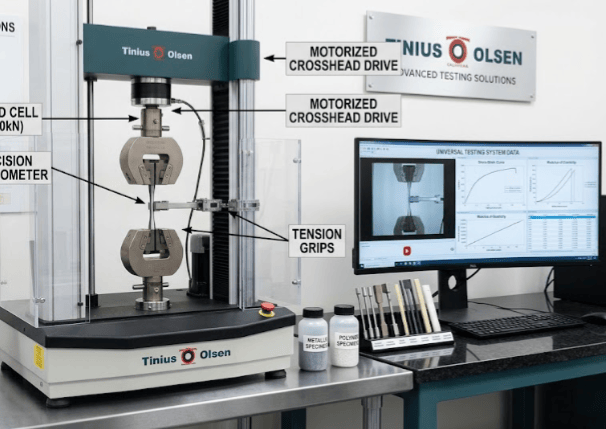
    The image shows a universal testing machine evaluating the tensile properties of oriented polypropylene film specimens according to ASTM D2673.
    ASTM D2673 Universal Testing Machine (UTM)

    Common Challenges and Troubleshooting

    Variations in film thickness, orientation, specimen dimensions, conditioning, test direction, equipment calibration, and film defects can affect measured properties. Technicians need to prepare consistent, uniform specimens and ensure machine-direction and transverse-direction identification remains consistent throughout the testing program. Wrinkles, scratches, uneven thickness, contamination, or edge damage can also affect test results. Laboratories should examine specimens before testing and either exclude or document specimens with conditions that may affect the evaluation. Technicians should verify the calibration and operation of measurement and testing equipment before beginning the test program.

    Analysis Results and Interpretation

    The laboratory should report the measured film properties together with specimen direction, film identification, thickness, test conditions, and applicable classification requirements. This information allows engineers to determine whether the film meets the specified requirements and to compare its performance with other OPP films. 

    Read more

    • The laboratory report may contain material identification, production lot, specimen size, film thickness, specimen orientation, test conditions, measured properties, and pertinent observations. 
    • The laboratory report includes the measured property, unit, applicable requirement, test method, specimen direction, and compliance status.
    • Each property measured should be reported in the laboratory using the appropriate unit (e.g., mm or µm for thickness, MPa for stress or strength, % for elongation, and °C for temperature, as appropriate to the selected test). 
    • The results help manufacturers determine whether the oriented polypropylene film meets the applicable ASTM D2673 requirements. 
    • Engineers can compare film properties between production lots, formulations, thicknesses, and processing conditions. 
    • Manufacturers can use the results for quality assurance, material qualification, product development, and process evaluation. 
    • Purchasers can use test results to support material acceptance and supplier verification. 
    • Laboratories should interpret results according to the specific test method, specimen direction, conditioning conditions, and applicable requirements. 
    • Laboratories should document unusual specimen behavior, failure modes, dimensional variations, or other observations that could influence result interpretation. 

    Link to ASTM D2673

    Updated on August 27, 2026

    Malhar Khole
    About Author
    Malhar Khole is a Material Testing Associate at Matestlab Inc. and holds a postgraduate degree in Material Science and Technology from IIT (BHU), Varanasi.
    Know More
    Testimonials
    Real results
    Engineers trust us with what matters most
    Start Your Testing
    Project Today
    Define your requirements and get access to
    specialized laboratories ready to deliver results
    Partners with us
    Clients
    Vendors
    Process for testing
    • STEP 01

      You share your testing requirements

    • STEP 02

      You share your sample(s)

    • STEP 03

      We deliver your test reports

    Get your testing done

    Let us know your testing requirements and we will be right back with a solution.

      Let us root for each other. Collaborate to grow, expand, and accelerate our businesses.

      Partner with us

        Discover more from Matestlab

        Subscribe now to keep reading and get access to the full archive.

        Continue reading