
ASTM D2565 Xenon-Arc Exposure of Plastics Intended for Outdoor Applications

    What is ASTM D2565?

    ASTM D2565 describes a standard practice for xenon-arc exposure of plastics for outdoor use. This practice involves subjecting plastic specimens to controlled xenon-arc radiation, temperature, and moisture conditions.  The practice mimics the effects of sunlight and moisture on plastic materials over an accelerated exposure period. Laboratories use ASTM D2565 (Standard Practice for Xenon-Arc Exposure of Plastics Intended for Outdoor Applications) to assess changes in appearance and selected physical properties, and to support material comparison, quality control, and the development of products for outdoor use. Specimens are tested before and after exposure to assess changes resulting from simulated outdoor weathering. Engineers compare the results with the weathering performance of plastic materials.

    Read more

    Get Certified ASTM D2565 Testing for Reliable Outdoor Plastic Performance

    Plastics used outdoors can be subjected to sun, heat, moisture, and frequent environmental fluctuations while in service. Accelerated weathering helps engineers understand how plastic materials react in a “weathered” environment. Controlled xenon-arc exposure conditions for the evaluation of these effects are specified in ASTM D2565. These results help select materials, develop new products, ensure quality control, and compare plastic products for outdoor use.
    What is the Scope of the ASTM D2565 Test Standard?

    ASTM D2565 is the method for xenon-arc exposure of plastics for outdoor use. The practice offers controlled exposure conditions that simulate important aspects of outdoor weathering. The ASTM D2565 standard-

    Read more

    • Submits plastics to xenon-arc radiation.
    • Emulates effects of weathering outdoors.
    • Regulates the temperature and moisture.
    • Assesses modifications of exposed plastic specimens.
    • Helps to compare weathering performance.
    • Assists in determining color/appearance changes.
    • Facilitates the assessment of physical properties chosen.
    • Supplies controlled conditions for accelerated exposure studies.

    What are the Uses of ASTM D2565 Testing?

    ASTM D2565 testing helps laboratories assess the impact of simulated outdoor weathering on plastic materials. Engineers then use the results to compare materials and to determine how well materials can withstand environmental exposure. This standard-

    • Assesses the weathering behavior of plastics.
    • Artificially mimics the effects of outdoor sunlight exposure.
    • Assesses the effects of moisture and temperature.
    • Assists in assessing color and appearance changes.
    • Aids in comparison of plastic formulations.
    • Assists in product development and quality control.
    • Assists in the choice of materials for use outdoors.

    Which materials can be tested under ASTM D2565?

    ASTM D2565 applies to plastic materials for outdoor use that can be fabricated into appropriate exposure specimens. When an appropriate specimen configuration is selected, the practice can be used to evaluate various plastic formulations, colors, and finished products. Prior to initiating the exposure program, an analyst should determine the material and its intended use outside, the form of the specimen, and the properties to be evaluated.

    Why is ASTM D2565 Important?

    ASTM D2565 specifies controlled xenon-arc exposure conditions for the assessment of the weathering behavior of plastics. Outdoor exposure can change properties, including fading, discoloration, surface degradation, cracking, or loss of certain properties. The results assist engineers in comparing plastic materials and determining whether a plastic formulation will perform in an acceptable manner under outdoor service conditions.

    ASTM D2565 Equipment and Sample Preparation Guide

    ASTM D2565 calls for a Xenon Arc exposure apparatus that has the ability to control radiation and environmental conditions. Representative samples with appropriate surfaces are prepared in laboratories for exposure and subsequent evaluation.

    Read more

    Sample and Specimen DetailsRepresentative samples of plastic materials for outdoor use are tested in the laboratories and prepared for controlled xenon-arc exposure.
    Specimen PreparationTechnicians prepare, identify, and measure the specimens before exposure and record their initial appearance or selected properties.
    Specimen DimensionsTechnicians select specimen dimensions based on the exposure apparatus, material form, and requirements for evaluating the properties after exposure.
    InstrumentationThe test uses a xenon-arc exposure chamber, irradiance monitoring system, temperature controls, moisture or water-spray system, and property-measurement equipment.

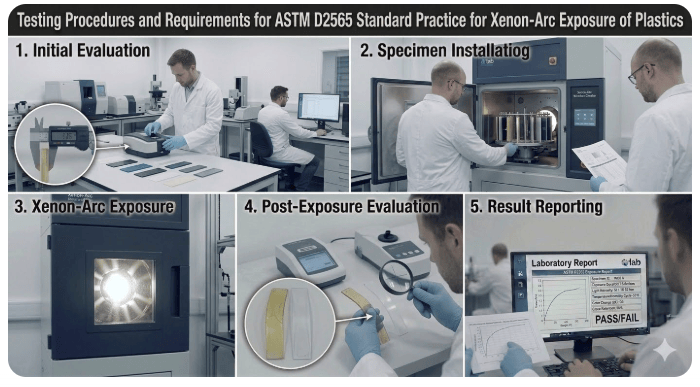
    Testing Procedures and Requirements for ASTM D2565

    This test standard subjects plastic specimens to controlled xenon-arc radiation and environmental conditions. Technicians set the required exposure parameters, and the chamber completes the test. The ASTM D2565 test methods comprise the following test procedure-

    Read more

    Initial EvaluationTechnicians evaluate and measure the specimens before exposure to establish baseline appearance and selected properties.
    Specimen InstallationTechnicians load the specimens into the xenon-arc exposure chamber with the test surfaces in the specified orientation.
    Xenon-Arc ExposureTechnicians expose the specimens to controlled radiation, temperature, and moisture conditions for the specified duration.
    Post-Exposure EvaluationAnalysts measure selected changes in appearance or physical properties and compare them with the baseline measurements.
    Result ReportingLaboratories report exposure conditions, length of exposure, specimen information, and changes observed or measured following exposure.

    ASTM D2565 Testing Process and Data Collection

    The analyst selects representative plastic specimens and determines properties that require evaluation. Then, technicians record the initial appearance and applicable baseline measurements. The operator then sets up the specimens in the xenon-arc exposure chamber. Technicians keep the radiation, temperature, and moisture levels fixed during exposure. Lastly, the specimens are removed, and changes in appearance or selected properties are assessed. Analysts compare exposed and unexposed specimens and record the data.

    The image depicts plastic samples being placed in a xenon-arc weathering chamber for outdoor weathering as per ASTM D2565.
    ASTM D2565 Xenon-Arc Exposure Testing of Plastics

    Common Challenges and Troubleshooting

    Accurate ASTM D2565 results require stable irradiance, temperature, moisture, and exposure conditions. Specimen positioning and variable chamber conditions may affect the weathering response. Technicians need to check the exposure chamber and monitoring systems prior to testing. Laboratories also achieve reliable weathering results when they prepare and evaluate their specimens in the same way.

    ASTM D2565 Analysis Results and Interpretation

    The report summarizes the changes observed in the plastic specimens after xenon-arc exposure. The exposed specimens are compared with the original condition by the appearance or physical-property evaluation chosen by the laboratories.

    Read more

    • The laboratory reports the exposure duration in hours (h) and records the applicable exposure conditions used during the test.
    • The analyst records changes in color and appearance using the selected color measurement system, while visual observations may include discoloration, cracking, chalking, loss of gloss, or other surface changes.
    • The laboratory reports changes in physical or mechanical properties, such as tensile strength, elongation, or mass, in the units specified by the applicable evaluation test method.
    • The report compares the exposed and unexposed specimens and documents the observed changes rather than assigning a single overall performance value to the material.

    Link to ASTM D2565

    Updated on August 24, 2026

    Rohit Dhembare
    About Author
    Rohit Dhembare is an Operations Associate at Matestlab Inc., holds a postgraduate degree in Organic Chemistry and is trained in Materials Science testing techniques.
    Know More
    Testimonials
    Real results
    Engineers trust us with what matters most
    Why Choose Matestlab?
    Matestlab is a unified testing services partner based in the USA. Matestlab offers raw material and product testing services through accredited, expert laboratories primarily based in the USA. Matestlab supports physical, thermal, chemical, electrical, mechanical, environmental, and characterization testing needs through its global network of 2200+ accredited testing laboratories. Matestlab's in-house materials science experts curate and design comprehensive testing programs matched to the sample material and specific testing need, with regulatory requirements and confidentiality in mind.

    If you are looking for a managed and trusted testing partner to achieve your research goals, feel free to schedule a meeting with us or send us a request at connect@matestlabs.com to learn more about our services. For a quick quote, call us at (302)244-7710. We are happy to serve you.
    Start Your Testing
    Project Today
    Define your requirements and get access to
    specialized laboratories ready to deliver results
    Partners with us
    Clients
    Vendors
    Process for testing
    • STEP 01

      You share your testing requirements

    • STEP 02

      You share your sample(s)

    • STEP 03

      We deliver your test reports

    Get your testing done

    Let us know your testing requirements and we will be right back with a solution.

      Let us root for each other. Collaborate to grow, expand, and accelerate our businesses.

      Partner with us