ASTM D2435 Standard Test Methods for One-Dimensional Consolidation Properties of Soils Using Incremental Loading

    What is ASTM D2435?

    ASTM D2435 is a set of standard test methods for determining soil consolidation behavior using incremental loading. The laboratory laterally restrains the soil specimen, applies controlled axial stress increments, and measures deformation with time. The test is commonly used for saturated, intact fine-grained soils naturally deposited in water. The basic procedure can also be used for compacted soils and natural soils that have been weathered or chemically altered, which may need special interpretation. ASTM D2435 (Standard Test Methods for One-Dimensional Consolidation Properties of Soils Using Incremental Loading) determines one-dimensional soil properties using incremental loading.  Laboratories can collect data on axial stress, specimen deformation, time-deformation, compression characteristics, consolidation rate, and secondary compression. 

    Read more

    Get Certified ASTM D2435 Testing for Reliable Soil Consolidation Evaluation

    Soil consolidation data helps engineers estimate the magnitude and rate of differential and total settlement caused by structural loading or additional earthfill. Engineers use these estimates in the design and performance testing of engineered structures. ASTM D2435 allows laboratories to determine soil compressibility, consolidation rate, preconsolidation stress, and other settlement conditions under controlled loading. 
    What is the scope of the ASTM D2435 test standard? 

    Laboratories use ASTM D2435 to measure the magnitude of soil consolidation rate when they laterally restrain the specimen and permit axial drainage during incremental controlled-stress loading. The ASTM D2435 standard-

    Read more

    • Determines the magnitude of soil consolidation and the rate of soil consolidation.
    • Applies incremental controlled-stress loading and restrains the specimen laterally. And allows axial drainage.
    • Provides Test Method A with constant load-increment duration and Test Method B with time-deformation readings on all load increments.
    • Provides data for evaluating secondary compression. 
    • Provides the coefficient of consolidation for saturated soils under Test Method B.
    • Supports evaluation of preconsolidation stress.

    What are the uses of ASTM D2435 testing?

    ASTM D2435 testing determines the deformation and consolidation characteristics of soils under loading. Engineers can use this information to forecast settlement and understand the soil’s response under engineering structures. This standard:

    • Determines the magnitude of soil consolidation, the rate of consolidation, and soil compression behavior.
    • Helps estimate total and differential settlement and evaluate preconsolidation stress.
    • Determines the coefficient of consolidation for applicable saturated soils and secondary compression behavior.
    • Provides data for engineering interpretation of effective-stress behavior.

    Which materials can be tested under ASTM D2435?

    ASTM D2435/D2435M most commonly applies to saturated intact samples of fine-grained soils naturally sedimented in water. This basic procedure also applies to compacted soils and intact soils that are weathered or chemically altered.

    Why is ASTM D2435 important?

    ASTM D2435/D2435M offers a standardized method for determining soil deformation and consolidation under incremental loading. Manufacturers use this result to determine how quickly soil will settle when earthfill applies additional load.

    ASTM D2435/D2435M Equipment and Sample Preparation Guide

    To get reliable, reproducible results, equipment should restrain a soil specimen laterally, apply a predetermined vertical load, allow free drainage, and measure the specimen’s deformation over time.

    Read more

    Sample and Specimen DetailsEngineers analyze intact or compacted soil samples based on project requirements. Most frequently used for saturated intact fine-grained soil samples.
    Specimen PreparationTechnicians carefully prepare the specimen to reduce disturbance, place it in the consolidation apparatus, and set the desired drainage and loading conditions.
    Specimen DimensionsTechnicians prepare specimens in compliance with ASTM D2435 for consolidation apparatus and test configuration. The standard specimen for ASTM D2435 testing requires a minimum diameter of 50 mm (2.0 in.) and a minimum diameter-to-height ratio of 2.5
    Instrumentation Consolidation apparatus, loading frame, consolidation ring, porous stones, drainage components, deformation-measuring device, loading system, and timing and data-recording equipment. 

    Testing Procedures and Requirements for ASTM D2435

    ASTM D2435 requires technicians to laterally restrain the soil specimen and apply controlled axial stress through incremental loading. The laboratory measures deformation over time for the applicable load increments. The testing procedures and requirements for ASTM D2435 are given below-

    Read more

    Specimen Preparation and Apparatus Setup Technicians first prepare and install the soil specimen in the consolidation ring with minimum disturbance. Then they ensure the necessary conditions for drainage, loading, and deformation measurement.
    Initial Loading and Incremental LoadingTechnicians apply the indicated initial load and the specified sequence of axial stress increments, and record specimen deformation.
    Time-Deformation MeasurementThe laboratory records specimen deformation with time for the load increments required by Test Method A or B.
    Primary ConsolidationEvaluate the time required for primary consolidation according to the applicable interpretation procedure.
    Data RecordingThe laboratory documents applied stress, deformation, time readings, specimen information, and relevant test conditions.

    ASTM D2435 Testing Process and Data Collection

    Technicians first select representative soil samples, prepare them with minimum disturbance, place the specimen in the consolidation apparatus, and set up the drainage and loading conditions. Then, they apply the predetermined series of controlled axial stresses. They measure deformation over time according to Test Method A or Test Method B. Laboratories measure axial stress, specimen deformation, time-deformation, compression characteristics, consolidation rate, and secondary compression. 

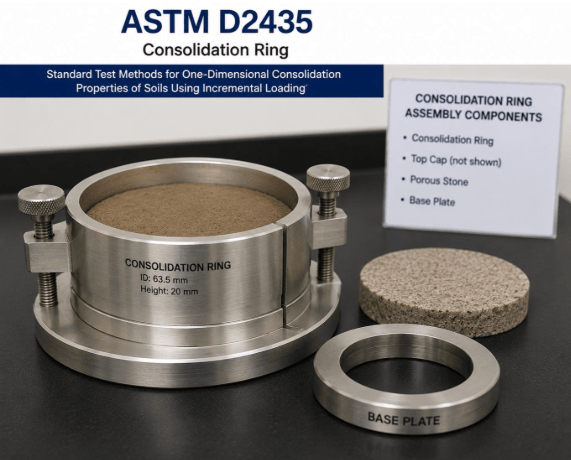
    This image shows a consolidation ring used for one-dimensional consolidation testing as per ASTM D2435.
    ASTM D2435 Consolidation Ring

    Common Challenges and Troubleshooting

    To achieve accurate consolidation results, careful sampling, preparation of samples, equipment setup, and loading conditions are all important. The measured consolidation behavior can be greatly influenced by sample disturbance. The usual problems of testing are that the sample is disturbed during preparation, that the dimensions of the sample are not correct, that the load is not applied correctly, that the load is not applied in the correct sequence, that the sample is not properly drained, that the duration of the load is not consistent, and that the measured deformations are not correct. Laboratories need to pay attention to carefully preparing specimens, verifying the apparatus, monitoring loading and drainage conditions, and choosing the appropriate interpretation procedure.

    ASTM D2435 Analysis Results and Interpretation

    • The test assesses the magnitude and rate of soil consolidation under incremental controlled stress loading.
    • Laboratories report results for axial stress in kPa, specimen dimensions and deformation in mm, coefficient of consolidation in m²/s, and deformation time in seconds (s).
    • Consistent specimen preparation, controlled loading, adequate drainage, and accurate deformation measurements help laboratories produce reliable results. 

    Link to ASTM D2435

    Read more

    Updated on August 26, 2026

    Malhar Khole
    About Author
    Malhar Khole is a Material Testing Associate at Matestlab Inc. and holds a postgraduate degree in Material Science and Technology from IIT (BHU), Varanasi.
    Know More
    Testimonials
    Real results
    Engineers trust us with what matters most
    Start Your Testing
    Project Today
    Define your requirements and get access to
    specialized laboratories ready to deliver results
    Partners with us
    Clients
    Vendors
    Process for testing
    • STEP 01

      You share your testing requirements

    • STEP 02

      You share your sample(s)

    • STEP 03

      We deliver your test reports

    Get your testing done

    Let us know your testing requirements and we will be right back with a solution.

      Let us root for each other. Collaborate to grow, expand, and accelerate our businesses.

      Partner with us

        Discover more from Matestlab

        Subscribe now to keep reading and get access to the full archive.

        Continue reading