
ASTM D2396 Standard Test Methods for Powder-Mix Time of Poly (Vinyl Chloride) (PVC) Resins Using a Torque Rheometer

    What is ASTM D2396? 

    ASTM D2396 is a set of standard test methods for determining the powder-mix time of general-purpose PVC resin with a torque rheometer. This method measures the time it takes for PVC granules to absorb the specified plasticizer and become dry and free-flowing under controlled mixing. The method records changes in motor torque during mixing. The torque curve determines the maximum torque and the subsequent local minimum, per ASTM D2396 (Standard Test Methods for Powder-Mix Time of Poly(vinyl chloride) (PVC)), which defines this as the dry point. The interval between these points is the plasticizer absorption time, known as powder-mix time.

    Read more

    Get Certified ASTM D2396 Testing for Reliable PVC Resin Characterization

    PVC resin can differ in its ability to absorb plasticizer because of differences in resin structure, plasticizer properties, temperature, and mixing conditions. ASTM D2396 offers a controlled method for comparing this behavior. Engineers use these resulting powder-mix times to determine PVC resins, compare resin performance, and assess suitability for specific intensive mixing operations. ASTM D2396 (using a torque rheometer) determines the powder mix time of PVC resin using a torque rheometer.

    What is the scope of the ASTM D2396 test standard? 

    ASTM D2396 specifies a torque rheometer method for measuring the powder-mix time for general-purpose PVC resin. The standard recognizes SI units as the standard measurement system. The ASTM D2396 standard-

    Read more

    • Determines the powder-mix time of general-purpose PVC resin. 
    • Measures plasticizer absorption behavior during mixing and uses a torque rheometer to monitor mixing torque.
    • Includes a sigma mixer and planetary mixer test method and calculates the max torque point.
    • Calculates plasticizer absorption time between the maximum torque and dry point. 
    • Considers resin, plasticizer, temperature, equipment, and rotor speed as factors that can affect the result.

    What are the uses of ASTM D2396 testing?

    ASTM D2396 testing helps laboratories determine the rate at which PVC resin absorbs plasticizer during intensive mixing. Manufacturers can use the results to compare resins and assess their suitability for mixing operations. This standard-

    • Determines PVC powder-mix time and plasticizer absorption behavior and compares different PVC resins.
    • Helps classify resins according to plasticizer absorption rate. 
    • Supports evaluation of resin suitability for intensive mixing.
    • Helps PVC formulation and process development.
    • Provides comparative data for quality-control activities.

    Which materials can be tested under ASTM D2396?

    ASTM D2396 applies to general-purpose polyvinyl chloride (PVC) resin. The test also uses a plasticizer during mixing. The standard lists diisodecyl phthalate (DIDP) and clay among the materials used in the test procedure.

    Why is ASTM D2396 important?

    ASTM D2396 is a controlled procedure for measuring the rate at which PVC resin absorbs plasticizer during mixing. The powder-mix time relates to the resin’s internal pore structure, resin temperature, plasticizer temperature, and plasticizer selection.

    ASTM D2396 Equipment and Sample Preparation Guide

    ASTM D2396 requires a torque rheometer with an appropriate mixing head. Laboratories select either a sigma mixer or a planetary mixer based on the selected test method.

    Read more

    Sample and Specimen DetailsLaboratories prepare general-purpose PVC resin with the specified plasticizer and other required ingredients for torque-rheometer mixing.
    Specimen PreparationTechnicians prepare and weigh the resin and plasticizer, preheat the mixing bowl to the desired test temperature, and introduce the plasticizer via the appropriate dispersion system.
    Specimens’ dimensionsASTM D2396 does not define a conventional specimen geometry because it tests a resin/plasticizer mixture inside a torque rheometer bowl.
    Instrumentation Torque rheometer, 650-mL Sigma mixer or planetary mixer, balance with 0.1-g sensitivity, 0.95-L container, 400-mL beaker, dispersion funnel, metric ruler, thermometer, spatula, paintbrush, and Brookfield RVF viscometer or equivalent.

    Testing Procedures and Requirements for ASTM D2396

    ASTM D2396 heats and mixes a PVC resin sample before adding a measured amount of plasticizer. The torque rheometer records the torque response as the plasticizer enters the resin and the mixture changes from wet to dry and free-flowing.

    Read more

    Other reference ASTM documents include D883 and D1600. 

    Equipment Preparation and Resin Mixing Laboratories prepare the torque rheometer and mixing head used for the test as per the specified test method. Then they heat and mix the PVC resin in the bowl at the required test temperature.
    Plasticizer Addition and Torque Measurement Analysts add the measured plasticizer using the appropriate dispersion funnel or trough and record the torque changes while the resin absorbs the plasticizer.
    Maximum Torque and Dry Point Analysts identify the global maximum on the torque curve after plasticizer addition and the local minimum following the maximum torque.
    Powder-Mix Time and Result ReportingLaboratories determine the time between the maximum torque and the following dry point. Then they report the test method, PVC resin identification, plasticizer, bowl temperature, and powder-mix time. 

    ASTM D2396 Testing Process and Data Collection

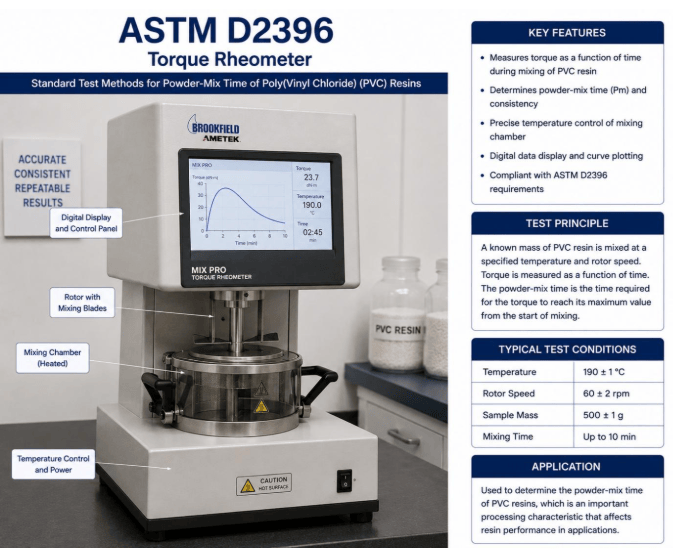
    The analysts first set up the torque rheometer and selected either the sigma mixer or planetary mixer procedure. They then heat and mix the PVC resin at the required temperature. Technicians then add the measured plasticizer through the appropriate dispersion system and continue mixing. The instrument measures torque response as the plasticizer is absorbed. First, torque rises after the plasticizer is added, then drops as the resin dries and becomes free-flowing. Laboratories identify the maximum torque, dry point, and powder-mix time from the torque curve.

    This image depicts a torque rheometer used for testing PVC resin powder-mix time according to ASTM D2396.
    ASTM D2396 Torque Rheometer

    Common Challenges and Troubleshooting

    Several factors can change ASTM D2396 powder-mix time. These factors include resin characteristics, plasticizer viscosity, resin temperature, plasticizer temperature, equipment, and rotor speed. Common testing challenges include inconsistent resin temperature, variation in plasticizer temperature, differences in plasticizer viscosity, incorrect plasticizer addition, incorrect rotor speed, and inaccurate torque-rheometer setup. To achieve repeatability, technicians should keep temperatures, equipment settings, plasticizer conditions, and mixing procedures consistent.

    ASTM D2396 Analysis Results and Interpretation

    • Laboratories determine powder-mix time from the time between the maximum torque point and the following dry point on the torque curve.
    • Laboratories report powder-mix time in seconds (s).
    • Laboratories can obtain reliable, comparative results through consistent resin preparation, plasticizer conditions, temperature, equipment, and rotor speed.

    Link to ASTM D2396

    Read more

    Updated on August 26, 2026

    Malhar Khole
    About Author
    Malhar Khole is a Material Testing Associate at Matestlab Inc. and holds a postgraduate degree in Material Science and Technology from IIT (BHU), Varanasi.
    Know More
    Testimonials
    Real results
    Engineers trust us with what matters most
    Start Your Testing
    Project Today
    Define your requirements and get access to
    specialized laboratories ready to deliver results
    Partners with us
    Clients
    Vendors
    Process for testing
    • STEP 01

      You share your testing requirements

    • STEP 02

      You share your sample(s)

    • STEP 03

      We deliver your test reports

    Get your testing done

    Let us know your testing requirements and we will be right back with a solution.

      Let us root for each other. Collaborate to grow, expand, and accelerate our businesses.

      Partner with us

        Discover more from Matestlab

        Subscribe now to keep reading and get access to the full archive.

        Continue reading