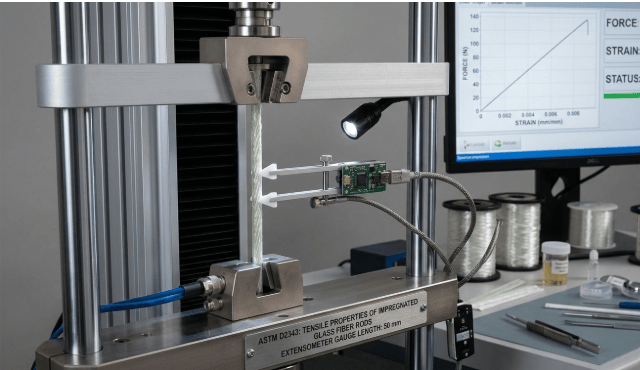
ASTM D2343 describes a standard method for measuring the relative tensile properties of glass fiber strands, yarns, and rovings for reinforced plastics. Then, glass fibers are impregnated with an appropriate polymeric binder and subjected to failure in a tension testing machine. The method applies to continuous-filament glass fiber materials coated with a sizing compatible with the resin. Consistent tensile measurements require consistent specimen preparation, resin impregnation, conditioning, gripping, testing speed, and environmental conditions. Engineers use ASTM D2343 (Standard Test Method for Tensile Properties of Glass Fiber Strands, Yarns, and Rovings Used in Reinforced Plastics) to determine tensile performance for quality control, material specification, and research and development. This standard involves a resin system compatible with the glass-fiber sizing and emphasizes complete resin impregnation to obtain representative results.
Get Certified ASTM D2343 Testing for Reliable Glass Fiber Tensile Properties
Glass fiber reinforcement requires uniform tensile properties for reinforced plastics. This method can be characterized in a laboratory by preparing resin-impregnated glass fiber specimens under controlled conditions as per ASTM D2343. The resulting tensile data helps manufacturers with quality control, material characterization, specification control, and research and development.
What is the scope of the ASTM D2343 test standard?
This standard specifies the relative tensile characteristics of glass fiber strands, yarns, and rovings in the form of impregnated rod specimens. The method is applicable to continuous-filament glass fiber materials with compatible resin sizing and uses defined pretreatment, temperature, humidity, and tension-testing conditions. The ASTM D2343 standard-
- Tests glass fiber strands, yarns, and rovings using resin-impregnated rod test specimens.
- Applies to any continuous-filament glass fiber materials.
- Uses resin systems compatible with fiber sizing.
- Determines comparative tensile properties and controls temperature and relative humidity during conditioning and testing.
- Supports quality control and research-and-development applications.
What are the uses of ASTM D2343 testing?
Laboratories use ASTM D2343 to assess the tensile performance of glass fiber reinforcement used in plastics. Engineers use these results to characterize materials and maintain consistent production quality. This standard-
- Determines the tensile strength of impregnated glass fiber and tensile modulus if specified.
- Compares glass fiber materials under controlled conditions and supports quality-control testing.
- Supports material specification and characterization, and provides data for research and development.
- Helps compare different resin impregnation systems and evaluate the effect of specimen preparation and testing conditions.
Which materials can be tested under ASTM D2343?
ASTM D2343 applies to continuous-filament glass fiber strands, glass fiber yarns, and glass fiber rovings with resin-compatible sizing. Before tensile testing, technicians impregnate these materials with a suitable polymeric binder.
Why is ASTM D2343 Important?
ASTM D2343 offers a standardized technique for comparing the tensile properties of glass fiber reinforcement. The specimen may influence the measured tensile properties. Preparation, resin impregnation, gage length, gripping system, testing speed, and environmental conditions.