MaTestLab > ASTM Methods > Polymers and Plastics > ASTM D2321 Standard Practice for Underground Installation of Thermoplastic Pipe for Sewers and Other Gravity-Flow Applications
Last updated 2nd March 2026
ASTM D2321 Standard Practice for Underground Installation of Thermoplastic Pipe for Sewers and Other Gravity-Flow Applications
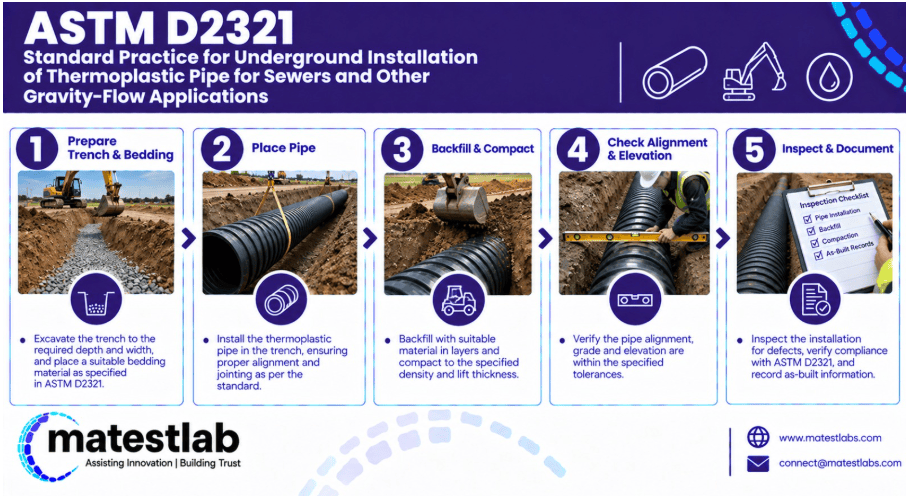
ASTM D2321 gives detailed applications in installation. This is the standard practice and covers all the important stages of installation, like trench excavation, bedding of the pipe, backfilling at the beginning and at the end, and the method of compaction. This practice must be applied properly since the structural performance of the thermoplastic pipes is strongly dependent on the quality of the surrounding soil support and not the stiffness of the pipe itself. This method ensures that the installation practices are kept in conformity with the material attributes of the pipe to reduce deflection, collapse under the load of the earth, and uphold long-term serviceability.
Read More
GET STARTED
ASTM D2321 Introduction
ASTM D2321 deals with compaction, backfilling, trench construction, and bedding to avoid deformation and ensure long pipe life. Since the functionality of the buried thermoplastic pipes is largely reliant on the installation factors. This standard plays an important role to the engineers, contractors, and utility agencies interested in developing reliable infrastructure. It acts as a guideline booklet for engineers, contractors, and public utility authorities in their efforts to develop long-lasting and low-maintenance underground piping systems.
Get Certified ASTM D2321 for Reliable Underground Pipe Performance and Project Success
Proper compliance with ASTM D2321 ensures optimal soil-structure interaction, minimized deflection, and extended service life of thermoplastic sewer and drainage pipelines.
Service Name
Remarks
ASTM D2321 Testing
Contact US
ASTM D2321 Testing Procedure and Requirements
Scope
Addresses underground installation (no pressure) of flexible thermoplastic pipeline (e.g., PVC, HDPE, PP).
Trench Construction
Indicates conditions of the bottom, bottom depth, and trench width.
Bedding Requirements
Tells of materials and methods to give consistent support under the pipe.
Initial Backfill
Prescriptions of appropriate backfill materials and compaction on the sides of the pipe up to 6 inches above the crown.
Final Backfill
Outlines positioning and compacting of the remaining backfill to ground level.
Compaction Guidance
Recommends getting the right compaction of the soil to withstand the loads of the pipes without suffering deformation.
Scope of ASTM D2321
Covers the installation of flexible thermoplastic pipes underground
Applicable to gravity-flow, non-pressure systems
Also included are PVC, HDPE, and PP pipes
Subgrade guidance for trench, bedding, and backfill
Focuses on soil-structure interaction performance
For use in municipal, industrial, and infrastructure projects
ASTM D2321 Equipment and Sample Preparation
Specimen Details
Field application is through installation.
Specimen Preparation
Preparation is interested in trench, bedding, and position of pipes, not in laboratory specimens.
Specimen Dimensions
The sizes of thermoplastic pipes are different; the methods of installation are changed according to the diameter of the pipes and the conditions of the place.
Specimen Details
Field application is through installation.
Applications of ASTM D2321
Storm drainage systems
Sanitary sewer systems
Agricultural drainage
Culverts and roadway drainage
Municipal infrastructure projects
Residential and commercial developments
ASTM D2321 Common Challenges and Troubleshooting
Trench width can result in excessive lateral deflection of the pipes in use due to insufficient practices of bedding support/ compaction that do not accommodate the pipe design. Setting up in unfavorable or wet soil profiles subjects settlement and wildlife breakdown to the possibility. Over-compaction may ruin the pipe, and under-compaction will result in less support of the soil.
ASTM D2321 Aggregate Testing Technique, Processes and Data Collection
ASTM D2321 is not a laboratory test procedure but is a practice standard. It thus does not generate laboratory test data. The process is aimed at checking the preparation of trenches, laying bedding, compacting backfill, and the alignment of pipes. Measurements of soil density, documentation of compaction verification, and post-installation pipe deflection measurements with proper testing techniques are possible under data collection.
ASTM D2321 Analysis Results and Interpretation
The properly compacted embedment materials should show successful installation. Proper use of the standard is ensured by long-term performance that does not result in structural failure.
ASTM D2321 Problem and Solution
Problem: Poor soil support, improper trench size, or improper compaction can lead to excessive deflection or collapse of the pipes; this can be avoided by using approved bedding material and using proper procedures to compact the trench. Instability normally causes settlement and unequal alignment.
Solution: Poor soil support, improper trench size, or improper compaction can lead to excessive deflection or collapse of the pipes; this can be avoided by using approved bedding material and using proper procedures to compact the trench. The causes of settlement and uneven alignment are normally due to an unsteady bottom of the trench, and unregulated backfilling and this necessitates the need to prepare a firm foundation and to place instill control over the backfill placement.
Factors to Consider Us to Test for ASTM D2321
Speed
Responsible field evaluation and inspection processes would ensure that the project was complete in time without any damage to the installation.
Expert
To conduct a good trench assessment, bedding placement, and compaction verification, qualified engineers and trained field personnel are necessary.
Cost
Proper installation as per ASTM D2321 lowers the long term maintenance costs, avoids premature failure,s and decreases the expensive repair work.
Related
FAQ's
Where can I get the astm d2321 tested?
You can share your astm d2321 testing requirements with MaTestLab. MaTestLab has a vast network of material testing laboratories, spread across the USA and Canada. We support your all material testing needs ranging from specific astm d2321 test to various testing techniques.
How much do I need to pay for the astm d2321 test?
Please contact us for a detailed quote for your astm d2321 testing needs. Cost incurred to carry out different astm d2321 testing methodology depends on the type of raw material; number of samples, coupons, or specimens; test conditions, turn around time etc. Costs of some ASTM testing methods start from $100 and the final value depends upon the factors listed above. Please contact us for the best and latest prices.
How many samples are required for astm d2321?
The required number of samples or specimens should comply with the procedure given in the astm d2321 standard. However, the MaTestLab operations team can assist you for your special requirements once you share your testing details with us.
How much discount can I get on the astm d2321 test?
MaTestLab has a vast testing laboratory network, hence we bring you the best testing facilities in a cost-effective way. We offer considerable discounts (15-20%) to our returning customers based on test volume and frequency.
How many days will it take to complete the astm d2321 test?
The turnaround time for astm d2321 test methodology depends upon the test procedure mentioned in the standard test document. However, we at MaTestLab understand your research requirements and hence try to get your test completed within the least possible time.
Where can I get the astm d2321 tested?
You can share your astm d2321 testing requirements with MaTestLab. MaTestLab has a vast network of material testing laboratories, spread across the USA and Canada. We support your all material testing needs ranging from specific astm d2321 test to various testing techniques.
MaTestLab Inc. offers accessible, quick, and affordable material testing, product testing, and failure analysis services. We support your on-demand testing and expert consultation needs with the help of our extensive network of material testing laboratories situated in the US and other parts of the world.
MATERIAL TESTING
We offer destructive and non-destructive tests over a range of mechanical, electrical, chemical, thermal, optical, corrosion, radiation, and biological testing methodologies defined by ASTM, ISO and other organizations.
PRODUCT TESTING
We help you evaluate and ensure your product quality and performance with standard and custom-made testing solutions. All the tests are done at well-equipped testing laboratories using standard testing methods for best output and satisfaction.
FAILURE ANALYSIS
Failure analysis ensures high levels of quality in every manufacturing process. We help you with getting the best failure or root cause analysis to determine the cause of the failure. The results help you identify means to prevent failure recurrences.