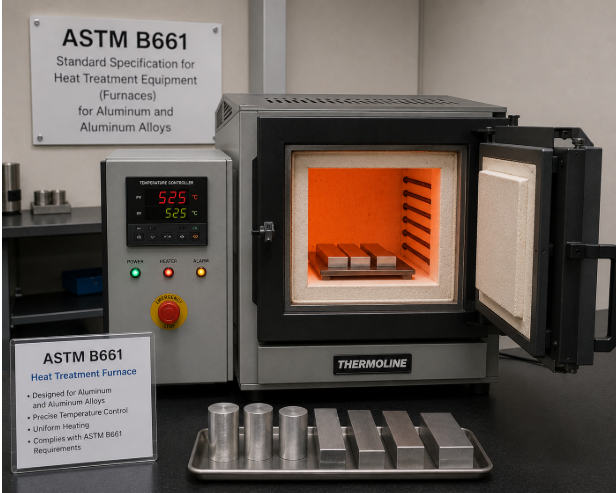
ASTM B661 provides recommended practices for the heat treatment of magnesium alloy engineering and structural products. Basic directions are provided for solution treatment, artificial aging, stress relieving, annealing, and cooling procedures which result in uniform mechanical properties and metallurgy. The ASTM B661 test standard-
- Provides recommended practices for the heat treatment of magnesium alloys.
- Covers solution heat treatment and artificial aging of applicable magnesium alloys.
- Provides recommended practices for stress relieving and annealing.
- Establishes recommended furnace processing procedures.
- Discusses controlled cooling techniques following heat treatment.
- Improves mechanical properties and dimensional stability.
- Maintains product consistency in the metallurgy of magnesium alloy products.
What is the Use of ASTM B661 Heat Treatment?
ASTM B661 specifies standard heat-treatment procedures for magnesium alloys to achieve the desired mechanical properties, dimensional stability, stress relief, and microstructure. Adhering to the recommended thermal processing procedures ensures that manufacturers achieve consistent quality and performance in the magnesium alloy components produced. ASTM B661 heat treatment
- Enhances the mechanical properties of Magnesium alloys.
- Relieves residual stress after casting and/or fabrication.
- Improves dimensional stability prior to machining or use.
- Improves the microstructure by controlled heat treatment.
- Assists in ensuring the quality of magnesium alloy production.
- Helps manufacturers select appropriate heat treatment cycles for specific magnesium alloys.
- Maintains uniformity in tasks relating to structural and engineering uses.
What Materials Can be Tested Under ASTM B661?
ASTM B661 covers magnesium alloy castings and wrought magnesium alloy products such as bars, plates, sheets, extrusions, forgings, and fabricated products. It offers guidelines for heat treatment of alloys for which improved mechanical properties and dimensional stability are desired.
Why is ASTM B661 Important?
ASTM B661 outlines recommended heat treatment methods to ensure a more uniform mechanical property and microstructural quality among magnesium alloy manufacturers. The standard will ensure product reliability, less residual stress, and better performance of magnesium parts in challenging applications.
Common Challenges and Troubleshooting
A successful heat treatment depends on controlling the furnace temperature, soaking time, and cooling rate. Typical issues are non-uniformity of the temperature, overheating, oxidation, lack of stress relief, and improper aging cycles. Proper component cleaning and heat treatment parameters plus regular furnace calibration will help to achieve consistent and repeatable results.
ASTM B661 Heat Treatment Process and Data Collection Guide
The first step is to select representative magnesium alloy parts and remove contamination from the parts before the heat treatment process. The material is solution heat treated, stress relieved, annealed, or artificially aged by controlled furnace treatments, depending on the alloy and desired properties. Processing parameters such as furnace temperature, holding time, cooling method, heat treatment cycle, and post-treatment hardness or mechanical property data are recorded during processing. The collected information is used to confirm that the material has been processed according to ASTM B661 specifications.