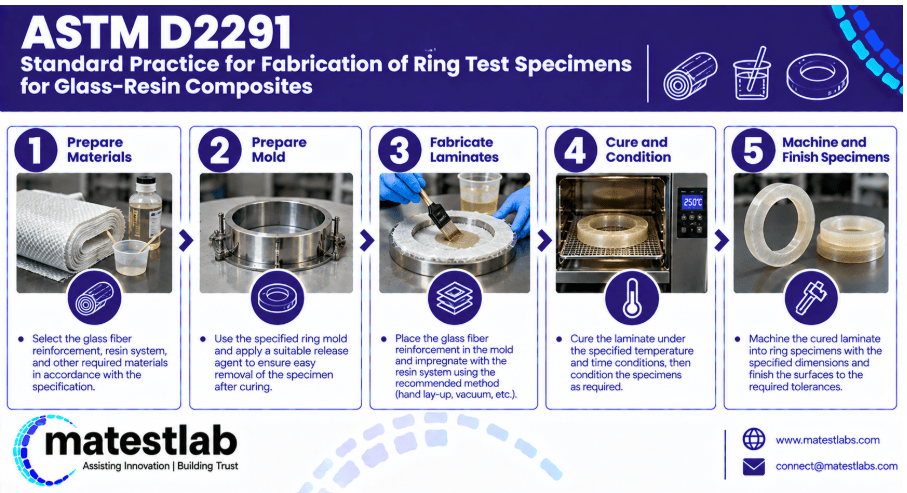
ASTM D2291 Standard Practice for Fabrication of Ring Test Specimens for Glass-Resin Composites

    What is ASTM D2291? 

    ASTM D2291 provides a standard practice for producing ring-type test specimens to measure the mechanical properties of a composite structure of reinforcement and resin. This practice provides a uniform procedure for fabricating glass fiber and thermoset resin ring samples and outlines specimen preparation steps, including final specimen machining where applicable. ASTM D2291 (Standard Practice for Fabrication of Ring Test Specimens for Glass-Resin Composites) includes several final ring configurations, and specimens fabricated under this practice are used in Test Methods D2290 and D2344. In the lab, it produces uniform rings for mechanical testing. Engineers use the resulting specimens to evaluate the performance of glass fiber composite materials. 

    Read more

    Get Certified ASTM D2291 Fabrication for Reliable Composite Test Specimens 

    Manufacturers and testing laboratories rely on certified ASTM D2291 fabrication because consistent specimen preparation directly affects the reliability of downstream mechanical property tests. Inconsistently machined ring specimens introduce variability in hoop tensile strength or short beam strength results before testing even begins. Certified fabrication ensures that samples are fabricated to the correct size and configuration for proper mechanical property testing. 

    What is the Scope of ASTM D2291? 

    ASTM D2291 is designed for the making of ring test specimens for the mechanical property testing of reinforcement and resins in a composite structure. The practice describes the method for preparing test specimens, including the final specimen machining (if applicable), and includes multiple final ring configurations. The primary purpose of ASTM D2291 is to provide a uniform procedure for fabricating glass fiber/thermoset resin ring samples that are used in Test Methods D2290 and D2344. 

    Read more

    The scope of ASTM D2291 includes: 

    • Material type: Glass fiber and thermoset resin composite ring specimens. 
    • Purpose: Fabricate uniform ring specimens for mechanical property evaluation of reinforcement and resin. 
    • Properties measured: Consistent specimen configuration and final machining for downstream mechanical testing.
    • Method: Winding or layup of glass fibre and thermoset resin into a ring shape, curing, and final machining. 
    • Result: Fabricated ring specimens conforming to one of the standard final ring configurations. 
    • Test Limitations: ASTM D2291 addresses specimen fabrication rather than a single mechanical test. 
    • Environmental conditions: Controlled specimen preparation ensures uniformity and reduces variability during subsequent mechanical testing.
    • Applications: Making composite ring samples for hoop tensile strength and short-beam strength testing. 

    What are the Uses of ASTM D2291?

    ASTM D2291 fabrication provides a uniform method for creating ring-type composite specimens for laboratory use, and engineers use the resulting specimens to evaluate reinforcement and resin performance. This standard-

    • Provides a uniform procedure for fabricating glass fiber and thermoset resin ring samples.
    • Supports preparation of specimens for use in Test Method D2290, apparent hoop tensile strength testing.
    • Helps prepare specimens for short-beam strength testing in accordance with Test Methods D2344/D2344M.
    • Assists with the standardization of final specimen machining for various composite formulations.
    • Helps to create a uniform ring shape for repeatable mechanical property testing
    • Works with Quality Control and research applications of glass fiber reinforced composites. 

    What Materials Are Covered Under ASTM D2291? 

    The ASTM D2291 standard applies to materials that consist of glass fiber and thermoset resin and are made into ring-type specimens. The purpose of the use of these specimens is specifically to assess the mechanical properties of the reinforcement and the resin matrix of a composite structure. Laboratories select combinations of fiber and resin that are representative of the composite system being tested and prepare them into one of the standard final ring forms outlined in the practice. 

    Why is ASTM D2291 Important? 

    ASTM D2291 fabrication provides a standard process to ensure fabrication of ring specimens uniformly, thus promoting consistency in hoop tensile strength and short beam strength data. Ring-type specimens enable laboratories to test the mechanical properties of the reinforcement and resins of a composite structure with the same and repeatable geometry. Variability during fabrication or final machining may directly impact the accuracy of the mechanical property results obtained in subsequent Test Methods D2290 and D2344. 

    ASTM D2291 Equipment and Sample Preparation Guide

    ASTM D2291 fabrication requires a mandrel or winding apparatus to shape the glass fiber and resin into a ring, a curing oven/press, and a machining apparatus for the final preparation of specimens. Glass fiber and thermoset resin materials are selected and mixed based on the composite system under investigation. 

    Read more

    Sample and Specimen DetailsRepresentative samples of glass-resin composite materials are tested in the laboratories and prepared for controlled ring specimen fabrication. 
    Specimen PreparationTechnicians wind or lay up the glass fiber and resin onto a mandrel, cure the composite, and remove it to form the initial ring shape. 
    Specimen DimensionsType A: 146.05 mm ID, 6.35 mm width, 1.52 mm wall. Type B: same ID and width, 1.52 mm ± 0.25 mm wall. Type C: 3.18 mm wall. 
    InstrumentationThe test uses a winding mandrel or layup fixture, curing oven or press, and machining equipment for final specimen dimensioning. 

    Testing Procedures and Requirements for ASTM D2291  

    ASTM D2291 fabrication produces ring-type specimens through a winding or layup process, using curing and final machining. Technicians perform the required actions to make one of the standard end ring configurations. 

    Read more

    Reinforcement and Resin Preparation Technicians store glass rovings in a dry place without temperature extremes. They condition rovings per Practice D618. Resins are stored in closed containers at supplier-specified temperatures. 
    Winding and Fabrication The reinforcement mounts on the winding machine. It passes through the resin bath and over tensioning pulleys. Tension deviation must not exceed ±5%. 
    Curing Fabricated rings undergo controlled curing at temperatures within ±5°C. Specimens may require machining to final dimensions. 
    Inspection Laboratories inspect finished rings for defects including voids, delaminations, and uneven curing. Technicians verify dimensional accuracy 
    Result Reporting Laboratories record fabrication parameters, specimen dimensions, conditioning details, and observed defects in the test report. 

    ASTM D2291 Process and Data Collection

    The process starts with an analyst selecting representative glass fiber and thermoset resin materials for the composite system being evaluated. The technician then winds or lays up the material into the initial ring shape, using a mandrel. The operator then performs the final machining (where applicable) to obtain the desired ring configuration after curing. At the end, the analysts prepare the fabricated specimens for further mechanical property testing in accordance with either Test Methods D2290 or D2344. 

     The image depicts a glass fiber and resin ring specimen being fabricated on a mandrel per ASTM D2291.
    ASTM D2291 Fabrication of Glass-Resin Composite Ring Specimens

    Common Challenges and Troubleshooting

    Consistent ASTM D2291 fabrication depends on uniform fiber and resin combination, proper curing conditions, and accurate final machining. Variability in winding tension, inconsistent curing, and machining variations cause dimensional variation, which impacts downstream mechanical properties. Technicians minimize these problems by carefully performing the process of fabrication as described and checking the ring dimensions after machining. The laboratories also get more reliable specimens when they use more than one batch of fiber and resin and process them under the same conditions. 

    ASTM D2291 Analysis Results and Interpretation

    This report provides a summary of the ring specimens produced from the tested glass fiber and thermoset resin composite. It shows the ring configuration, dimensions, and the conditions under which the rings were prepared. This interpretation is a comparison of the fabricated rings with the configuration requirements for further mechanical property testing.

    Read more

    • The laboratory notes the final ring configuration made in accordance with the practice.
    • The technician records the fiber and resin types and the curing conditions used for fabrication.
    • Analysts note the final machined dimensions of the ring specimen prior to mechanical testing.
    • Engineers consider winding tension, cure cycle, and machine accuracy when interpreting specimen consistency.
    • Laboratories use the fabricated specimens for subsequent testing under Test Methods D2290 or D2344. 

    Link to ASTM D2291 

    FAQ

    What is the difference between the ring configurations in ASTM D2291?
    ASTM D2291 contains three final ring configurations. Each configuration is suited for specific test requirements, and the choice depends on the mechanical testing desired and specimen preparation procedure.
    Where possible, final specimen machining is used to achieve the dimensional accuracy of the cured ring as needed for the selected final ring configuration, to ensure accurate results in mechanical testing.
    Standardized fabrications minimize test result variation. Specimens may not accurately reflect the performance of the material due to poor fibre alignment, incomplete impregnation, or poor curing.

    Updated on October 5, 2026

    Rohit Dhembare
    About Author
    Rohit Dhembare is an Operations Associate at Matestlab Inc., holds a postgraduate degree in Organic Chemistry and is trained in Materials Science testing techniques.
    Know More
    Testimonials
    Real results
    Engineers trust us with what matters most
    Start Your Testing
    Project Today
    Define your requirements and get access to
    specialized laboratories ready to deliver results
    Partners with us
    Clients
    Vendors
    Process for testing
    • STEP 01

      You share your testing requirements

    • STEP 02

      You share your sample(s)

    • STEP 03

      We deliver your test reports

    Get your testing done

    Let us know your testing requirements and we will be right back with a solution.

      Let us root for each other. Collaborate to grow, expand, and accelerate our businesses.

      Partner with us

        Discover more from Matestlab

        Subscribe now to keep reading and get access to the full archive.

        Continue reading