
ASTM D2222 Standard Test Method for Methanol Extract of Vinyl Chloride Resins

    What is ASTM D2222?

    ASTM D2222 is a standard test method for measuring the methanol extract, or nonvolatile methanol-soluble portion, of vinyl chloride resins. Laboratories apply this method to paste- or dispersion-type vinyl resins used in organosol or plastisol applications. This extraction process removes the soap system left over after polymerization, providing a parameter the manufacturer can use to compare resin lots. The solvent extraction method and gravimetric measurement of extracted material in ASTM D2222 (Standard Test Method for Methanol Extract of Vinyl Chloride Resins) determine the amount of extractable material. Manufacturers use these results to track formulation drift and verify resin consistency across production batches through MaTestLab’s polymer and plastics testing services. 

    Read more

    Get Certified ASTM D2222 Testing for Reliable Vinyl Chloride Resin Quality

    ASTM D2222 provides an accepted method for measuring the methanol extract of vinyl chloride resins, allowing lot-to-lot comparisons and monitoring changes in the methanol-soluble fraction. Certain manufacturers depend on consistent resin composition, so it is important. 

    What is the Scope of ASTM D2222?

    ASTM D2222 covers the determination of the methanol extract, or nonvolatile methanol-soluble portion, of vinyl chloride resins. The method is most commonly used with paste- or dispersion-type vinyl resins intended for organosol or plastisol applications. ASTM identifies the soap system used during polymerization as the main ingredient removed during extraction. This standard-

    • Determines the nonvolatile portion of vinyl chloride resin that dissolves in methanol under the specified test conditions.
    • Applies specifically to vinyl chloride resins. It is not a general extraction method for all polymer materials. 
    • Is most commonly employed with paste- or dispersion-type vinyl resins intended for organosol or plastisol applications. 
    • Provides a quantitative measure of the methanol-soluble, nonvolatile, essentially nonpolymeric content of virgin, unmodified resin. 
    • Removes mainly the soap system employed in the polymerization reaction. 
    • Provides a measure of resin lot-to-lot uniformity with respect to the soluble material removed during the test. 

    What are the Uses of ASTM D2222 Testing?

    ASTM D2222 provides a quantitative measure of the methanol-soluble portion of vinyl chloride resin. The results can be used to compare materials or track resin consistency. This standard-

    • Provides a quality-control parameter for resin consistency.
    • Supports comparison between production lots.
    • Applies especially to paste- and dispersion-type resins used in organosol or plastisol applications.
    • Feeds into broader material evaluation alongside other characterization data.
    • Gives researchers one parameter for comparing resins or studying formulation and processing changes.

    Why is ASTM D2222 Important?

    Methanol extract measures a specific soluble fraction of a vinyl chloride resin, not its complete chemical or physical profile. Because the removed fraction is largely the soap system from polymerization, the result helps manufacturers compare resin lots and assess uniformity as part of a broader quality-control program.

    ASTM D2222 Equipment and Sample Preparation

    ASTM D2222 uses solvent extraction and gravimetric analysis to determine the methanol extract of vinyl chloride resins. Technicians use various pieces of equipment to recover and quantify the material extracted from the resin as they prepare a representative resin sample.

    Read more

    Sample and Specimen Details Technicians prepare representative samples of paste- or dispersion-type vinyl chloride resin in the laboratory for methanol extraction. 
    Specimen Preparation Technicians weigh the dried resin sample and place it in an extraction thimble before testing. 
    Extraction Process The Soxhlet assembly circulates refluxing methanol through the resin sample and transfers the methanol-soluble material into the receiving flask. 
    InstrumentationThe test uses a Soxhlet extraction assembly, heating and reflux equipment, drying equipment, and an analytical balance. 

    ASTM D2222 Testing Procedure and Requirements

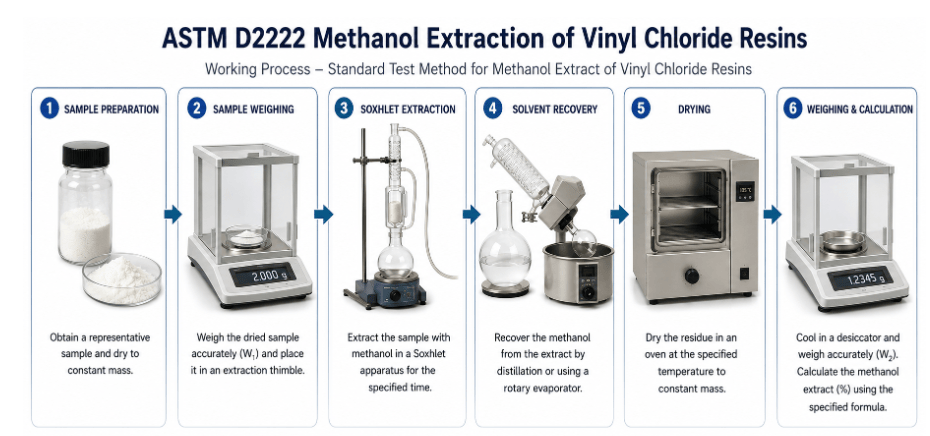
    ASTM D2222 uses solvent extraction to separate the methanol-soluble portion of a vinyl chloride resin from the rest of the material. The technician weighs the resin sample, extracts it with methanol, collects the extract, removes the solvent, and weighs the residue to get the methanol extract value. The ASTM D2222 test methods comprise the following test procedure-

    Read more

    Sample Preparation and WeighingThe technician weighs a representative resin sample and places it in an extraction thimble that keeps the sample in effective contact with the solvent. 
    Soxhlet ExtractionTechnicians use anhydrous methanol in the extraction flask to repeatedly contact the resin during reflux. The methanol dissolves the extractable portion of the resin while the thimble retains the remaining sample material. 
    Blank DeterminationAnalysts perform a blank measurement to account for any residue contributed by the methanol or extraction setup, separate from the material extracted from the resin. 
    Solvent Removal and Residue DryingThe technician removes the methanol from the collected extract and dries the remaining residue to remove residual solvent before final weighing. 
    Residue Weighing and CalculationThe technician weighs the dried residue and combines its mass with the applicable blank and original sample measurements to calculate the methanol extract value according to the ASTM method. 
    Result ReportingThe technician records the result with the sample identification, relevant measurement data, ASTM designation, applicable units, and notable test observations. 

    ASTM D2222 Testing Process and Data Collection

    The technician weighs the representative resin sample and records its original mass before extraction. During extraction, the analyst tracks the run and weighs the resulting residue, including the blank measurement. From these values, they calculate the methanol extract. The test report includes the sample ID, original sample mass, extract residue mass, blank determination (where applicable), the calculated methanol extract, test conditions and observations, and the ASTM designation and edition used.

    This image illustrates the working process of ASTM D2222 for determining the methanol extract of vinyl chloride resins. It shows six sequential steps: sample preparation, sample weighing, Soxhlet extraction with methanol, solvent recovery, drying of the residue, and final weighing with calculation. 
    ASTM D2222 Methanol Extraction Testing of Vinyl Chloride Resins

    Common Challenges and Troubleshooting

    Variation in sample condition, solvent quality, extraction conditions, drying, and weighing can all introduce variations in methanol extract testing. Under-extraction reduces measurement of the extract, and inadequate solvent removal or loss during handling will increase or distort the measurement. To ensure the equipment is appropriate, the quality of the solvents, extraction conditions, and the quality of the weighing equipment should be controlled in the labs before interpreting unexpected results.

    ASTM D2222 Analysis Results and Interpretation

    ASTM D2222 gives a quantitative measure of the nonvolatile, methanol-soluble portion of a vinyl chloride resin under specified test conditions. This is analyzed to compare resin materials and monitor changes in the resin extract fraction.

    Read more

    • ASTM D2222 reports the methanol extract as the nonvolatile, methanol-soluble portion of the resin, determined through extraction and gravimetric measurement.
    • A higher methanol extract value indicates that more nonvolatile material dissolved in methanol under the test conditions.
    • A lower methanol extract value shows that less nonvolatile material dissolved during extraction. 
    • Engineers and analysts compare results against material specifications, customer requirements, historical production data, or internal quality criteria to judge resin consistency.
    • Consistent methanol extract values across lots point to uniformity, while significant variation may signal a change worth investigating further.

    Calculation principle: 

    Methanol Extract (%) = (Corrected Extract Residue Mass / Original Sample Mass) × 100 

    Use the exact calculation, correction, rounding, and reporting requirements specified in the licensed ASTM D2222 standard.

    Link to ASTM D2222

    FAQ

    Where can I get the astm d2222 tested?
    You can share your astm d2222 testing requirements with MaTestLab. MaTestLab has a vast network of material testing laboratories, spread across the USA and Canada. We support your all material testing needs ranging from specific astm d2222 test to various testing techniques.
    Please contact us for a detailed quote for your astm d2222 testing needs. Cost incurred to carry out different astm d2222 testing methodology depends on the type of raw material; number of samples, coupons, or specimens; test conditions, turn around time etc. Costs of some ASTM testing methods start from $100 and the final value depends upon the factors listed above. Please contact us for the best and latest prices.
    The required number of samples or specimens should comply with the procedure given in the astm d2222 standard. However, the MaTestLab operations team can assist you for your special requirements once you share your testing details with us.
    MaTestLab has a vast testing laboratory network, hence we bring you the best testing facilities in a cost-effective way. We offer considerable discounts (15-20%) to our returning customers based on test volume and frequency.
    The turnaround time for astm d2222 test methodology depends upon the test procedure mentioned in the standard test document. However, we at MaTestLab understand your research requirements and hence try to get your test completed within the least possible time.
    Dr Ruchika Yogesh
    About Author
    Dr Ruchika Yogesh
    Dr. Ruchika Yogesh is an entrepreneur, science and AI/ML enthusiast, medicinal chemistry subject matter expert (SME), scientific/medical copyeditor, and an independent researcher.
    Testimonials
    Real results
    Engineers trust us with what matters most
    Start Your Testing
    Project Today
    Define your requirements and get access to
    specialized laboratories ready to deliver results
    Partners with us
    Clients
    Vendors
    Process for testing
    • STEP 01

      You share your testing requirements

    • STEP 02

      You share your sample(s)

    • STEP 03

      We deliver your test reports

    Get your testing done

    Let us known your testing requirements and we will be right back with a solution.

      Let us root for each other. Collaborate to grow, expand, and accelerate our businesses.

      Partner with us

        Contact Us

        Discover more from MaTestLab

        Subscribe now to keep reading and get access to the full archive.

        Continue reading