ASTM D1995 Standard Test Methods for Multi-Modal Strength Testing of Autohesives (Contact Adhesives)
What is ASTM D1995?
ASTM D1995 provides test methods for evaluating the strength of autohesive, or contact-adhesive, bonds under compression shear, cleavage, climbing drum peel, and T-peel modes. Autohesives form bonds between adhesive-coated surfaces through a bond-formation process that differs from conventional adhesives. Therefore, ASTM D1995 uses specialized procedures to evaluate these bonds. The standard assesses four principal stressing modes: compression shear, cleavage, climbing drum peel, and T-peel. It also provides static, roller, and impact techniques for exerting pressure for bonding.
Get Certified ASTM D1995 Testing for Reliable Autohesive Bond Strength
Autohesive bond strength can change with film thickness, pressure application, pressure magnitude and duration, temperature, humidity, open time, and bond-conditioning time. ASTM D1995 allows laboratories to control these parameters according to the intended end use of the autohesive. The standard uses application procedures that produce adhesive films with fewer irregularities and application artifacts than brushing, spraying, or trowelling. This approach helps laboratories evaluate the strength of bonds between autohesive films based on the characteristics of the autohesive itself.
What is the scope of the ASTM D1995 test standard?
This test method provides rigid-to-rigid, flexible-to-rigid, and flexible-to-flexible adherend combinations, including wood, aluminum, steel flakeboard, and plastic laminates. The standard also includes static, roller, and impact pressure modes. ASTM D1995 allows laboratories to select the test mode, coating thickness, temperature, relative humidity, pressure magnitude and mode, open time, and bond-conditioning time based on the end use of the autohesive. The ASTM D1995 standard-
Evaluates autohesive bonds under compression shear.
Evaluates cleavage strength, climbing drum peel performance, and T-peel resistance.
Applies to rigid-to-rigid, flexible-to-rigid, and flexible-to-flexible combinations of adherends.
Includes wood, aluminum, steel, flakeboard, and plastic laminates among the available adherends.
Offers static, roller, and impact pressure modes.
Allows selection of coating thickness, temperature, relative humidity, pressure magnitude, open time, and bond-conditioning time.
What are the uses of ASTM D1995 testing?
ASTM D1995 helps manufacturers to characterize the strength of contact adhesives under different mechanical conditions. Engineers use these results to compare autohesive formulations and determine performance under selected bonding and environmental conditions. This standard-
Determines contact-adhesive bond strength.
Compares different autohesive formulations.
Assesses bond performance under shear, cleavage, and peel loading.
Supports autohesive product development.
Provides support for adhesive quality control.
Compares different adherend combinations.
Assesses the effect of film thickness, temperature, relative humidity, and pressure on bond strength.
Which materials can be tested under ASTM D1995?
ASTM D1995 supports autohesive bond testing with different rigid and flexible adherends. The test standard covers wood, aluminum, steel flakeboard, and plastic laminates among the available substrate materials. Manufacturers choose the combination based on the applicable test and the specific combinations according to this standard.
Why is ASTM D1995 Important?
ASTM D1995 provides a controlled method for evaluating autohesive bonds because autohesives form bonds differently from conventional adhesives. The application procedures help produce adhesive films with fewer irregularities and artifacts, allowing the laboratory to evaluate autohesive bond strength more consistently. The measured bond strength also depends on film thickness, pressure application, pressure magnitude and duration, temperature, and humidity.
ASTM D1995 Equipment and Sample Preparation Guide
Accurate autohesive testing requires suitable adherends, controlled adhesive-film application, appropriate pressure equipment, and the correct loading fixture. Technicians should prepare the specimens properly and select the pressure mode based on the selected test method and adherend combination.
Technicians prepare the autohesive bond specimens using specified adherends, including wood, aluminum, steel, flakeboard, and plastic laminates.
Specimen preparation
Analysts prepare the specimens, apply adhesive film thickness, control open time, form bonds, and apply static, roller, or impact pressure.
Specimen dimensions
Technicians select specimen dimensions according to selected test mode and adherend combination as specified in ASTM D1995. Laboratories should follow the applicable dimensions in the standard.
Instrumentation
Mechanical testing machine, knife applicator, environmental-control equipment, pressure equipment, roller or impact apparatus, and appropriate test fixtures.
Testing Procedures and Requirements for ASTM D1995
Technicians first condition the autohesive and substrate under selected temperature and humidity. Then, laboratories prepare the substrate surface, apply wet-film thickness, select open assembly time, bring the coated surfaces together, and apply pressure using the selected mode.
Other reference ASTM standards include D905, D1062, D1151, D1781, D1836, and E4.
Adherent Selection and Material Conditioning
Laboratories first select the appropriate adherend combination based on the specific tests, and then they condition the autohesive and substrates under selected temperature and relative humidity.
Surface Preparation and Adhesive Application
Technicians prepare the surface, clean, precut, or prepare the substrate according to applicable material requirements and apply a predetermined wet-film thickness using a knife applicator
Open-Time Control and Bond Formation
Then, they allow the coated adhesive to remain open for the selected open-assembly time and press the coated surfaces together using static, roller, or impact pressure.
Bond Conditioning
Then, laboratories condition the bonded assembly under a controlled environment during the bond-conditioning time.
Mechanical Testing
Laboratories evaluate compression shear, cleavage, climbing drum peel, or T-peel tests based on selected testing procedures.
ASTM D1995 Testing Process and Data Collection
Analysts first choose the appropriate adherend combination, pressure, loading mode, coating thickness, temperature, relative humidity, open time, and bond-conditioning time. Technicians then condition and prepare the substrates and autohesive based on selected conditions. Then laboratories apply the autohesive film, allow the selected open time, bring the coated surfaces together, and allow the bond formation using static, roller, or impact pressure. The laboratory then conditions the bonded assembly for the specified period. Finally, the laboratory conducts the compression shear, cleavage, climbing drum peel, or T-peel test chosen. The laboratory documents the load applied, test type, specimen details, environmental parameters, and failure characteristics observed.
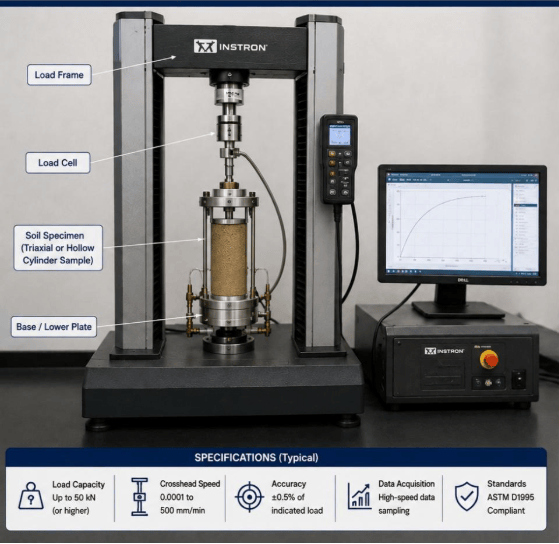
ASTM D1995 Universal Testing Machine (UTM)
Common Challenges and Troubleshooting
Laboratories require consistent film application, substrate preparation, pressure application, conditioning, and mechanical testing to obtain accurate authesive results. According to ASTM D1995, several factors may influence measured bond strength, including film thickness, pressure magnitude, pressure duration, pressure mode, temperature, and humidity. Common problems include inconsistent autohesive-film thickness, incorrect open-assembly time, uneven pressure application, inaccurate pressure duration, inadequate substrate surface preparation, improper specimen alignment, and inadequate temperature or humidity control.
ASTM D1995 Analysis Results and Interpretation
Laboratories present results based on selected loading mode, adherend combination, specimen configuration, and test conditions.
Laboratories report results for compression shear strength in MPa, cleavage strength in MPa, climbing drum peel strength in N/mm, and T-peel strength in N/mm.
Laboratories also document the measured load, failure mode, pressure conditions, open time, and bond-conditioning time to support interpretation of the results.
Laboratories use the applicable calculation procedure for each loading mode to determine the final bond-strength value.
Gokula Srinivasan Selvam is a Material Testing Associate at Matestlab Inc. and holds a postgraduate degree in Ceramic Engineering from IIT (BHU), Varanasi. His academic background and professional experience are centered on advanced ceramic materials, their processing, characterization, and performance evaluation. Know More
Testimonials
Real results
Engineers trust us with what matters most
“We had a great experience working with this company for our ASTM E84 testing. They were the first company to respond to our inquiry within just a few minutes of submitting it. From start to finish, the communication was excellent, and the entire process was swift, straightforward, and hassle-free.”
Ivars FancyWalls
United States
“Very good communication, testing associates were very patient with delays on our end. Reasonable turnaround time for results and nicely detailed report. Analysts were also quick to answer any follow-up questions. Happy with results.”
Skye Henderson
United States
“Matestlab connected us with an accredited lab within days, cutting weeks off our product validation timeline.”
Rebecca Kozodoy-Pins
United States
Start Your Testing Project Today
Define your requirements and get access to specialized laboratories ready to deliver results